
Penny Dreadfuls, 1865 · page 30 of 400
Agnes: A Tale of the Streets — page 30: what you’re looking at
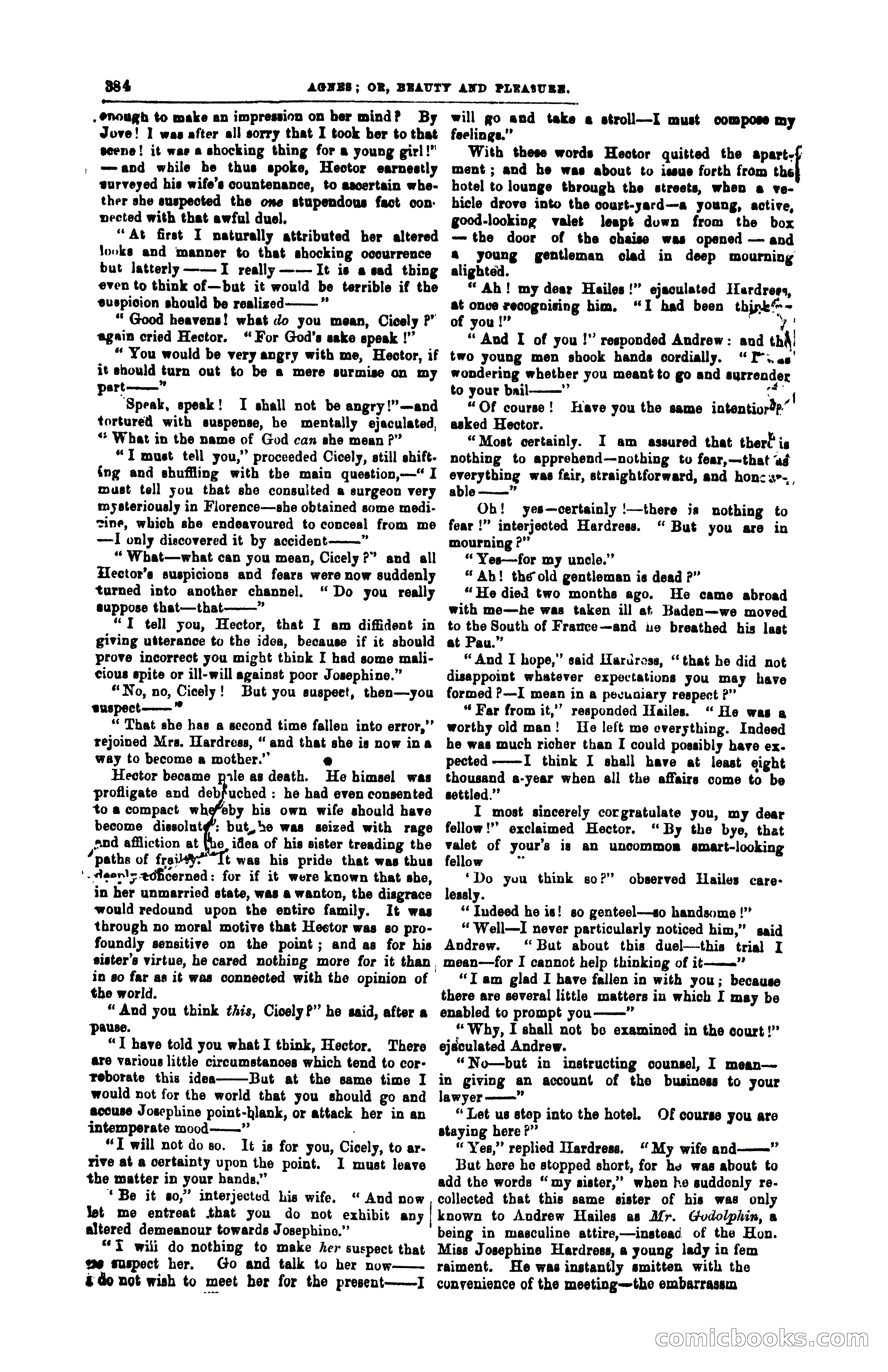
A restored page from Penny Dreadfuls, 1865. Page through the whole issue in the reader above.
📄 Transcribed text from this page (OCR, searchable)
Machine-transcribed from the original scan — historical spelling and the odd misread are preserved.
384 AGNES; OR, BEAUTY AND PLEASUBE., .@nough to make an impression on her mind? By Jove! I was after all sorry that I took ber to that scene! it wae a shocking thing for a young gir! !” --and while he thus spoke, Hector earnestly surveyed his wife’s countenance, to ascertain whe- ther she suspected the one stupendous fact con: wected with that awful duel. “At first I naturally attributed ber altered looks and manner to that shocking occurrence but latterly -——-I really —— It is a ead thing even to think of—but it would be terrible if the suspicion should be realized ” “Good heavens! what do you mean, Cicely ?” again cried Hector. “For God's eske speak !” “ You would be very angry with me, Hector, if it should turn out to be a mere surmise on my part———” Speak, speak! TI shall not be angry!”—and tortured with suspense, he mentally ejaculated, ** What in the name of God can she mean ?” “I must tell you,” proceeded Cicely, still shift. ing and shuffling with the main question,—“ I must tell you that she consulted a surgeon very mysteriously in Florence—she obtained some medi- tine, which she endeavoured to conceal from me —I only discovered it by accident ” “ What—what can you mean, Cicely?” and all Hector’s suspicions and fears were now suddenly turned into another channel. “Do you really suppose that—that a “TI tell you, Hector, that I am diffident in giving utterance to the idea, because if it should prove incorrect you might think I had some mali- cious epite or ill-will against poor Josephine.” “No, no, Cicely! But you suspeet, then—you suspect = “‘ That she has a second time fallen into error,” rejoined Mrs. Hardress, “ and that she is now ina way to become a mother.” e Hector became pxle as death. He himsel was profligate and debfuched : he had even consented to a compact wheeby his own wife should have become dissolut@: but, he was seized with rage and affliction at {he idea of his sister treading the “paths of fray? “Te was his pride that was thus -deorly edficerned: for if it were known that she, in her unmarried state, was a wanton, the disgrace ‘would redound upon the entire family. It was through no moral motive that Hector was so pro- foundly sensitive on the point; and as for his sister’s virtue, he cared nothing more for it than. in go far as it was connected with the opinion of the world. “ And you think this, Cicely?” he said, after a pause. “J have told you whatI think, Hector. There are various little circumstances which tend to cor- Foborate this idea But at the same time I would not for the world that you should go and accuse Josephine point-hlank, or attack her in an intemperate mood——” . “I will not do so. It is for you, Cicely, to ar- rive at a certainty upon the point. I must leave the matter in your hands.” “Be it so,” interjected his wife. “ And now Yet me entreat that you do not exhibit any altered demeanour towards Josephine.” “ZT wili do nothing to make her suspect that @e suspect her. Go and talk to her now & do not wish to meet her for the present——I will go and take a stroll—I must compose my feelings.” With these words Hector quitted the apart-f ment ; and he was about to issue forth from the hotel to lounge through the streets, when a ve- hicle drove into the court-yard—a young, active, good-looking valet leapt duwn from the box — the door of the chaise was opened — and a young gentleman clad in deep mourning alighted. “Ah! my dear Heiles !” ejaculated Hardrees, at onve recognising him. “I had been think%~ of you !” ‘ “And I of you !” responded Andrew: and thi! two young men shook hands cordially. ‘I. as’ wondering whetber you meant to go and surrender to your bail . oe “Of course ! asked Hector. “Most certainly. I am assured that ther is nothing to apprehend—nothing to fear,—that ‘ad everything was feir, straightforward, and hon<y°-_, able ——-” Have you the same intentior®p”| Ob! yes—certainly !—there is nothing to fear!” interjected Hardress. “ But you are in mourning ?” “'Yes—for my uncle.” “Ab! the old gentleman is dead ?” “He died two months ago. He came abroad with me—he was taken ill at Baden~we moved to the South of France~and ue breathed his last at Pau.” “And I hope,” said Hardross, “that he did not disappoint whatever expectations you may have formed P—I mean in a pevuniary respect ?” “ Far from it,” reaponded Hailes. “He was a worthy old man! He left me everything. Indeed he was much richer than I could possibly have ex. pected ——I think I shall have at least eight thousand a-year when all the affairs come to be settled.” I most sincerely corgratulate you, my dear fellow!’’ exclaimed Hector. “By the bye, that valet of your’s is an uncommon smart-looking fellow . ‘Do you think so?” leasly. ‘* Indeed he is! so genteel—so handsome !” “ Well—I never particularly noticed him,” said Andrew. ‘But about this duel—this trial I mean—for I cannot help thinking of it——” “T am glad I have fallen in with you; because there are several little matters in which I may be enabled to prompt you 7 “Why, I shall not bo examined in the court !” ejaculated Andrew. “No—but in instructing counsel, I mean— in giving an account of the business to your lawyer———” “ Let us step into the hotel. staying bere ?” “Yes,” replied Ilardress. “ My wife and——” But here he stopped short, for he was about to add the words “my sister,’ when he suddenly re- collected that this same sister of his was only observed Hailes care- OF course you are | known to Audrew Hailes as Mr. Gudolphin, a being in masculine attire,—insteac of the Hon. Miss Josephine Hardress, a young lady in fem raiment. He was instantly smitten with the convenience of the meeting—the embarrasam ANICLO©© CO S