
Penny Dreadfuls, 1865 · page 29 of 400
Agnes: A Tale of the Streets — page 29: what you’re looking at
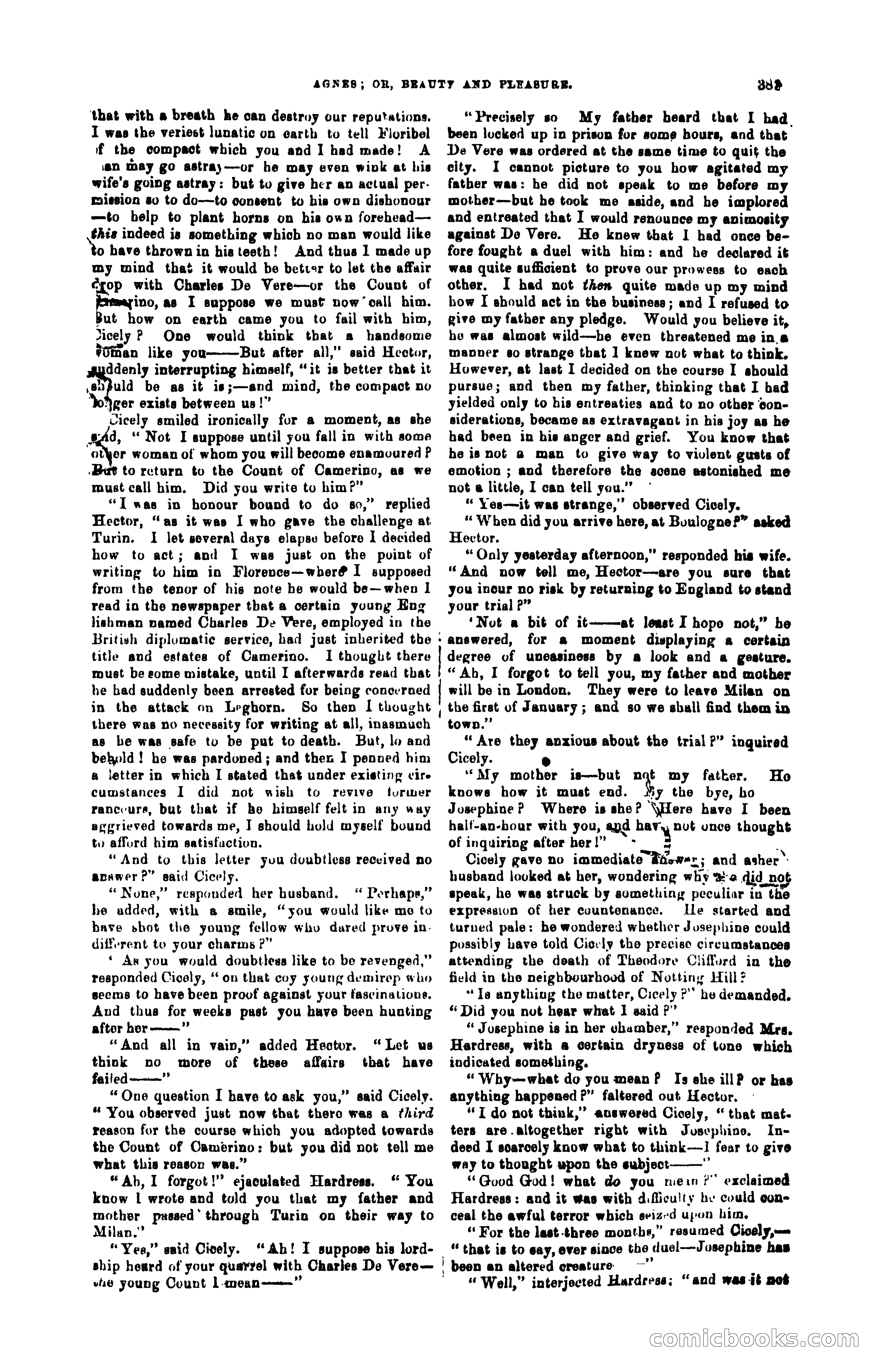
A restored page from Penny Dreadfuls, 1865. Page through the whole issue in the reader above.
📄 Transcribed text from this page (OCR, searchable)
Machine-transcribed from the original scan — historical spelling and the odd misread are preserved.
AGNES; OR, BEAUTY AND PLEASURE. ‘that with a breath he can destroy our reputations. I was the veriest lunatic on earth to tell Filoribel if the compact which you and I had made! A an may go astray—or he may even wink at his wife's going astray: but to give her an actual per- mission so to do—to consent to his own dishonour —to help to plant horns on hie own forehead— this indeed is something which no man would like ‘to have thrown in his teeth! And thus 1 made up my mind that it would be bettor to let the affuir Crop with Charles De Vere—or the Count of ino, as I suppose we must now ‘call him. but how on earth came you to fail with him, sicely P One would think that a handsome *0iman like you--—But after all,” said Hector, Su interrupting himself, “it is better that it ,ausuld be as it is;—and mind, the compact no ‘bo}ger exists between us!” Cicely smiled ironically fur a moment, as she afd, “ Not I suppose until you fall in with some otyer woman of whom you will become enamoured P Bat to return to the Count of Camerino, as we must call him. Did you write to him?” “Twas in honour bound to do so,” replied Hector, “as it was I who gave the challenge at Turin. I let several days elapse before I decided how to act; and I was just on the puint of writing to him in Florence—wher® I supposed from the tenor of his note he would be—when 1 read in the newspaper that a certain young Eng lishman named Charles De Vere, employed in the British diplumatie service, had just inherited the title and estates of Camerino. I thought there must be eome mistake, until I afterwards read that he bad suddenly been arrested for being concerned in the attack on Leghorn. So then I thought there was no necessity for writing at all, inasmuch as be wae safe to be put to death. But, lo and behold! he was pardoned; and then I penned him a letter in which I stated that under existing vire cumstances I did not wish to revive furwer ranccvure, but that if be himself felt in any way aggrieved towards me, J should hold myself bound tv affurd him satisfaction. “And to this letter you doubtless received no answer?” gaid Cicely. “None,” responded her husband. ‘ Perhaps,” he added, with a smile, “you would like mo to have shot the young fellow who dared prove in- different to your charms ?” * Aw you would doubtless like to bo revenged,” reaponded Cicely, “on that coy young demirep who secms to have been proof against yuur fascinatione. And thus for weeks past you have been hunting after her ———”’ “And all in vain,” added Hectur. “Let us think no more of these affairs that have failed “One question I have to ask you,” said Cicely. “ You observed just now that thero was a third reason fur the course which you adopted towards the Count of Caméerino: but you did not tell me what this reason was.” “Ab, I forgot!” ejaculated Hardress. “ You know | wrote and told you that my father and mother pussed' through Turia on their way to Milan.” “Yea,” ssid Cively. “Ab! I suppose bis lord- ship heard of your quaryel with Charles De Vere— been an altered creature = — vie young Count ] amean——— an. eg Sen 38d “Precisely so My father beard that I had been lucked up in prison fur some bours, and that De Vere was ordered at the same time to quit the city. I cannot picture to you how agitated my father was: he did not speak to me before my mother—but he took me aside, and he implored and entreated that I would renounce my animosity against De Vere. He knew that I had once be- fore fought a duel with him: and he declared it¢ was quite sufficient to prove our prowess to each other, I had not then quite made up my mind how I should act in the business; and I refused to give my father any pledge. Would you believe it, he was almost wild—hbe even threatened me ine manner go strange that ] knew not what to think. However, at last I decided on the course I should pursue; and then my father, thinking that I had yielded only to his entreaties and to no other con- siderations, became as extravagant in his joy as he had been in his anger and grief. You know that he is not @ man to give way to vivient guste of emotion ; and therefore the scene astonished me not a little, I can tell you.” “ Yes—it was strange,” observed Cicely. “When did you arrive here, at Boulogne?” asked Hector. “Only yesterday afternoon,” responded his wife. “And now tell me, Hector—are you sure that you incur no risk by returning to England to stand your trial P” ‘Not a bit of it——at least I hopo not,” he anewered, for a moment displaying a certain degree of uneasiness by a look and a gesture. “Ah, I forgot to tell you, my father and mother will be in London. They were to leave Milen on the first of January; and so we sball find them in town.” “Are they anxious about the trial?” inquired Cicely. ‘““My mother is—but not my fatker. knows how it must end. My the bye, bo Josephine P Where is she? \Here have I been half-an-bour with you, apd havy, nut unce thought of inquiring after her!” - = & Cicely gave no immediate Biiew*r; and asher * husband looked at her, wondering why % 0 did no speak, he was struck by sumething peculiar in the expression of her countenance. He started and turned pale: he wondered whether Josephine could possibly bave told Ciecly the precise circumstances attending the death of Theodore Clifford in the field in the neighbourhood of Notting Hill? “Is anything the matter, Cicely?’ he demanded. “Did you not hear what I said P” “ Josephine is in her vhumber,” responded Mrs. Herdress, with a certain dryness of tono which indicated something. “'Why—what do you mean P Is she illP or has anything happened P” faltered out Hector. “TI do not think,” answered Cicely, “that mat. ters are altogether right with Jusephine, In- deed I scarcely know what to think—JI fear to give way to thought upon the subject " “Good God! what do you nein?” exclaimed Hardress: and it was with difficulty he could cone ceal the awful terror which seized upon him, “For the last-three months,” resumed Cicely,a= “ that is to say, ever since the duel—J osephine has Ho “Well,” interjected Hardress; “and was it not COmnmiclsoo nn S CO