
Penny Dreadfuls, 1865 · page 242 of 400
Agnes: A Tale of the Streets — page 242: what you’re looking at
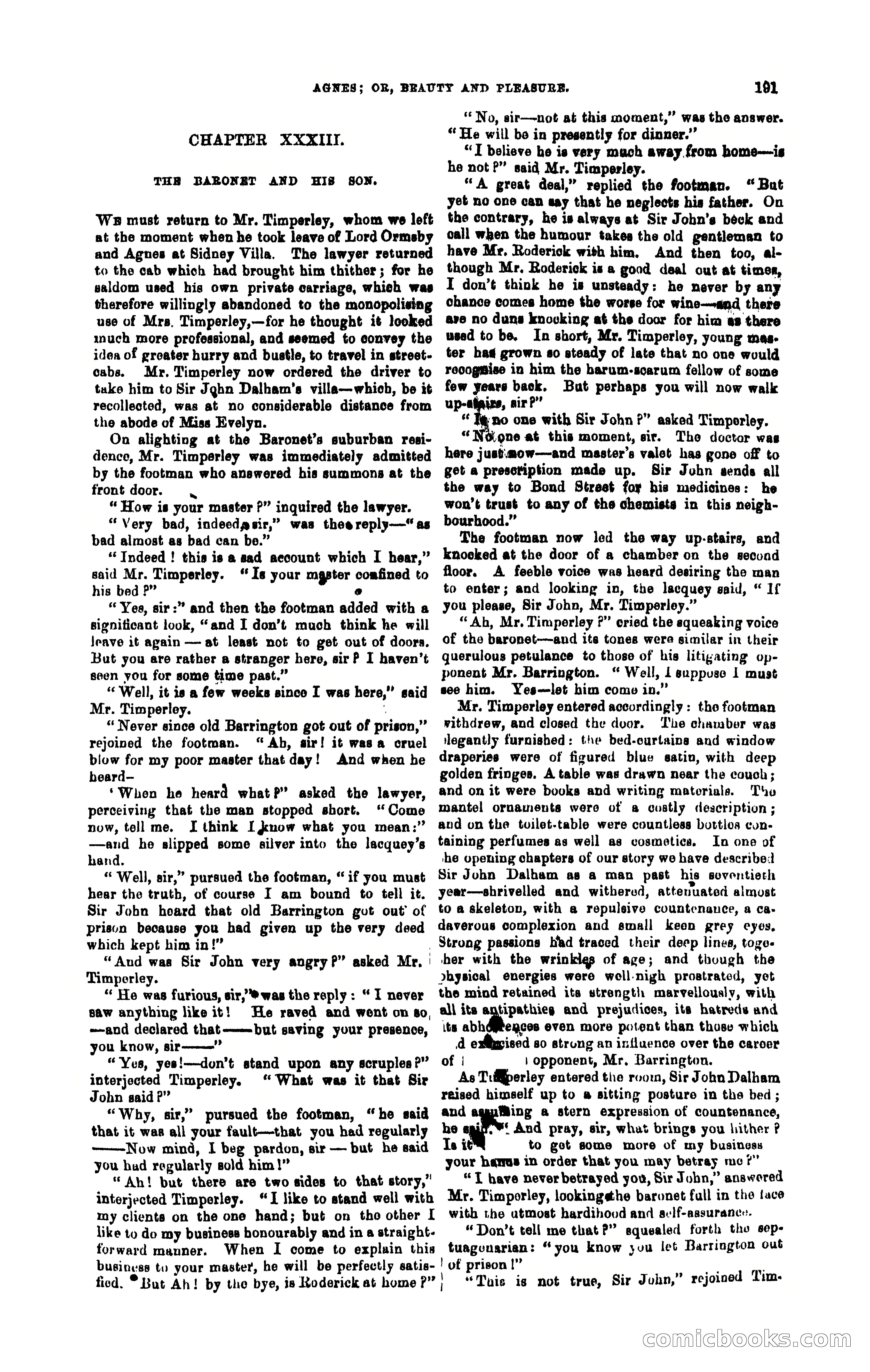
A restored page from Penny Dreadfuls, 1865. Page through the whole issue in the reader above.
📄 Transcribed text from this page (OCR, searchable)
Machine-transcribed from the original scan — historical spelling and the odd misread are preserved.
AGNES; OR, BEAUTY AND PLEASURE. CHAPTER XXXIII. THE BARONET AND HI# SON. Ws must return to Mr. Timperley, whom we left at the moment when he took leave of Lord Ormsby and Agnes at Sidney Villa. The lawyer returned to the cab which had brought him thither; for he saldom used his own private carriage, whieh was therefore willingly abandoned to the monopolising use of Mrs. Timperley,—for he thought it looked much more professional, and seemed to convey the idea of greater hurry and bustle, to travel in street. cabs. Mr. Timperley now ordered the driver to tuke him to Sir Jghn Dalham’s villa—which, be it recollected, was at no considerable distance from the abode of Miss Evelyn. On alighting at the Baronet’s suburban resi- dence, Mr. Timperley was immediately admitted by the footman who answered his summons at the front door. , “ How is your master P” inquired the lawyer. “Very bad, indeedgsir,” was thee reply—“ as bad almost as bad can be.” ‘Indeed ! this is a aad account which I hear,” said Mr. Timperley. “Is your mgster comfined to his bed ?” o Yes, sir:” and then the footman added with a significant look, “and I don’t much think he will Jeave it again — at least not to get out of doors. But you are rather a stranger here, sir P I haven’t seen you for some time past.” “Well, it is a few weeks since I was here,” said Mr. Timperley. ; “ Never since old Barrington got out of prison,” rejoined the footman. “Ab, air! it wasa cruel blow for my poor master that day! And when he beard- ‘When he heard what?” asked the lawyer, perceiving that the man stopped short. ‘ Come now, tell me. I think I know what you mean:” —and he slipped some silver into the lacquey’s hand. “ Well, sir,” pursued the footman, “if you must hear the truth, of course I am bound to tell it. Sir John heard that old Barrington got out of prison because you had given up the very deed which kept him in!” | “And was Sir John very angry?” asked Mr. | Timperley. “* He was furious, sir, * was the reply: “I never saw anything like it! He raved and went on so, ~and declared that-——=but saving your presence, you know, sir———”” “Yus, yes!—don’t stand upon any scruples?” interjected Timperley. “ What was it that Sir John said ?” “Why, sir,” pursued the footman, “he said that it was all your fault—that you had regularly ——Now mind, I beg pardon, sir — but he said you had regularly sold him!” “Ah! but there are two sides to that story,” interjected Timperley. “I like to stand well with 191 * No, sir—not at this moment,” was the answer. “He will be in presently for dinner.” “I believe he is very mach away.from bome—is he not P” said Mr. Timperley. “A great deal,” replied the footman. “ Bat yet no one can aay that he neglects his father. On the contrary, he is always at Sir John’s beck and call when the humour takes the old gentleman to have Mr. Roderick with him. And then too, al- though Mr. Roderick is a good daal out at timer, I don’t think he is unsteady: he never by any chance comes home the worse for wine—-and there ave no duns knovking at the door for him as there used to be. In short, Mr. Timperley, young mas- ter had grown so steady of late that no one would recogaise in him the barum-scarum fellow of some few years back. But perhaps you will now walk up-ataize, sir?” “ Teno one with Sir John ?” asked Timporley, “Noone at this moment, sir. Tho doctor was here just.mow—and master’s valet has gone off to get a presetiption made up. Sir Juhn sends all the way to Bond Street foxy his medicines: he won't trust to any of the chemists in this neigh- bourhood.” The footman now led the way up-stairs, and knocked at the door of a chamber on the second floor. A feeble voice was heard desiring the man to enter; and looking in, the lacquey said, “ If you please, Sir John, Mr. Timperley.” “Ah, Mr. Timperley ?” cried the squeaking voice of the baronet—-and ite tones were similar in their querulous petulance to those of his litigating op- ponent Mr. Barrington. “ Well, L suppuse 1 must see him. Yes—let him come in.” Mr. Timperley entered accordingly: the footman withdrew, and closed the dvor. The chavaber was legantly furnished: the bed-curtains and window draperies were of figured blue satiu, with deep golden fringes. A table was drawn near the couch ; and on it were booke and writing matorials. Tho mantel ornaments were of a costly description ; and on the tvilet-table were countless bottios con- taining perfumes as well as cosmetica. In one of ihe opening chapters of our story we have described Sir John Dalham a8 a man past his seventieth year—shrivelled and withered, attenuated almost to a skeleton, with a repuleive countenance, a ca- daverous complexion and small keen grey eyes, Strong passions hiad traced their deep lines, togo- ‘her with the wrin of age; and thuugh the >bysical energies were well-nigh prostrated, yet the mind retained its strength marvellously, with all ite antipathies and prejudices, its hatreds and its abhoregces even more potent than those which d ex@zvised 50 strong an influence over the caroer of | | opponent, Mr. Barrington. As Tif}perley entered the room, Sir John Dalham reised himself up to @ sitting posture in the bed ; and agguMing a stern expression of countenance, he a: And pray, sir, what brings you hither ? To i¢ to got some more of my business your hatras in order that you may betray me?” “T have never betrayed you, Sir John,” answored Mr. Timporley, lookingshe baronet full in the face my clients on the one hand; but on tho other [ with the utmost hardihood and aulf-assurance. like to do my business honourably and in a straight- “Don’t tell me that?” squealed forth the sep- forward manner. When I come to explain this tuagenarian: “you know yuu let Barrington out business to your master, he will be perfectly satis- ' of prison |” fied, ° But Ah! by the bye, is Roderick at home ?” . . ee fy, “Tais is not true, Sir Juhn,” rejoined Tim. comicbaoo S