
Penny Dreadfuls, 1865 · page 241 of 400
Agnes: A Tale of the Streets — page 241: what you’re looking at
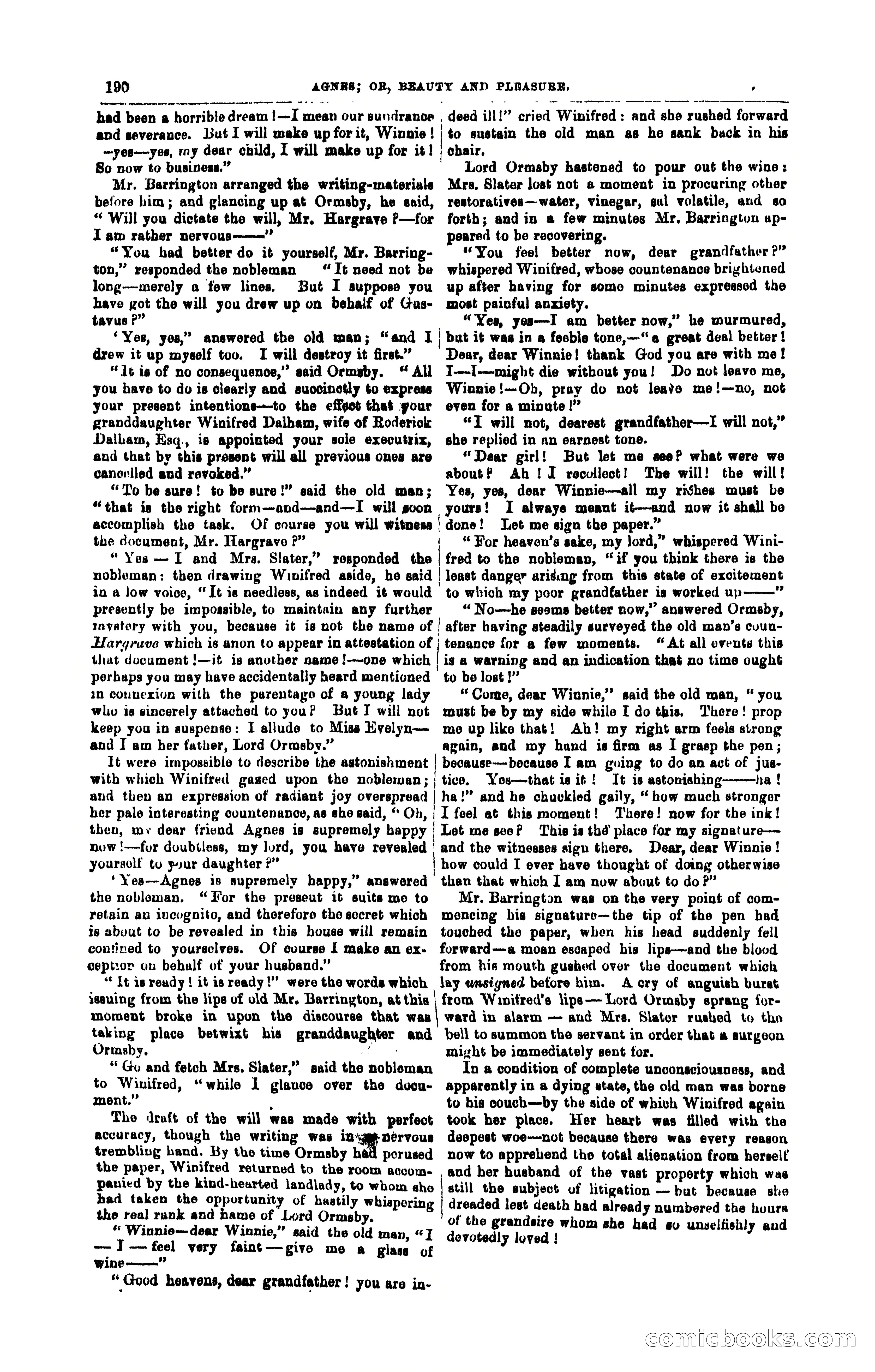
A restored page from Penny Dreadfuls, 1865. Page through the whole issue in the reader above.
📄 Transcribed text from this page (OCR, searchable)
Machine-transcribed from the original scan — historical spelling and the odd misread are preserved.
190 Cert ELANCE mW Et <Petn rnp ere Tt eit meat Ds eR euhinte Mf 4 = had been a horrible dream !|—I — our sundrance AGNES; OR, BEAUTY AND PLEASURE, , —_ mere eel ne re et emt ee te ne eae mer erteg deed any? cniad Winifred : and she rushed forward and severance. But I will make upfor it, Winnie! | to sustain the old man as he sank buck in his —yes—yes, my dear child, I will make up for it! | chair, So now to business.” Mr. Barrington arranged the writing-matoriale before him; and glancing up at Ormsby, he said, “ Will you dictate the will, Mr. Hargrave P—for J am rather nervous——” “You had better do it yourself, Mr. Barring- ton,” responded the nobleman “It need not be long—merely o few lines. But I suppose you have ot the will you drew up on behalf of Gus- tavus ?” . ‘Yes, yes,” answered the old man; “and I | Grew it up myself tuo. I will destroy it first.” 1t is of no consequence,” said Ormsby. “ All you have to do ia clearly and succinctly to express your present intentionse-—-to the effgot that your granddaughter Winifred Dalham, wife of Roderick Dalam, Esq., is appointed your sole executrix, aud that by this present will all previous ones are cancriled and revoked.” “To be sure! to be sure!” said the old man; “that is the right form—and—and—I will svon accomplish the task. Of course you will witness | the document, Mr. Hargrave P” | “ Yes — I and Mrs. Slater,” responded the nobleman: then drawing Winifred aside, he said | in a low voice, “It is needless, as indeed it would presently be impossible, to maintain any further inystory with you, because it is not the name of | Hargrave which is anon to appear in attestation of | that document !—it is another name !—one which | perhaps you may have accidentally heard mentioned In connexion with the parentage of a young lady who is sincerely attached to you? But J will not keep you in suspense: J allude to Misa Kvelyn— and J am her father, Lord Ormeby.” It were impossible to describe the astonishment with which Winifred gazed upon the nobleman; | and then an expression of radiant joy overspread her pale interesting countenance, as she said, “ Ob, then, my dear friend Agnes is supremely happy now !—fur doubtless, my lurd, you have revealed | yoursolf tu pour daughter P” ‘Yes—Agnes is supremely happy,” answered the nubleman. “Tor the preseut it suite me to retain an incognito, and therefore the secret which is about to be revealed in this house will remain contined to yourselves. Of course I make an ex- ceptior an behalf of your husband.” ** Kt is ready ! it is ready!” were the words which issuing from the lips of old Mr. Barrington, at thie | moment broke in upon the discourse that was | taking place betwixt his granddaughter and Ormsby. ps “Gu and fetch Mrs. Slater,” said the nobloman to Winifred, “while I glance over the ducu- ment.” . The draft of the will was made with perfect accuracy, though the writing was ini nervous trembling hand. By the time Ormsby had perused the paper, Winifred returned to the room accom- panied by the kind-hearted landlady, to whom she had taken the opportunity of hastily whispering the real rank and hame of Lord Ormsby. “ Winnie—dear Winnie,” said the old man, “J —— I— feel very faint—givo mo a glass of wine 7 “ Good heavens, dear grandfather! you are in- Lord Ormsby hastened to pour out the wine: Mrs, Slater Jost not a moment in procuring other restoratives— water, vinegar, sul volatile, and so forth; and in a few minutes Mr. Barrington ap- peared to be recovering. “You feel better now, dear grandfather P” whispered Winifred, whose countenance brightened up after having for some minutes expressed the most painful anxiety. “Yea, yes——I am better now,” he murmured, but it was in a feeble tone,—“a great deal better! Dear, dear Winnie! thank God you are with me! I—I—might die without you! Do not leavo me, Wianie!—Ob, pray do not leave me!—no, not even for a minute !” “T will not, dearest grandfather—I will not,” she replied in an earnest tone. “Dear girl! But let me see? what were we about? Ah!I recollect! The will! the will! Yes, yes, dear Winnie—all my rivhes must be yours! I always meant it—and now it shall bo done! Let me sign the paper.” “ Por heaven’s sake, my lord,” whispered Wini- fred to the nobleman, “if you think there is the least danger arid.ng from thie state of excitement to which my poor grandfather is worked up———” “‘No—he seoms better now,” answered Ormaby, after having steadily surveyed the old man’s cuun- tenance for a few moments. “ At all events this ig a warning and an indication that no time ought to be lost!” ‘Come, dear Winnie,”’ said the old man, “ you must be by my side while I do this, There! prop me up like that! Ab! my right arm feels strong again, and my hand is firm as I grasp the pen; because—because I am going to do an act of jus- tice, Yosu—that isit! It is astonishing ha ! ha!” and he chuckled gaily, “ how much stronger I feel at this moment! There! now for the ink! Let me see? Thies is thé place for my signature— and the witnesses sign there. Dear, dear Winnie ! how could I ever have thought of doing otherwise then that which I am now about to do P” Mr. Barrington was on the very point of com- mencing his signature—the tip of the pen had touched the paper, when his head suddenly fell forwerd—a moan escaped his lips—and the blood from his mouth gushed over the document which lay unsigned before him. A cry of anguish burat from Winifred’s lips— Lord Ormsby sprang for- ward in alarm — and Mra. Slater rushed to tho bell to summon the servant in order that a surgeon miht be immediately sent for. In a condition of complete unconsciousness, and apparently in a dying state, the old man was borne to his couch—by the side of which Winifred again took her place. Her heart was filled with the deepest woe—not because thera was every reason now to appreliend the total alienation from herself , and her husband of the vast property which wae still the subject uf litigation — but because she dreaded leat death had already numbered the houra of the grandsire whom she had so unselfishly and devotedly loved ! IN@alK