
Penny Dreadfuls, 1858 · page 348 of 400
The Young Duchess; or, Memoirs of a Lady of Quality — page 348: what you’re looking at
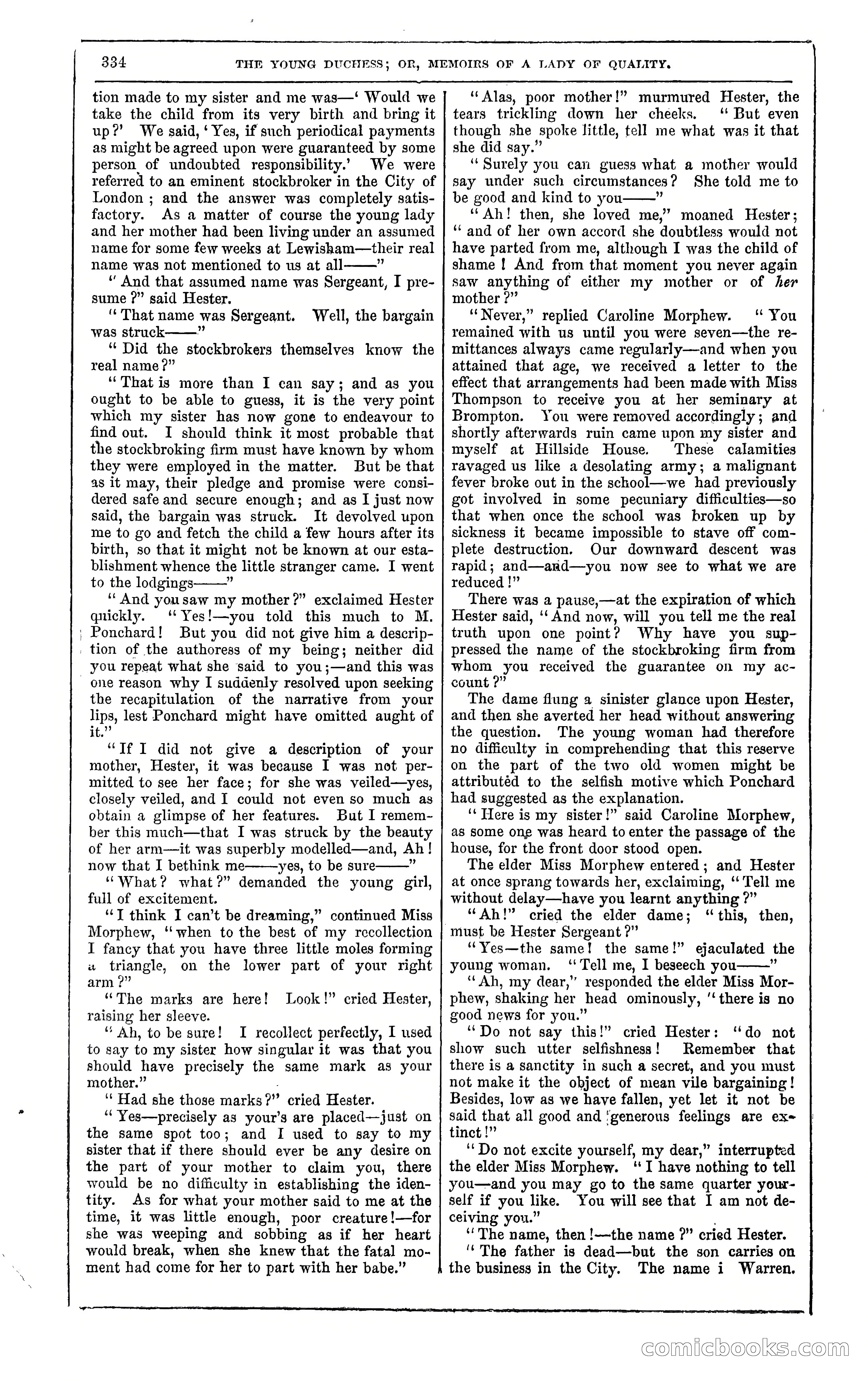
A restored page from Penny Dreadfuls, 1858. Page through the whole issue in the reader above.
📄 Transcribed text from this page (OCR, searchable)
Machine-transcribed from the original scan — historical spelling and the odd misread are preserved.
384 THE YOUNG DUCHESS; OR, MEMOIRS OF A LADY OF QUALITY. tion made to my sister and me was—‘ Would we take the child from its very birth and bring it up?’ We said, ‘ Yes, if such periodical payments as might be agreed upon were guaranteed by some person of undoubted responsibility.’ We were referred to an eminent stockbroker in the City of London ; and the answer was completely satis- factory. As a matter of course the young lady and her mother had been living under an assumed name for some few weeks at Lewisham—their real name was not mentioned to us at all ” “ And that assumed name was Sergeant, I pre- sume ?” said Hester. “ That name was Sergeant. was struck——” ‘Did the stockbrokers themselves know the real name?” ‘That is more than I can say; and as you ought to be able to guess, it is the very point which my sister has now gone to endeavour to find out. I should think it most probable that the stockbroking firm must have known by whom they were employed in the matter. But be that as it may, their pledge and promise were consi- dered safe and secure enough; and as I just now said, the bargain was struck. It devolved upon me to go and fetch the child a few hours after its birth, so that it might not be known at our esta- blishment whence the little stranger came. I went to the lodgings ” ‘‘ And yousaw my mother?” exclaimed Hester quickly. ‘Yes!—you told this much to M. Ponchard! But you did not give him a descrip- Well, the bargain . tion of the authoress of my being; neither did you repeat what she said to you;—and this was one reason why I suddenly resolved upon seeking the recapitulation of the narrative from your lips, lest Ponchard might have omitted aught of it.” “If I did not give a description of your mother, Hester, it was because I was not per- mitted to see her face; for she was veiled—yes, closely veiled, and I could not even so much as obtain a glimpse of her features. But I remem~- ber this much—that I was struck by the beauty of her arm—it was superbly modelled—and, Ah! now that I bethink me yes, to be sure 2 “What? what?” demanded the young girl, full of excitement. ““T think I can’t be dreaming,” continued Miss Morphew, ‘when to the best of my recollection I fancy that you have three little moles forming w triangle, on the lower part of your right arm ?” “The marks are here! raising her sleeve. “Ah, to be sure! I recollect perfectly, 1 used to say to my sister how singular it was that you should have precisely the same mark as your mother.” : ‘‘ Had she those marks?” cried Hester. ‘‘'Yes—precisely as your’s are placed—just on the same spot too; and I used to say to my sister that if there should ever be any desire on the part of your mother to claim you, there would be no difficulty in establishing the iden- tity. As for what your mother said to me at the time, it was little enough, poor creature!—for she was weeping and sobbing as if her heart would break, when she knew that the fatal mo- ment had come for her to part with her babe.” Look!” cried Hester, ‘“‘ Alas, poor mother!” murmured Hester, the tears trickling down her cheeks. ‘ But even though she spoke little, tell me what was it that she did say.” “ Surely you can guess what a mother would say under such circumstances? She told me to be good and kind to you y ‘‘Ah! then, she loved me,” moaned Hester; ‘‘ and of her own accord she doubtless would not have parted from me, although I was the child of shame ! And from that moment you never again saw anything of either my mother or of her mother ?” ‘‘Never,” replied Caroline Morphew. ‘ You remained with us until you were seven—the re- mittances always came regularly—and when you attained that age, we received a letter to the effect that arrangements had been made with Miss Thompson to receive you at her seminary at Brompton. You were removed accordingly; and shortly afterwards ruin came upon my sister and myself at Hillside House. These calamities ravaged us like a desolating army; a malignant fever broke out in the school—we had previously got involved in some pecuniary difficulties—so that when once the school was broken up by sickness it became impossible to stave off com- plete destruction. Our downward descent was rapid; and—and—you now see to what we are reduced !” There was a pause,—at the expiration of which Hester said, ‘‘ And now, will you tell me the real truth upon one point? Why have you sup- pressed the name of the stockbroking firm from whom you received the guarantee on my ac- count 2?” The dame flung a sinister glance upon Hester, and then she averted her head without answering the question. The young woman had therefore no difficulty in comprehending that this reserve on the part of the two old women might be attributéd to the selfish motive which Ponchard had suggested as the explanation. ‘‘ Tere is my sister!” said Caroline Morphew, as some ong was heard to enter the passage of the house, for the front door stood open. The elder Miss Morphew entered; and Hester at once sprang towards her, exclaiming, ‘‘ ‘Tell me without delay—have you learnt anything ?” “Ah!” cried the elder dame; “this, then, must be Hester Sergeant ?” ‘““Yes—the same! the same!” ejaculated the young woman. ‘‘Tell me, I beseech you d ‘Ah, my dear,” responded the elder Miss Mor- phew, shaking her head ominously, ‘there is no good news for you.” ‘““Do not say this!” cried Hester: ‘do not show such utter selfishness! Remember that there is a sanctity in such a secret, and you must not make it the object of mean vile bargaining! Besides, low as we have fallen, yet let it not be said that all good and ‘generous feelings are ex- tinct !” ‘Do not excite yourself, my dear,” interrupted the elder Miss Morphew. ‘I have nothing to tell you—and you may go to the same quarter your- self if you like. You will see that I am not de- ceiving you.” ‘‘ The name, then !—the name ?” cried Hester. ‘The father is dead—but the son carries on the business in the City. The name i Warren. i a ee ee ee ee peas ari cin ean te COMO oO SS Colin