
Penny Dreadfuls, 1858 · page 347 of 400
The Young Duchess; or, Memoirs of a Lady of Quality — page 347: what you’re looking at
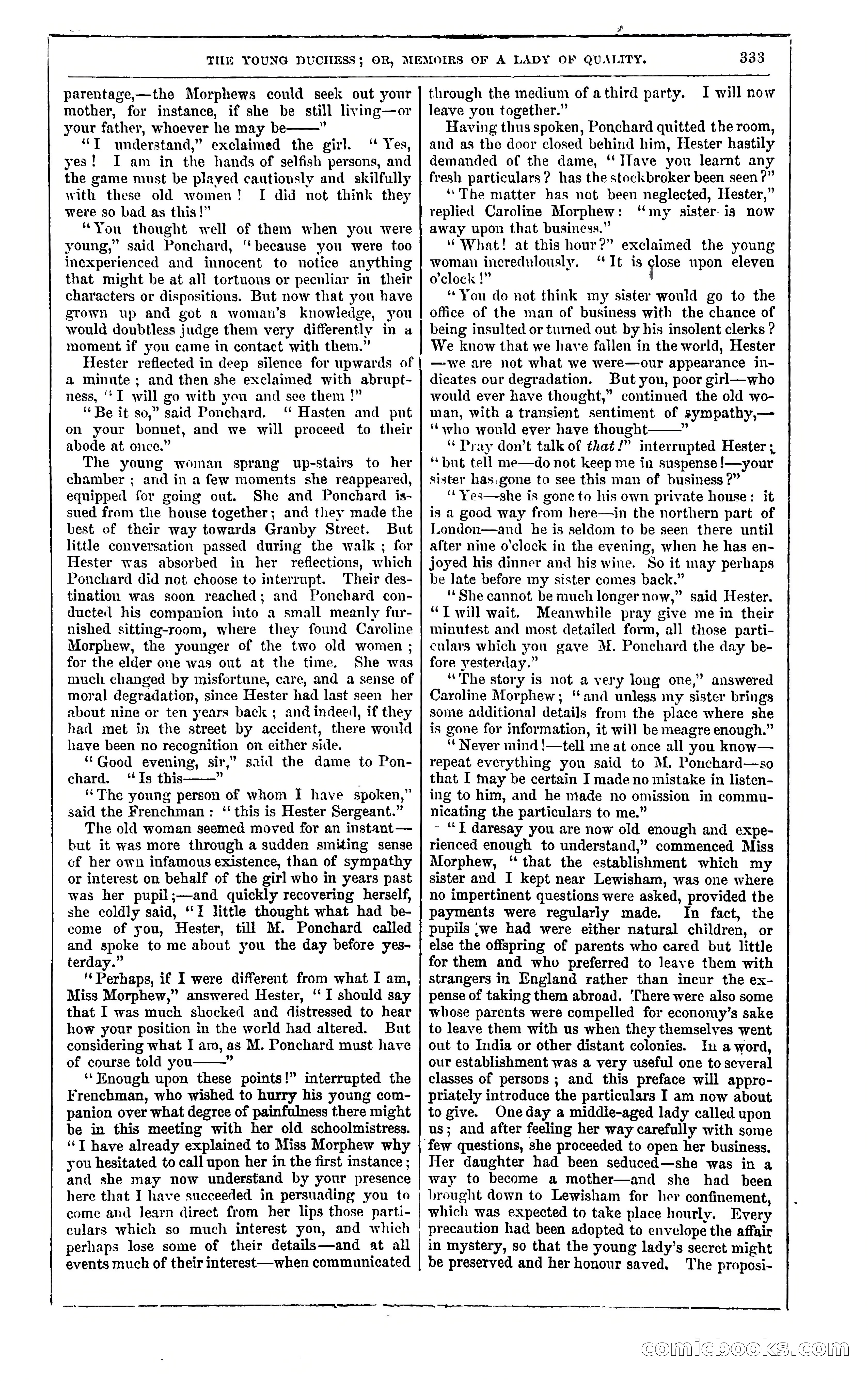
A restored page from Penny Dreadfuls, 1858. Page through the whole issue in the reader above.
📄 Transcribed text from this page (OCR, searchable)
Machine-transcribed from the original scan — historical spelling and the odd misread are preserved.
TIE YOUNG DUCHESS; OR, MEMOIRS OF A LADY OF QUALITY. 333 parentage,—the Morphews could seek out your mother, for instance, if she be still living—or your father, whoever he may be : “Y understand,” exclaimed the girl. ‘ Yes, yes! I am in the hands of selfish persons, and the game must be played cautiously and skilfully with these old women! I did not think they were so bad as this!” “You thought well of them when you were young,” said Ponchard, ‘because you were too inexperienced and innocent to notice anything that might be at all tortuous or peculiar in their characters or dispositions. But now that you have grown up and got a woman's knowledge, you would doubtless judge them very differently in a moment if you came in contact with them.” Hester reflected in deep silence for upwards of a minute; and then she exclaimed with abrupt- ness, ‘I will go with you and see them !” ‘“‘ Be it so,” said Ponchard. ‘ Hasten and put on your bonnet, and we will proceed to their abode at once.” The young woman sprang up-stairs to her chamber ; and in a few moments she reappeared, equipped for going out. She and Ponchard is- sued from the house together; and they made the best of their way towards Granby Street. But little conversation passed during the walk ; for Hester was absorbed in her reflections, which Ponchard did not choose to interrupt. Their des- tination was soon reached; and Ponchard con- ducted his companion into a small meanly fur- nished sitting-room, where they found Caroline Morphew, the younger of the two old women ; for the elder one was out at the time. She was much changed by misfortune, care, and a sense of moral degradation, since Hester had last seen her about nine or ten years back ; and indeed, if they had met in the street by accident, there would have been no recognition on either side. “Good evening, sir,” said the dame to Pon- chard. “Is this , “The young person of whom I have spoken,” said the Frenchman: ‘‘ this is Hester Sergeant.” The old woman seemed moved for an instant— but it was more through a sudden smiting sense of her own infamous existence, than of sympathy or interest on behalf of the girl who in years past was her pupil;—and quickly recovering herself, she coldly said, ‘‘I little thought what had be- come of you, Hester, till M. Ponchard called and spoke to me about you the day before yes- terday.” ‘Perhaps, if I were different from what I am, Miss Morphew,” answered Hester, ‘‘ I should say that I was much shocked and distressed to hear how your position in the world had altered. But considering what I am, as M. Ponchard must have of course told you ” ‘tenough upon these points!” interrupted the Frenchman, who wished to hurry his young com- panion over what degrce of painfulness there might be in this meeting with her old schoolmistress. ‘“‘T have already explained to Miss Morphew why you hesitated to call upon her in the first instance ; and she may now understand by your presence here that I have succeeded in persuading you to come and learn direct from her lips those parti- culars which so much interest you, and which perhaps lose some of their details—and at all events much of their interest—when communicated # through the medium of athird party. I will now leave you together.” Having thus spoken, Ponchard quitted the room, and as the door closed behind him, Hester hastily demanded of the dame, “ ITave you learnt any fresh particulars? has the stockbroker been seen ?” ‘‘The matter has not been neglected, Hester,” replied Caroline Morphew: ‘my sister-is now away upon that business.” “What! at this hour?” exclaimed the young woman incredulously. ‘It is gone upon eleven o'clock !” “You do not think my sister would go to the office of the man of business with the chance of being insulted or turned out by his insolent clerks ? We know that we have fallen in the world, Hester —we are not what we were—our appearance in- dicates our degradation. But you, poor girl—who would ever have thought,” continued the old wo- man, with a transient sentiment of sympathy,— ‘‘who would ever have thought ” ‘Pray don’t talk of that!” interrupted Hester ; “but tell me—do not keep me in suspense !—your sister has.gone to see this man of business ?” ‘* 'Yes—she is gone to his own private house: it is a good way from here—in the northern part of London—and he is seldom to be seen there until after nine o'clock in the evening, when he has en- joyed his dinner and his wine. So it may perhaps be late before my sister comes back.” ‘‘ She cannot be much longer now,” said Hester. ‘“‘E will wait. Meanwhile pray give me in their minutest and most detailed form, all those parti- culars which you gave M. Ponchard the day be- fore yesterday.” “The story is not a very long one,” answered Caroline Morphew; “and unless my sister brings some additional details from the place where she is gone for information, it will be meagre enough.” ‘* Never mind !—tell me at once all you know— repeat everything you said to M. Ponchard—so that I may be certain I made no mistake in listen- ing to him, and he made no omission in commu- nicating the particulars to me.” ~ ““T daresay you are now old enough and expe- rienced enough to understand,” commenced Miss Morphew, ‘‘ that the establishment which my sister and I kept near Lewisham, was one where no impertinent questions were asked, provided the payments were regularly made. In fact, the pupils ;we had were either natural children, or else the offspring of parents who cared but little for them and who preferred to leave them with strangers in Itngland rather than incur the ex- pense of taking them abroad. ‘There were also some whose parents were compelled for economy’s sake to leave them with us when they themselves went out to India or other distant colonies. In a word, our establishment was a very useful one to several classes of persons ; and this preface will appro- priately introduce the particulars I am now about to give. Oneday a middle-aged lady called upon us; and after feeling her way carefully with some ‘few questions, she proceeded to open her business. Her daughter had been seduced—she was in a way to become a mother—and she had been brought down to Lewisham for her confinement, which was expected to take place hourly. Every precaution had been adopted to envelope the affair in mystery, so that the young lady’s secret might be preserved and her honour saved. The proposi- ee a ree COMO YN Wn) Colin