
Penny Dreadfuls, 1897 · page 3 of 16
Beadle's Half Dime Library: Barney Blake, the Boy Privateer — page 3: what you’re looking at
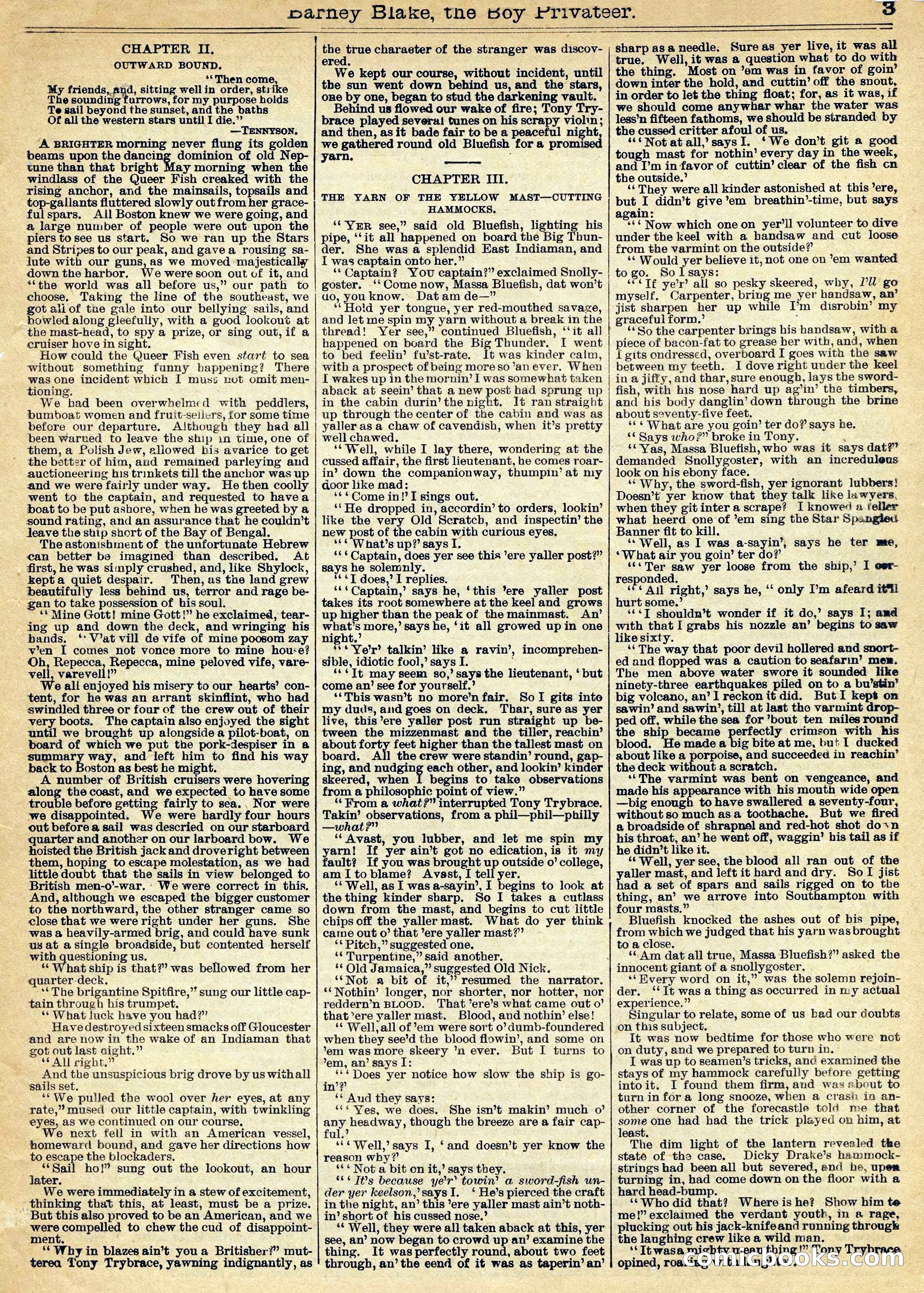
A restored page from Penny Dreadfuls, 1897. Page through the whole issue in the reader above.
📄 Transcribed text from this page (OCR, searchable)
Machine-transcribed from the original scan — historical spelling and the odd misread are preserved.
CHAPTER II, OUTWARD BOUND. ** Then come My friends, 2nd, sitting wellin order, strike The sounding furrows, for my purpose holds Te sail beyond the sunset, and the baths Of all the western stars until I die.”’ —TENNYSON, ‘A BRIGHTER morning never flung its golden beams upon the ene e dominion of old Ne tune than that bright May morning when the windlass of the Queer Fish creaked with the rising anchor, and the mainsails, topsails and top-gallants fluttered slowly outfrom her grace- fulspars. All Boston knew we were going, and a large number of people were out upon the piers to see us start. So we ran up the Stars and Stripes to our peak, and gave a rousing sa- lute with our guns, as we moved majestically down the harbor. Weweresoon out of it, and **the world was all before us,” our path to choose, Taking the line of the southeast, we got aliof tue gale into our bellying sails, and howled along gleefully, with a guod lookout at the mast-head, to spy a prize, or sing out, if a cruiser hove in sight, How could the Queer Fish even start to sea without something funny happening? There was one incident which I muss net omit men- tioning. We had been overwheimed with peddlers, bumboat women and fruit-sellers, for some time before our departure, Although they had all been warrved to leave the ship in time, one of them, a Polish Jew, aliowed bis avarice to get the better of him, and remained parleying and auctioneering his trinkets till the anchor was up and we were fairly under way. He then coolly went to the captain, and requested to havea boat to be put ashore, when he was greeted by a sound rating, and an assurance that he couldn’t Jeave the ship short of the Bay of Bengal. The astonishment of the unfortunate Hebrew can better bea imagined than described. At _ first, he was simply crushed, and, like Shylock, kept a quiet despair. Then, as the land grew beautifully less behind us, terror and rage be- - gan to take possession of his soul. ‘* Mine Gott! mine Gott!” he exclaimed, tear- ing up and down the deck, and wringing his hands, ‘ V’at vill de vife of mine poosom zay ven I comes not vonce more to mine house? Oh, Repecca, Repecca, mine peloved vife, vare- vell, varevell!” We all enjoyed his misery to our hearts’ con- tent, for he was an arrant skinflint, who had swindled three or four of the crew out of their very boots. The captain also enjoyed the sight until we brought up alongside a pilot-boat, on board of which we put the pork-despiser in a summary way, and left him to find his way back to Boston as best he might. A number of British cruisers were hovering along the coast, and we expected to have some trouble before getting fairly to sea. . Nor were we disappointed. We were hardly four hours out before a sail was descried on our starboard quarter and another on our larboard bow. We hoisted the British jack and droveright between them, hoping to escape molestation, as we had little doubt that the sails in view belonged to British men-o’-war. : We were correct in this. And, although we escaped the bigger customer to the northward, the other stranger came so close that we were right under her guns. She was a heavily-armed brig, and could have sunk us at asingle broadside, but contented herself with questioning us. ‘¢ What ship is that?’ was bellowed from her quarter-deck, ‘‘The brigantine Spitfire,’ sung our little cap- tain through his trumpet. ** What luck have you had?’ Have destroyed sixteen smacks off Gloucester and are now in the wake of an Indiaman that got out last aight.” *S All right.” And the unsuspicious brig drove by us withall sails set. ‘*We pulled the wool over her eyes, at any rate,” mused our little captain, with twinkling eyes, as we continued on our course. We next fell in with an American vessel, homeward bound, and gave her directions how to escape the blockaders, **Sail ho!” sung out the lookout, an hour later. ; We were immediately in a stew of excitement, thinking that this, at least, must be a prize. - But this also proved to be an American, and we sere compelled to chew the cud of disappoint- ment, ee ‘* Why in blazes ain’t you a Britisher?’ mut- parney Blake, the boy wee true charaeter of the stranger was discov- ered, We kept our course, without incident, until the sun went down behind us, and the stars, one by one, began to stud the darkening vault. Behind us flowed our wake of fire; Tony Try- brace played several! tunes on his scrapy violin; and then, as it bade fair to be a peaceful night, we gathered round old Bluefish for a promised yarn. : CHAPTER III. OF THE YELLOW MAST—CUTTING HAMMOCKS. ‘YER see,” said old Bluefish, lighting his pipe, ‘‘it all happened on board the Big Thun- der. She was a splendid East Indiaman, and I was captain onto her.” ‘‘ Captain? You captain?” exclaimed Snolly- goster. ‘‘Come now, Massa Bluefish, dat won’t ao, you know. Dat am de—” ‘‘Hold yer tongue, yer red-mouthed savage, and let me spin my yarn without a break in the thread! Yer see,” continued Bluefish, ‘‘it all happened on board the Big Thunder. I went to bed feelin’ fu’st-rate. It was kinder calm, with a prospect of being moreso’an ever. When I wakes up in the mornin’ I was somewhat taken aback at seein’ that a new post had sprung up in the cabin durin’ the night. It ran straight up through the ceater of the cabin and was as yaller as a chaw of cavendish, when it’s pretty well chawed, ‘*'Well, while I lay there, wondering at the cussed affair, the first lieutenant, he comes roar- in’? down the companionway, thumpin’ at my door like mad: ‘** Come in!’ I sings out. ‘tHe dropped in, accordin’ to orders, lookin’ like the very Old Scratcb, and inspectin’ the new post of the cabin with curious eyes. ‘*¢ What’s up?’ says I. ‘** Captain, does yer see this ’ere yaller post?” says he solemnly. ‘¢*T does,’ I replies. ‘** Captain,’ says he, ‘this ’ere yaller post takes its root somewhere at the keel and grows up higher than the peak of the mainmast. An’ ohette more,’ says he, ‘it all growed upin one night. ‘** Ye’r’ talkin’ like a ravin’, incomprehen- sible, idiotic fool,’ says I. ‘**It may seem so,’ says the lieutenant, ‘ but come an’ see for yourself.’ ‘¢This wasn’t no more’n fair. Sol gits into my duds, and goes on deck. Thar, sure as yer live, this’ere yaller post run straight up be- tween the mizzenmast and the tiller, reachin’ about forty feet higher than the tallest mast on board. All the crew were standin’ round, gap- ing, and Betas each other, and lookin’ kinder skeered, when I begins to take observations from a philosophic point of view.” ‘*From a what?” interrupted Tony Trybrace. Takin’ observations, from a phil—phil—philly —what?” ‘* Avast, you lubber, and let me spin my yarn! If yer ain’t got no edication, is it my fault? If you was brought up outside o’ college, amItoblame? Avast, I tell yer. ‘* Well, as I was a-sayin’, I begins to look at the thing kinder sharp. So I takes a cutlass down from the mast, and begins to cut little chips off the yaller mast. What do yer think caine out o’ that ’ere yaller mast?” ‘* Pitch,” suggested one. ‘* Turpentine,” said another, ‘¢ Old Jamaica,” suggested Old Nick. ‘*Not a bit of it,’ resumed the narrator. ‘Nothin’ longer, nor shorter, nor hotter, nor reddern’n BLOOD. That ’ere’s what came out 0’ that’ere yaller mast. Blood, and nothin’ else! ‘¢ Well, all of °em were sort 0’ dumb-foundered when they see’d the blood flowin’, and some on ’em wasmore skeery ’n ever. But I turns to ’em, an’ says I: we Does yer notice how slow the ship is go- in’? ‘¢ And they says: ‘*< Yes, we does. She isn’t makin’ much 0’ any headway, though the breeze are a fair cap- ful. ‘** Well,’ says I, ‘and doesn’t yer know the reason why? ‘** Not a bit on it,’ says they. ‘*< T?s because yer’ towin’ a sword-fish un- der yer keelson,’saysI. ‘ He’s pierced the craft in the night, an’ this ’ere yaller mast ain’t noth- in’ short of his cussed nose.’ ** Well, they were all taken aback at this, yer see, an’ now began to crowd up an’ examine the | thing. It was perfectly round, about two feet THE YARN terea Tony Trybrace, yawning indignantly, as ' through, an’ the eend of it was as taperin’ an’ Frivateer. —— sharp asa needle. Sureas yer live, it was all true. Well, it was a question what to do with the thing. Most on ’em was in favor of goin’ down inter the hold, and cuttin’ off the snout, in order to let the thing float; for, as it was, if we should come anywhar whar the water was less’n fifteen fathoms, we should be stranded by the cussed critter afoul of us. : ‘<¢Not atall,saysI. ‘We don’t git a good tough mast for nothin’ every day in the week, and I’m in favor of cuttin’ clear of the fish cn the outside.’ : ‘¢ They were all kinder astonished at this ’ere, but I didn’t give’em breathin’-time, but says again: : ‘¢¢ Now which one on yer’ll volunteer to dive under the keel with a handsaw and cut loose from the varmint on the outside?’ ‘¢ Would yer believe it, not one on ’em wanted to go. Solsays: ‘©¢Tf ye’r’ all so pesky skeered, why, l’U go myself. Carpenter, bring me yer handsaw, an’ jist sharpen her up while I’m disrobin’ my graceful form.’ : ‘So the carpenter brings his handsaw, with a piece of bacon-fat to grease her with, and, when { gits ondressed, overboard I goes with the saw between my teeth. I dove right under the keel in a jiffy, and thar, sure enough, lays the sword- fish, with his nose hard up ag’in’ the timbers, and his body danglin’ down through the brine about seventy-five feet. ‘¢¢ What are you goin’ ter do? says he, ‘Says who?” broke in Tony. : ‘‘-Yas, Massa Bluefish,who was it says dat?” demanded Snollygoster, with an increduleus look on his ebony face. ‘¢ Why, the sword-fish, yer ignorant lubbers! Doesn’t yer know that they talk like lawyers, when they git inter a scrape? I knowed a feller what heerd one of ’em sing the Star Spangled Banner fit to kill. ‘+ Well, as I was a-sayin’, says he ter me, ‘What air you goin’ ter do?’ ‘6 Ter saw yer loose from the ship,’ I oer- responded. é ‘¢¢ Ail right,’ says he, “‘ only I’m afeard itl hurt some,’ ‘¢¢T shouldn’t wonder if it do,’ says I; amd with that I grabs his nozzle an’ begins to saw like sixty. ‘¢The way that poor devil hollered and snort- ed and flopped was a caution to seafarin’ men. The men above water swore it sounded like ninety-three earthquakes piled on to a bu’stin’ big volcano, an’1 reckon it did. But I kept on sa win’ and sawin’, till at last the varmint drop- ped off, while the sea for bout ten miles round the ship became ekg ales crimson with his blood. He made a big bite at me, but I ducked about like a porpoise, and succeeded in reachin’ the deck without a scratch. ‘‘The varmint was bent on vengeance, and made his ap ance with his mouth wide open —big enough to have swallered a seventy-four, without so much asa toothache. But we fired a broadside of shrapnel and red-hot shot do.n his throat, an’ he went off, waggin’ his tail as if he didn’t like it. ‘‘ Well, yer see, the blood all ran out of the yaller mast, and left it hard and dry. SoTI jist had a set of spars and sails rigged on to the thing, an’ we arrove into Southampton with four masts.” Bluefish knocked the ashes out of his pipe, from which we judged that his yarn was brought to a close. ‘¢ Am dat all true, Massa Bluefish?” asked the innocent giant of a snollygoster. ‘¢‘Every word on it,” was the solemn rejoin- der. ‘‘It was a thing as occurred in my actual experience.” Singular to relate, some of us bad our doubts on this subject, It was now bedtime for those who were not on duty, and we prepared to turn in. I was up to seamen’s tricks, and examined the stays of my hammock carefully before getting intoit. I found them firm, and was sbout to turn in for a long snooze, when a crasii in an- other corner of the forecastle told me that some one had had the trick played on him, at least. The dim light of the lantern revesled the state of the case. Dicky Drake’s hammock- strings had been all but severed, and he, upem turning in, had come down on the floor with a hard head-bump. ‘¢ Who did that? Where is he? Show him te me!” exclaimed the verdant youth, in a rage, plucking out his jack-knifeand running througk the laughing crew like a wild man. 7 com 2 Ste Gi ‘ole a y b } S