
Penny Dreadfuls, 1897 · page 2 of 16
Beadle's Half Dime Library: Barney Blake, the Boy Privateer — page 2: what you’re looking at
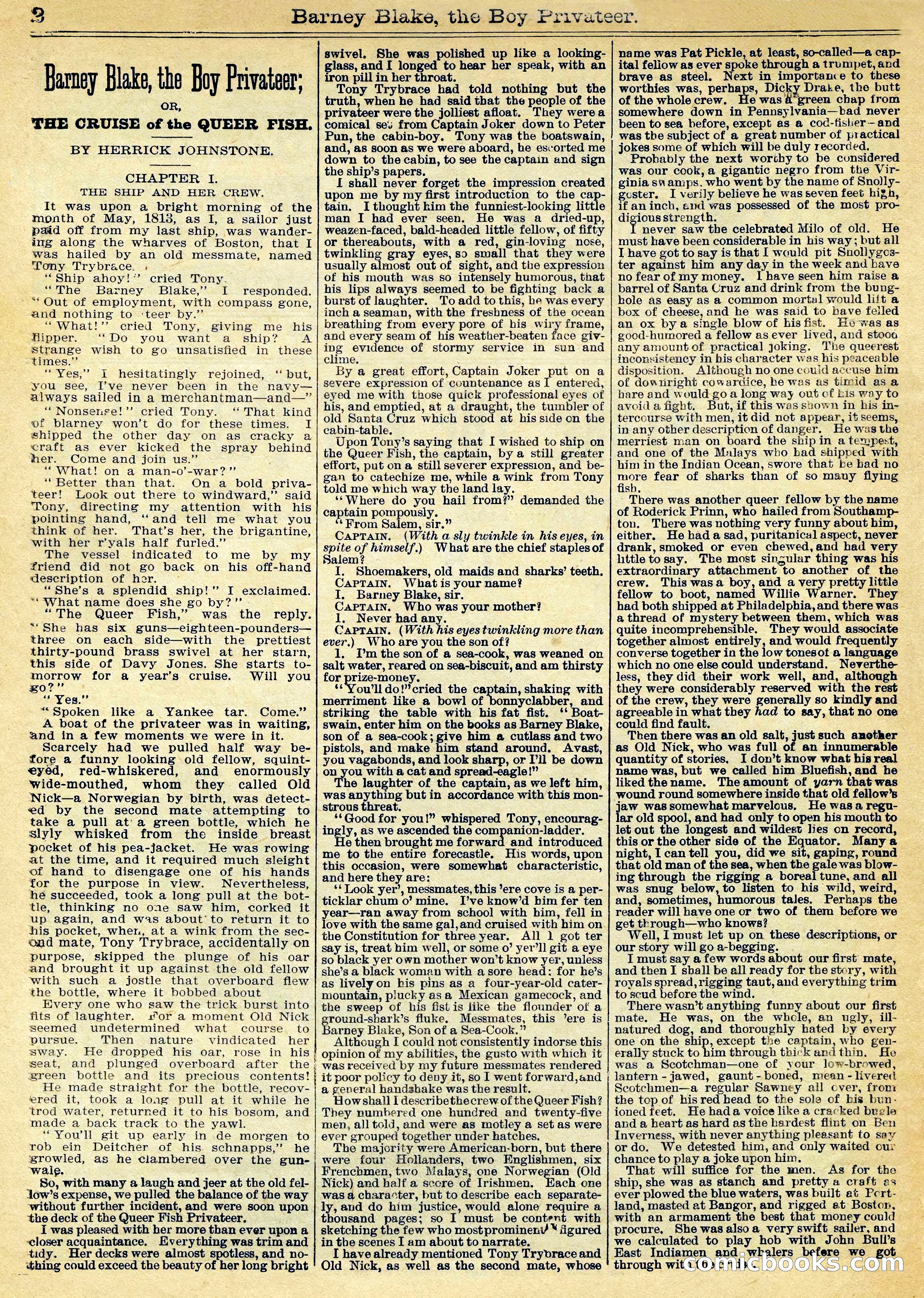
A restored page from Penny Dreadfuls, 1897. Page through the whole issue in the reader above.
📄 Transcribed text from this page (OCR, searchable)
Machine-transcribed from the original scan — historical spelling and the odd misread are preserved.
pt i Barney Blake, the Boy Privateer THE CRUISE of the QUEER FISH. BY HERRICK JOHNSTONE. eee See -_ CHAPTER I. THE SHIP AND HER CREW. It was upon a bright morning of the month of May, 1813, as I, a sailor just paid off from my last ship, was wander- ing along the wharves of Boston, that I was hailed by an old messmate, named Tony Trybrace. . “Ship ahoy!’*’ cried Tony. “The Barney Blake,’’ I responded. ~ ** Out of employment, with compass gone, and nothing to ‘teer by.” “What!” eried Tony, giving me his Aiipper. 20> You: want a ship? A Strange wish to go unsatisfied in these times.” “Yes,” I hesitatingly rejoined, ‘ but, you see, I’ve never been in the navy— always sailed in a merchantman—and—” **Nonsense!’’ cried Tony. ‘‘ That kind of blarney won’t do for these times. I shipped the other day on as cracky a craft as ever kicked the spray behind her. Come and join us.” “What! on a man-o’-war?”’ ‘Better than that. On a bold priva- teer! Look out there to windward,’’ said Tony, directing my attention with his pointing hand, ‘‘and tell me what you think of her. That’s her, the brigantine, with her r’yals half furled.”’ The vessel indicated to me by my friend did not go back on his off-hand deseription of her. : ‘““She’s a splendid ship!” I exclaimed. “What name does she go by?” “The Queer Fish,” was the reply. ““She has six guns—eighteen-pounders— three on each side—with the prettiest thirty-pound brass swivel at her starn, this side of Davy Jones. She starts to- morrow for a year’s cruise. Will you 0?” ‘* Yes.’ “Spoken like a Yankee tar. Come.’ A boat of the privateer was in waiting, and in a few moments we were in it. Searcely had we pulled half way be- fore a funny looking old fellow, squint- eyed, red-whiskered, and enormously wide-mouthed, whom they called Old Nick—a Norwegian by birth, was detect- ed by the second mate attempting to take a pull at'a green bottle, which he Slyly whisked from the inside breast pocket of his pea-jacket. He was rowing at the time, and it required much sleight of hand to disengage one of his hands for the purpose in view. Nevertheless, he succeeded, took a long pull at the bot- tle, thinking no one saw him, corked it up again, and ws about’ to return it to his pocket, when, at a wink from the sec- ond mate, Tony Trybrace, accidentally on purpose, skipped the plunge of his oar and brought it up against the old fellow with such a jostle that overboard flew the bottle, where it bobbed about Every one who saw the trick burst into fits of laughter. sor a moment Old Nick seemed undetermined what course to pursue. Then nature vindicated her sway. seat, green bottle and its precious contents! He made straight for the bottle, recov- ered it, took a long pull at it while he trod water, returned it to his bosom, and made a back track to the yawl. “You'll git up early in de morgen to rob ein Deitcher of his schnapps,’’ he growled, as he clambered over the gun- waie. So, with many a laugh and jeer at the old fel- low’s expense, we pulled the balance of the way without further incident, and were soon upon the deck of the Queer Fish Privateer. I was pleased with her more than ever upon a ‘closer acquaintance, Everything was trim and tidy. Her decks were almost spotless, and no- wthing could exceed the beauty of her long bright arney Blake, the Boy P He dropped his oar, rose in his! and plunged overboard after the} aoe a eee swivel. She was polished up like a looking- glass, and [I longed to hear ber speak, with an iron pill in her throat. Tony Trybrace had told nothing but the truth, when he had said that the people of the privateer were the jolliest afloat. They werea comical se from Captain Joker down to Peter Pun, the cabin-boy. Tony was the boatswain, and, as soon as we were aboard, he escorted me down to the cabin, to see the captain and sign the ship’s papers. I shall never forget the impression created upon me by my first introduction to the cap- tain. I thought kim the funniest-looking little man I had ever seen. He was a dried-up, weazen-faced, bald-headed little fellow, of fifty or thereabouts, with a red, gin-loving nose, twinkling gray eyes,so small that they were usually almost out of sight, and the expression of his mouth was so intensely humorous, that his lips always seemed to be fighting back a burst of laughter. To add to this, he was every inch a seaman, with the freshness of the ocean breathing from every pore of his wiry frame, and every seam of his weather-beaten face giv- ing evidence of stormy service in sun and clime. By a great effort, Captain Joker put on a severe expression of countenance as I entered, eyed me with those quick professional eyes of his, and emptied, at a draught, the tumbler of old Santa Cruz which stood at his side on the cabin-table. Upon Tony’s saying that I wished to ship on the Queer Fish, the captain, by a still greater effort, put on a still severer expression, and be- gan to catechize me, while a wink from Tony told me which way the land lay. ‘‘Where do you hail from?” demanded the captain pompously. ‘¢ From Salem, sir.” CAPTAIN. (With a sly twinkle in his eyes, in spite of himself.) What are the chief staples of Salem? I. Shoemakers, old maids and sharks’ teeth. CAPTAIN. Whatis your name? I, Barney Blake, sir. CAPTAIN. Who was your mother? I. Never hadany. | Captain. (With his eyestwinkling more than ever.) Who are you the son of? 1. I’m the son of a sea-cook, was weaned on salt water, reared on sea-biscuit, and am thirsty for prize-money. **'You’ll do!” cried the cone, shaking with merriment like a bowl of bonnyclabber, and striking the table with his fat fist. ‘* Boat- swain, enter him on the books as Barney Blake, son of a sea-cook; give him a cutlass and two pistols, and make him stand around. Avast, you vagabonds, and look sharp, or Tl be down on you with a cat and spread-eagle!” he laughter of the captain, as we left him, was anything but in accordance with this mon- strous threat. ‘*Good for you!” whispered Tony, encourag- ingly, as we ascended the companion-ladder. He then brought me forward and introduced me to the entire forecastle. His words, upon this occasion, were somewhat characteristic, and here they are: ‘* Look yer’, messmates, this ’ere cove is a per- ticklar chum o’ mine. I’ve know’d bim fer ten year—ran away from school with him, fell in love with the same gal,and cruised with him on the Constitution for three year. All 1 got ter say is, treat him well, or some 0’ yer’ll git a eye so black yer own mother won’t know yer, unless she’s a black woman with a sore head: for he’s as livelyon his pins as a four-year-old cater- mountain, plucky asa Mexican gamecock, and the sweep of his fist is like the flounder of a eround-shark’s fluke. Messmates, this ’ere is Barney Blake, Son of a Sea-Cook,” Although I could not consistently indorse this opinion of my abilities, the gusto with which it was received by my future messmates rendered it poor policy to devy it, so I went forward,and a general handshake was the result. Howshall I describethecrew of the Queer Fish? They numbered one hundred and twenty-five men, all told, and were as motley a set as were ever grouped together under hatches. The majority were American-born, but there were four Hollanders, two Englishmen, six Frenchmen, two Malays, one Norwegian (Old Nick) and half a score of Irishmen. Each one was @ character, but to describe each separate- ly, and do him justice, would alone require a thousand pages; so I must be content with sketching the few who most prominenv * figured in the scenes I am about to narrate, I have already mentioned Tony Tryvrace and Old Nick, as well as the second mate, whose rivateer. name was Pat Pickle, at. least, so-called—a cap- ital feliow as ever spoke through a trumpet, and brave as steel. Next in importance to these worthies was, perhaps, Dicky Drake, the butt of the whole crew. He was ie chap from somewhere down in Pennsylvania—bad never been to sea before, except as a coc-fisher-—and was the subject of a great number of practical jokes some of which will be duly recorded. Probably the next worchy to be considered was our cook,a gigantic negro from the Vir- ginia swamps. who went by the name of Snolly- gester. I verily believe he was seven feet hiz,h, if an inch, end was possessed of the most pro- digious strength. t never saw the celebrated Milo of old. He must have been considerable in his way; but all I have got to say is that I would pit Snollyges- ter against him any day in the week and have no fear of my money. Ihave seen him raise a barrel of Santa Cruz and drink from the bung- hole as easy as a common mortal would lift a box of cheese, and he was said to have feiled an ox bya single blow of his fist. Ho-was as good-humored a fellow as ever lived, and stooa any amount of practical joking. The queerest inconsistency in bis character was his peaceable disposition. Although no one could accuse him of downright cowardice, he was as timid as a hare and would goa long way ovt cf kis way to avoid a fight. But, if this was shown in his in- tercourse with men, it did net appear, it seems, in any other description of danger. He was the merriest man on board the ship in a tempest, and one of the Malays who kad shipped with him in the Indian Ocean, swore that ke had no more fear of sharks than of so many flying fish. ’ There was another queer fellow by the name of Roderick Prinn, who hailed from Southamp- ton. There was nothing very funny about him, either. He hada sad, puritanical aspect, never drank, smoked or even chewed, and had very httle tosay. The most singular thing was his extraordinary attachment to another of the crew. This wasa boy, and a very pretty little fellow to boot, named Willie Warner. They had both shipped at Philadelphia, and there was - a thread of mystery between them, which was quite incomprehensible. They would associate together almost entirely, and would frequently converse together in the low tonesot a language which no one else could understand. Neverthe- less, they did their work well, and, although they were considerably reserved with the rest of the crew, they were generally so kindly and agreeable in what they had to say, that no one could find fault. Then there was an old salt, just such another as Old Nick, who was full of an innumerable quantity of stories, I don’t know what his real name was, but we called him Bluefish, and he liked the name. The amount of yarn that was wound round somewhere inside that old fellow'’s jaw was somewhat marvelous, He wasa regu- lar old spool, and had only to open his mouth to let out the longest and wildest lies on record, this or the other side of the Equator. Manya night, I can tell you, did we sit, gaping, round that old man of the sea, when the gale was blow- ing through the rigging a boreal tune, and all was snug below, to listen to his wild, weird, and, sometimes, humorous tales. Perhaps the reader will have one or two of them before we get through—who knows? Well, I must let up on these descriptions, or our story will go a-begging. I must say a few words about our first’ mate, and then I shall be all ready for the stery, with royals spread, rigging taut, and everything trim to scud before the wind. There wasn’t anything funny about our first mate, He was, on the whole, an ugly, ill- natured dog, and thoroughly hated by every one on the ship, except tke captain, who gen- erally stuck to him through thick and thin. He was a Scotchman—one of your low-browed, | lantern - jawed, gaunt- boned, mean -livered Scotchmen—a regular Sawney all cver, front the top of his red head to the sole of his bun- ioned feet. He hada voice like a cracked buvle and a heart as hard as the hardest flint on Ben Inverness, with never anything pleasant to say or do. We detested him, and cnly waited cur chance to play a joke upon him. That will suffice for the men. As for the ship, she was as stanch and pretty a craft as ever plowed the blue waters, was built at Pcrt- land, masted at Bangor, and rigged et Boston, with an armament the best that money could procure, She was alsoa very swift sailer, and we calculated to play hob with John Bull’s East Indiamen and ere we er tt through wit tOvenine oO) conn) eA