
Penny Dreadfuls, 1877 · page 3 of 16
Beadle's Half Dime Library — page 3: what you’re looking at
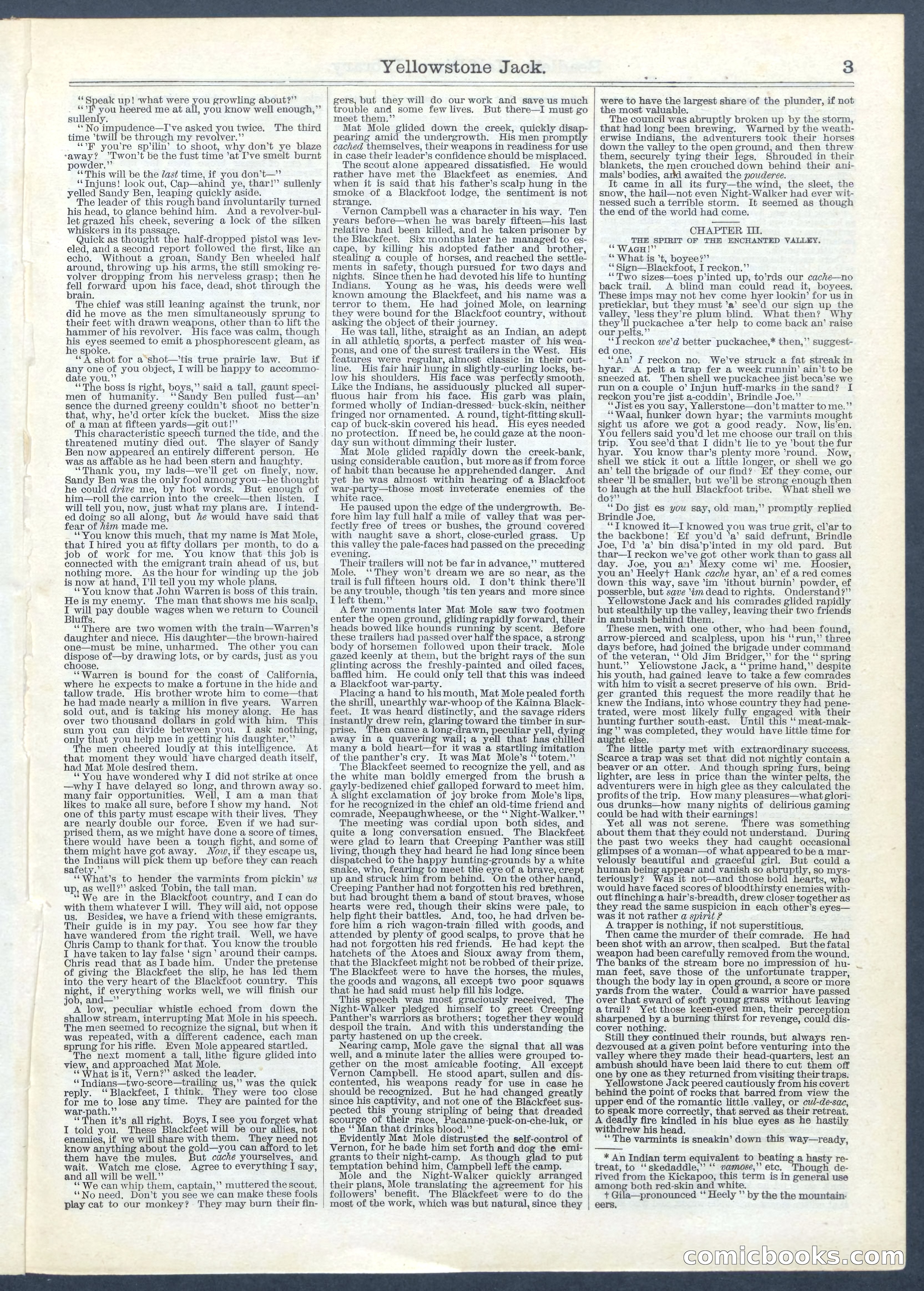
A restored page from Penny Dreadfuls, 1877. Page through the whole issue in the reader above.
📄 Transcribed text from this page (OCR, searchable)
Machine-transcribed from the original scan — historical spelling and the odd misread are preserved.
Yellowstone Jack. 3 .-. ou growling about?” you know well enough,”’ The third “Speak up! what were o P ou heered me at a sullenly. “No ae ee asked you twice. time ° be through my revolver.” ‘OW you're sp'ilin’ to shoot, why don’t ye blaze saway? °~Twon’t be the fust time ’at Pve smelt burnt powder,” “This will be the /ast time, if you don’t—” “Tnjuns! look out, Cap—ahind ye, thar!" sullenly yelled Sandy Ben, leaping quickly aside. The leader of this rough band involuntarily turned his head, to glance behind him. And a revolver-bul- let grazed his cheek, severing a lock of the silken whiskers in its passage. : Quick as thought the half-dropped pistol was lev- eled, and a second report followed the first, like an echo. Without a groan, Sandy Ben wheeled half around, throwing up his arms, the still smoking re- volver ie da from his nerveless grasp; then he a ag upon his face, dead, shot through the br The chief was still leaning against the trunk, nor did he move as the men simultaneously sprung to their feet with drawn weapons, other than to lift the hammer of his revolver. is face was calm, though his eyes seemed to emit a phosphorescent gleam, as he spoke. “A shot for a*shot—’tis true prairie law. But if any one of you object, I will be happy to accommo- date you.” “The boss is right, boys,” said a t aunt speci- men of REMbAley. nm sani Ben ed fust—an’ sence the durned greeny couldn’t shoot no better’n that, why, he'd orter kick the bucket. Miss the size of a man at fifteen yards—git out!” This characteristic speech turned the tide, and the threatened mutiny died out. The slayer of Sandy Ben now appeared an entirely different person. He was as affable as he had been stern and oa eats “Thank you, my lads—we'll get vn fine iy now. Sandy Ben was the only fool among you-—he thought he could drive me, by hot words. But enough of him—roll the carrion into the creek—then listen. I will tell you, now, just what my plans are. I intend- ed doing so all along, but he would have said that fear of fem made me. “You know this much, that my name is Mat Mole, that I hired you at fifty dollars per month, to do a job of work for me. You know that this job is connected with the emigrant train ahead of us, but nothing more. As the hour for winding up the job is now at hand, I'll tell you my whole plans, “You know that John Warren is boss of this train. He is my enemy. The man that shows me his scalp I will pay double wages when we return to Counci Bluffs. “There are two women with the traln—Warren’s daughter and niece. His daughter—the brown-haired one—must be mine, unharmed. The other you can dispose of—by drawing lots, or by cards, just as you choose. ‘‘Warren is bound for the coast of California where he expects to make a fortune in the hide and tallow trade. His brother wrote him to come—that he had made nearly a million in flve years. Warren sold out, and is Tak his money along. He has over two thousand dollars in gold with him. This sum you can divide between you. I ask nothing, onl that you help me in getting his daughter.” he men cheered loudly at this intelligence. that moment they would have charged death itself, had Mat Mole desired them. “You have wondered why I did not strike at once —why I have delayed so lon many fair opportunities. Well, I am a man that likes to make all sure, before I show my hand. Not one of this ey must escape with their lives. They are nearly double our force, Even if we had sur- prised them, as we might have done a score of times there would have been a tough pes and some o them might have got away. Vow,if they escape us, a Indians will pick them up before they can reach safety.’ ind at’s to hender the varmints from pickin’ us up, as well?” asked Tobin, the tall man. ‘We are in the Blackfoot country, and I can do with them whatever I will. They will aid, not oppose us, Besides, we have a friend with these emigrants. Their guide is in my pay. You see how far they have wandered from the right trail. Well, we have Chris Camp to thank for that. You know the trouble I have taken to lay false ‘sign’ around their camps. Chris read that as I bade Under the pretense of giving the Blackfeet the slip, he has led them into the very heart of the Blackfoot country, This night, q everything works well, we will finish our ob, and—’ y A low, peculiar whistle echoed from down the shallow stream, interrupting Mat Mole in his speech. The men seemed to recognize the signal, but when it was repeated, with a erent cadence, each man sprung for his rifle. Even Mole appeared startled, The next moment a tall, lithe figure glided into view, and approached Mat Mole. “What isit, Vern?” asked the leader. “ Indians—two-score—tr us,’ was the quick reply. ‘Blackfeet, I think. They were too close for me to lose any time. They are painted for the war-path.” “Then it’s allright. Boys, Isee you cif what I told you. These Blackfeet will be our allies, not enemies, if we will share with them. The need not know anything about the gold—you can afford to let them have the mules. ut cache yourselves, and wait. Watch me close. Agree to everything { say, and all will be well.” “We can whip them, captain,’ muttered the scout, “No need, Don’t you see we can make these fools play cat to our monkey? They may burn their fin- | and thrown away so. At | | Like the Indians, he assiduousl | fectly free of trees or bushes, the gers, but they will do our work and save us much trouble and some few lives. But there—I must go meet them.” Mat Mole glided down the creek, quickly disap- pearing amid the undergrowth. His men promptly cached themselves, their weapons in readiness for use in case their leader’s confidence should be misplaced. The scout alone appeared dissatisfied. He would rather have met the Blackfeet as enemies, And when it is said that his father’s scalp hung in the smoke of a Blackfoot lodge, the sentiment is not strange. Vernon Campbell was a character in his way. Ten years before—when he was barely fifteen—his last relative had been killed, and he taken prisoner by the Blackfeet, Six months later he Imanaged to es- cape, by Fee his adopted father and_ brother, 8 ’ stealing a couple of horses, and reached the settle- ments in safety, though pursued for two days and nights. Since then he had devoted his life to huntin Indians. Young as he was, his deeds were we known amoung the Blackfeet, and his name was a terror to them. He had joined Mole, on learning they were bound for the Blackfoot country, without asking the object of their journey. He was tall, lithe, straight as an Indian, an adept in all athletia sports, a perfect master of his wea- pons, and one of the surest trailers in the West. His features were regular, almost classic in their out- line. His fair hair hung in slightly-curling locks, be- low his shoulders. His face was perfectly smooth, plucked all super- fluous hair from his face. is garb was plain, formed wholly of Indian-dressed-buck-skin, neither fringed nor ornamented. A round, tight-fitting sIcull- cap of buck-skin covered his head. ig eyes needed no protection. Ifneed be, he could gaze at the noon- day sun without dimming their luster. at Mole glided rapidly down the creek-bank, using considerable caution, but more asif from force of habit than because he apprehended danger. And yet he was almost within hearing of a Blackfoot war-party—those most inveterate enemies of the white race, He paused upon the edge of the undergrowth. Be- fore him lay full half a mile of valley that was per- ound covered with naught save a short, close-curled grass. Up this valley the pale-faces had passed on the preceding evening. Their trailers will not be far in advance,’’ muttered Mole. ‘'They won’t dream we are so near, as the trail is full fifteen hours old. I don't think there'll be any trouble, though ‘tis ten years and more since TI left them.” A few moments later Mat Mole saw two footmen enter the open ground, gliding rapidly forward, their heads bowed like hounds running by scent. Before these trailers had passed over the space, astrong body of horsemen followed upon their track, Mole gazed keenly at them, but the bright rays of the sun glinting across the freshly-painted and oiled faces baffled him. He could only tell that this was indee | a Blackfoot war-party. Placing a hand to his mouth, Mat Mole pealed forth the shrill, unearthly war-whoop of the Kainna Black- feet, It was heard distinctly, and the savage riders instantly drew rein, a toward the timber in sur- prise. en came a long-drawn, prem ell, dyin away in a quavering wail; a y that in chilled many a bold heart—for it was a startling imitation of the panther’s cry. It was Mat Mole’s ‘‘ totem.” The Blackfeet seemed to recognize the yell, and as the white man boldly emerged from the brush a gayly-bedizened chief galloped forward to meet him, A slight exclamation of Joy broke from Mole’s lips for he recognized in the chief an old-time friend an comrade, Neepaughwheese, or the ‘' Night-Walker.,"’ The meeting was cordial upon both sides, and quite a long conversation ensued. The Blackfeet were glad to learn that Creeping Panther was still living, though they had heard he had long since been ispatched to the happy hunting-grounds by a white snake, who, fearing to meet the eye of a brave, crept up and struck him from behind. On the other hand, reeping Panther had not re his red brethren, but had brought them a band of stout braves, whose hearts were red, though their skins were pale, to help fight their battles, And, too, he had driven be- fore him a rich wagon-train filled with goods, and attended by plenty of good scalps, to prove that he had not forgotten his red friends. He had kept the hatchets of the Atoes and Sioux away from them, that the Blackfeet might not be robbed of their prize. The Blackfeet were to have the horses, the mules, the goods and wagons, all ae two poor squaws that he had said must help fill lodge. This Easy was most graciously recelved. The Night-Walker pledged himself to greet Creepin Panther’s warriors as brothers; together the woul despoil the train. And with this understanding the hastened on up the creek. Nearing camp, Mole gave the signal that all was well, and a minute later the allies were grouped to- gether on the most amicable foo ._ All except Vernon Campbell. He stood apart, sullen and dis- contented, bie aa ready for use in case he should be recognized. But he had changed greatly since his captivity, and not one of the Blackfeet sus- pected this young stripling of being that dreaded scourge of their race, Pacanne-puck-on-che-luk, or the ‘Man that drinks blood.” Evidently Mat Mole distrusted the self-control of Vernon, for he bade him set forth and dog the emi- grants to eh aS As though g to put temptation behin ampbell left the camp. Mole and the Night-Walker quickly ria their plans, Mole translating the agreement for his followers’ benefit. The Blackfeet were to do the most of the work, which was but natural, since they | to laugh at the hull Blackfoot tribe. were to have the largest share of the plunder, if not the most valuable. The council was abruptly broken up by the storm, that had long been brewing, Warned by the weath- erwise Indians, the adventurers took their horses down the valley to the open ground, and then threw them, securely tying their re hrouded in their blankets, the men crouched down behind their ani- mals’ bodies, and awaited the pouderee. It came in all its —the wind, the sleet, the snow, the hail—not even Night-Walker had ever wit- nessed such a terrible storm. It seemed as though the end of the world had come, CHAPTER Ii, THE SPIRIT OF THH ENCHANTED VALLEY. “WaAGH!”? “What is *t, boyee?”’ “ Sign—Blackfoot, I reckon.” “Two sizes—toes p’inted up, to'rds our cache—no back trail, A blind man could read it, boyees. These imps may not hev come hyer lookin’ for us in preticklar, but they must ’a’ see’d our sign up the valley, ‘less they’re plum blind. What then? Why they'll uckachee a’ter help to come back an’ raise our pelts.” * reckon we'd better puckachee,* then,”’ suggest- ed one, ‘An’ J reckon no. We've struck a fat streak in hyar. A pelt a trap fer a week runnin’ ain’t to be sneezed at. Then shell we puckachee jist beca’se we run ona couple o’ Injun huff-marks in the sand? I reckon you're jist a-coddin’, Brindle Joe,” “ Jistes you say, Yallerstone—don’t matter to me.”’ “Waal, hunker down hyar; the varmints mought sight us afore we got a good ready. Now, lis’en. You fellers said you'd let me choose our trail on this trip. You see’d that I didn’t lie to ye ‘bout the fur lhyar. You know thar’s plenty more ’round. Now, shell we stick it out a little jong or shell we go an’ tell the brigade of our find? Ef they come, our sheer ‘Il be smaller, but we’ll be strong enough then at shell we do?” “Do jist es you say, old man,” promptly replied Brindle Joe. ““T knowed it—I knowed you was true grit, cl’ar to the backbone! Ef you'd ’a’ said defrunt, Brindle Joe, Pd ’a’ bin disa'p'inted in my old pard. But thar—I reckon we’ve got other work than to gass all day. Joe gos an’ Mexy come wi’ me. oosier, you an’ Hee yt Hank cache hyar, an’ ef a red comes down this way, save ‘im ‘ithout burnin’ powder, ef posserble, but save im dead to rights. On erstand?” Yellowstone Jack and his comrades glided rapi but stealthily up the valley, leaving their two frien in ambush behind them. These men, with one other, who had been found, arrow-pierced and scalpless, upon his “run,” three days before, had joined the brigade under command of the veteran, ‘‘Old Jim Bridger,” for the ‘“ spring hunt.’ Yeliowstone Jack, a ‘prime hand,” despite his bY a had gained leave to take a few comrades with him to visit a secret preserve of his own. Brid- er granted this request the more readily that he ew the Indians, into whose country they had pene- trated, were most likely iy 2 lenge with their hunting further south-east. Until this '‘ meat-mak- ing’ was completed, they would have little time for caget else. he little party met with extraordinary success, Scarce a trap was set that did not nightly contain a beaver or an otter. And though spring furs, being lighter, are less in price than the winter pelts, the venturers were in high glee as they calc ated the profits of the trip. How many pleasures—what glori- ous dr —how many nights of delirious gaming could be had with their earni | Yet all was not serene, here was something about them that they could not understand. Durin the past two weeks they had caught occasion glimpses of a woman—of what eg tobe a mar- velously beauti and graceful girl. But could a human cig pgp and vanish so abruptly, so mys- teriously? as it not—and those bold hearts, who would have faced scores of bloodthirsty enemies with- out flinching a hair’s-breadth, drew closer together as they read the same icion in each other’s eyes— was it not rather a spinzt ? A trapper is nothing, if not superstitious. Then came the murder of their comrade. He had been shot with an arrow, then scalped. But the fatal wee on had been carefully removed from the wound, e man feet, save those of the unfortunate trapper, though the body lay in open ground, a score or more yards from the water. Coul a watTior have passed over that sward of soft Masato d grass without leaving a trail? Yet those keen-eyed men, their perception sharpened by a burning thirst for revenge, could dis- cover nothing. : Still they continued their rounds, but always ren- dezvoused at a given point before venturing into the valley where they made their head-quarters, lest an ambush should have been laid there to cut them off one by one as they returned from visiting their traps. Yellowstone Jack peered cautiously from his covert behind the point of rocks that barred from view the upper end of the romantic little valley, or cw-de-sac, to speak more correctly, that served as their retreat. A deadly fire kindled in his blue eyes as he hastily withdrew his head, “The varmints is sneakin’ down this way—ready, * An Indian term equivalent to beating a hasty re- treat, to ‘‘skedaddle,”’ ‘‘ vamose,’ etc. Though de- rived from the Kickapoo, this term is in general use among both red-skin and white. + Gila—pronounced ‘' Heely "’ by the the mountain. eers. anks of the stream bore no impression of hu- . MICLOOOLS (G(0) (E(0)