
Penny Dreadfuls, 1877 · page 2 of 16
Beadle's Half Dime Library — page 2: what you’re looking at
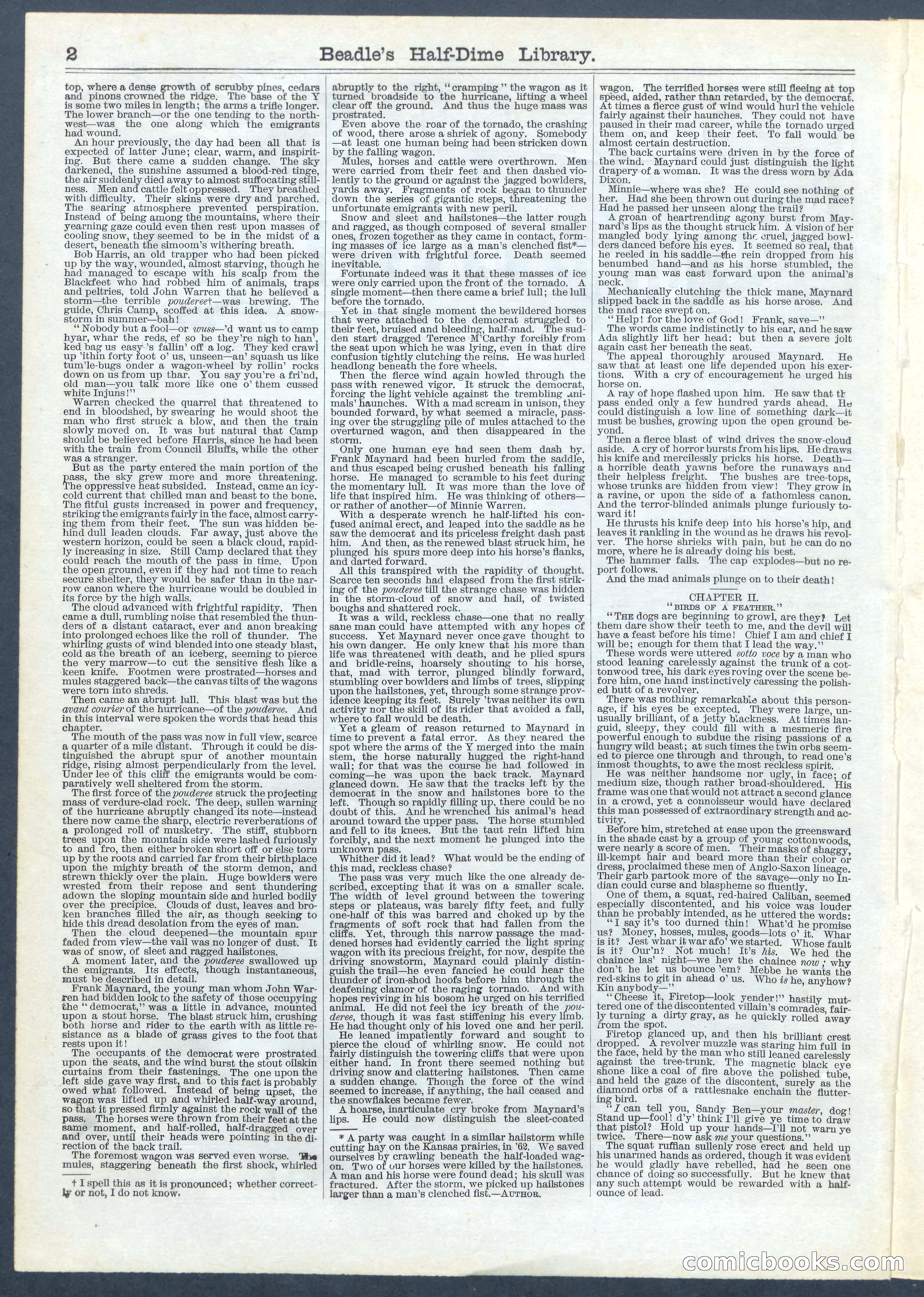
A restored page from Penny Dreadfuls, 1877. Page through the whole issue in the reader above.
📄 Transcribed text from this page (OCR, searchable)
Machine-transcribed from the original scan — historical spelling and the odd misread are preserved.
2 Beadle’s Half-Dime Library. top, where a dense | ip ge of scrubby pines, cedars and pinons crowned the ridge, The base of the Y is some two milesin length; the arms a trifle longer. The lower branch—or the one tending to the north- west—was_ the one along which the emigrants had wound, An hour previously, the day had been all that is expected of latter June; clear, warm, and inspirit- ing. But there came a sudden change. The sky darkened, the sunshine assumed a blood-red tinge, the air suddenly died away to almost suffocating - ness. Men and cattle felt oppressed. They breathed with difficulty. Their skins were and parched, The re atmosphere prevented perspiration. Instead of being among the mountains, where their yearning gaze could even then rest upon masses of cooling snow, they seemed to be in the midst of a desert, beneath the simoom’s ve breath. Bob ‘Harris, an old trapper who had been picked up by the way, wounded, almost starving, though he had managed to escape with his scalp from the Blackfeet who had robbed him of animals, traps and peltries, told John Warren that he believed a storm—the terrible poudereet—was brewing. The guide, Chris Camp, scoffed at this idea, A snow- storm in summer—bah} “ Nobody but a fool—or wuss—d want us to camp hyar, whar the reds, ef so be they’re nigh to han’ ked bag us easy~’s fallin’ off alog. They ked crawl up ‘ithin forty foot o’ us, unseen—an’ squash us like tum'le-bugs onder a wagon-wheel by rollin’ rocks down on us from up thar. You say you're a fri’nd old man—you talk more like one o’ them cussed white Injuns!”’ Warren checked the quarrel that threatened to end in bloodshed, by swearing he would shoot the man who first struck a blow, and then the train slowly moved on. It was but natural that Camp should be believed before Harris, since he had been with the train from Council Bluffs, while the other was a stranger. But as the party entered the main portion of the Rae the sky and more and more threatening. 6 oppressive heat subsided. Instead, came an icy- cold current that chilled man and beast to the bone. The fitful gusts increased in power and frequency, striking the emigrants fairly in the face, almost carry- ing them from their feet. The sun was hidden be- hind dull leaden clouds. Far away, just above the western horizon, could be seen a black cloud, rapid- ly increasing in size. Still Camp declared that they could reach the mouth of the pass in time. Upon the open ground, even if they had not time to reach secure shelter, they would be safer than in the nar- row canon where the hurricane would be doubled in its force by the high walls, The cloud advanced with frightful rapidi Then eame a dull, rumbling noise that resembled the thun- ders of a distant cataract, ever and anon breaking into prolonged echoes like the roll of thunder, The whirl € gusts of wind blended into one steady blast, cold as the breath of an iceberg, seeming to pierce the very marrow—to cut the sensitive dich Ties a keen knife, Footmen were prostrated—horses and mules staggered back—the canvas tilts of the wagons were torn into shreds. si Then came an abrupt lull. This blast was but the avant courier of the hurricane—of the pouderee. And in this interval were spoken the words that head this a eee e mouth of the } ae was now in full view, scarce a quarter of a mile ant. Through it could be dis- tinguished the abrupt spur of another mountain ridge, rising almost ete trai from the level. Under lee of this cliff the emigrants would be com- paratively well sheltered from the storm. The first force of the pouderee struck the projecting mass of verdure-clad rock. The deep, sullen wa. of the hurricane abruptly changed its note—in there now came the sharp, electric reverberations of a prolonged roll of musketry. The stiff, stubborn trees upon the mountain side were lashed furiously to and fro, then either broken short off or else torn up by the roots and carried far from their birthplace be the mighty breath of the storm demon, and strewn thickly over the plain. Huge bowlders were wrested from their repose and sent thundering adown. the sloping mountain side and hurled bodily over the precipice. Clouds of dust, leaves and bro- ken branches filled the air, as though seeking to hide this dread desolation from the eyes of man. Then the cloud deepened—the mountain spur faded from view—the vail was no longer of dust. It was of snow, of sleet and ragged fieaieC otic A moment later, and the pouderee swallowed up the emigrants. Its effects, though instantaneous, must be described in detail. Frank Maynard, the young man whom John War- ren had bidden look to the safety of those oceupyin the ‘‘ democrat,” was a little in advance, mounte upon a stout horse. The blast struck him, crushing both horse and rider to the earth with as little re- sistance as a blade of grass gives to the foot that rests upon it! The occupants, of the democrat were prostrated upon the seats, and the wind burst the stout oilskin curtains from their fastenings. The one upon the left side gave way first, and-_to this fact is probably owed what followed, ead of being upset, the wagon was lifted up and whitled half-way around, so that it pressed firmly against the rock wall of the pass. The horses were thrown from their feet at the same moment, and half-rolled, half-dragged over and over, until their heads were pointing in the di- rection of the back trail. The foremost wagon was served even worse, ‘The mules, staggering beneath the first shock, whirled +t I spell this as it is pronounced; whether correct- ly or not, I do not know. abruptly to the right, ‘‘cramping"’ the wagon as it turned broadside to the hurricane, lifting a wheel clear off the ground, And thus the huge mass was prostrated. Even above the roar of the tornado, the crashing of wood, there arose a shriek of agony. Somebody —at least one human being had been stricken down by the falling wagon. Mules, horses and cattle were overthrown. Men were carried from their feet and then dashed vio- lently to the ground or against the jagged bowlders, yards away. Fragments of rock began to thunder down the series of gigantic steps, threatening the unfortunate emigrants with new peril. Snow and sleet and hailstones—the latter rough and ragged, as though composed of several smaller ones, frozen together as they came in contact, form- ing masses of ice large as a man’s clenched fist*— were driven with frightful foree. Death seemed inevitable. Fortunate indeed was it that. these masses of ice were only carried upon the front of the tornado, A single moment—then there came a brief lull; the lull before the tornado. Yet in that single moment the bewildered horses that were attached to the democrat Ghee to their feet, bruised and bleeding, half-mad. e sud- den start ey Terence M’Carthy forcibly from the seat upon which he was lying, even in that dire confusion tightly clutching the reins. He was hurled headlong beneath the fore wheels, Then the flerce wind again howled through the ass with renewed vigor. It struck the democrat, orcing the light vehicle against the trembling ani- mals’ haunches. With a mad scream in unison, they bounded forward, by what seemed a miracle, pass- ing over the strugghng pile of mules attached to the overturned wagon, and then disappeared in the storm, Only one human eye had seen them dash by. Frank Maynard had been hurled from the saddle, and thus escaped being crushed beneath his falling horse. He managed to scramble to his feet during the momentary | It was more than the love of life that inspired him. He was thinking of others— or rather of another—of Minnie Warren. With a desperate wrench he half-lifted his con- fused animal erect, and leaped into the saddle as he saw the democrat and its priceless freight dash past him, And then, as the renewed blast struck him, he Nes ibe his spurs more deep into his horse’s flanks, and darted forward. All this transpired with the rapidity of thought. Scarce ten seconds had elapsed from the first strik- ing of the pouderee till the strange chase was hidden in the storm-cloud of snow and hail, of twisted boughs and shattered rock. It was a wild, reckless chase—one that no really sane man could have attempted with any hopes of success. Yet Maynard never once.gave thought to his own danger. He only knew that his more than life was threatened with death, and he plied spurs and bridle-reins, hoarsely shouting to his horse, that, mad with terror, plunged blindly forward, stumbling over bowlders and limbs of trees, slipping on the hailstones, yet, through some strange prov- idence keeping its feet. Surely ’twas neither its own activity nor the skill of its rider that avoided a fall, where to fall would be death. Yet a gleam of reason returned to Maynard in time to prevent a fatal error. As they neared the spot where the arms of the Y merged into the main stem, the horse naturally hugged the right-hand wall; for that was the course he had followed in coming—he was upon the back track. Maynard lanced down. He saw that the tracks left by the ie Sarat in the snow and hailstones bore to the left. Though so rapidly fillin _ there could be no doubt of this. End he wrenched his animal’s head around toward the upper pass. The horse stumbled and fell to its knees. But the taut rein lifted him forcibly, and the next moment he plunged into the unknown pass. ; : Whither did it lead? What would be the ending of this mad, reckless chase? The pass was very much like the one already de- scribed, excepting that it was on a smaller scale. The width of level ground between the towering steps or plateaus, was barely fifty feet, and fully one-half of this was barred and choked up by the fragments of soft rock that had fallen from the cliffs. Yet, through this narrow passage the mad- dened horses had evidently carried the light spring wagon. with its precious freight, for now, despite the driving snowstorm, Maynard could plainly distin- i the trail—he even fancied he could hear the hunder of iron-shod hoofs before him through the deafening clamor of the raging tornado. And with hopes ‘ee oe his bosom he urged on his terrified animal, He did not feel the icy breath of the pow- deree, though it was fast stiffening his every limb, He had thought only of his loved one and her peril. He leaned impatiently forward and sought to ot the cloud of whirling snow. He could not irly distinguish the towering cliffs that were upon either hand. In front there seemed nothing but driving snow and clattering hailstones. Then came a, sudden change. Though the force of the wind seemed to increase, if anything, the hail ceased and the snowflakes became fewer. A hoarse, inarticulate cry broke from Maynard’s lips. He could now distinguish the sleet-coated * A party was caught in a similar hailstorm while cutting hay on the Kansas prairies, in 62, We saved ourselves by crawling beneath the half-loaded wag- on, Two of vur horses were killed by the hailstones. A man and his horse were found dead; his skull was fractured. After the storm, we picked up hailstones larger than a man’s clenched fist.—AurHor, wagon. The terrified horses were still fleeing at to speed, aided, rather than retarded, by the democrat. At times a flerce gust of wind would hurl the vehicle fairly against their haunches. They could not have = in their mad career, while the tornado urged hem on,and keep their feet. To fall would be almost certain destruction. The back curtains were driven in by the force of the wind. Maynard could just distinguish the light cay ofa woman, It was the dress worn by Ada ixon. Minnie—where was she? He could see nothing of her, Had she been thrown out during the mad race? Had he passed her unseen along the trail? A groan of heartrending agony burst from May- nard’s ~+ as the thought struck him. A vision of her mangled body lying among the cruel, jagged bowl- ders danced before his eyes. It seemed go real, that he reeled in his saddle—the rein dropped from his benumbed hand—and as his horse stumbled, the a ag man was cast forward upon the animal's neck. Mechanically clutching the thick mane, Maynard slipped back in the saddle as his horse arose, And the mad race swept on. ‘“‘ Help! for the love of God! Frank, save—" The words came indistinctly to his ear, and he saw Ada slightly lift her head: but then a severe jolt again cast her beneath the seat. The appeal thoroug aroused Maynard. He saw that at least one life depended upon his exer- tions. With a cry of encouragement he urged his horse on. A ray of hope flashed upon him. He saw that tk pass ended Onn. a few hundred yards ahead. Hw could distinguish a low line of something dark—it ae Begs bushes, growing upon the open ground be- you Then a fierce blast of wind drives the snow-cloud aside, Acry of horror bursts from his lips, He draws his knife and mercilessly pricks his horse. Death— a horrible death yawns before the runaways and their helpless freight. The bushes are tree-tops, whose trunks are hidden from view! They grow in a ravine, or upon the side of a fathomless canon. Pegs terror-blinded animals plunge furiously to- war He thrusts his knife deep into his horge’s hip, and leaves it rankling in the wound as he draws his revol- ver. The horse shrieks with pain, but he can do no more, where he is already doing his best, The hammer falls. The cap explodes—but no re- port follows. And the mad animals plunge on to their death! CHAPTER I. “BIRDS OF A FRHATHER,”? “THE dogs are i se to growl, are they? Let them dare show their teeth to me, and the devil wil] have a feast before his time! Chief I am and chief I will be; enough for them that I lead the way.” These words were uttered sotto voce by a man who stood leaning carelessly against the trunk of a cot- tonwood tree, his dark eyes roving over the scene be- fore him, one hand instinctively caressing the polish- ed butt of a revolver. There was nothing remarkabie about this person- age, if his eyes be excepted, They were large, un- usually brilliant, of a jetty biackness. At times lan- guid, sleepy, they could fill with a mesmeric fire poe enough to subdue the rising passions of a ungry wild beast; at such times the twin orbs seem- ed to pierce one through and through, to read one’s inmost thoughts, to awe the most reckless spirit. He was neither handsome nor ugly, in face; of medium size, though rather broad-shouldered, frame was one that would not attract a second glance in a crowd, yet a connoisseur would have declared : gem possessed of extraordinary strength and ac- ivity. Before him, stretched at ease upon the greensward in the shade cast by a group of young rei eati om were nearly a score of men. Their masks of shaggy. ill-kempt hair and beard more than their color or dress, proclaimed these men of Anglo-Saxon lineage. Their garb partook more of the savage—only a dian could curse and blaspheme so fluently, One of them, a squat, red-haired Caliban, seemed especially discontented, and his voice was louder than he probably intended, as he uttered the words: “T say it’s too durned thin! What'd he promise us? Money, hosses, mules, goods—lots o’ it. Whar isit? Jest whar it war afo' we started. Whose fault is it? Our’n? Not much! It’s his. We hed the chaince las’ night—we hev the chaince now ¢ why don’t he let us bounce ’em? Mebbe he wants the red-skins to git in ahead 0’ us. Who is he, anyhow? Her Giese -Firctopslock “Cheese it, Firetop—look yender!” ha tered one of the discontented villain’s ott ate ae ly turning a dirty gray, as he quickly rolled away from the spot. ; Firetop glanced up, and then hig brilliant crest dropped. A revolver muzzle was staring him full in the face, held by the man who still leaned carelessly against the tree-trunk. The magnetic black eye shone like acoal of fire above the polished tube and held the gaze of the discontent, surely as the pape orbs of a rattlesnake enchain thé flutter- g ‘J can tell you, Sandy Ben—your master Stand A ogg ay’ think Pll ae ) that pistol? Hold up your hands—I’ll not warn ye twice. There—now ask me your questions,” The squat ruffian sullenly rose erect and held up his unarmed hands as ordered, though it was evident he would gladly have rebelled, had he geen one chance of doing so successfully. But he knew that any such attempt would be rewarded with a half- ounce of lead. dog! 6 time to draw Elo@O© (SO) CO