
Penny Dreadfuls, 1867 · page 93 of 196
The Skeleton Crew; Or, Wildfire Ned — page 93: what you’re looking at
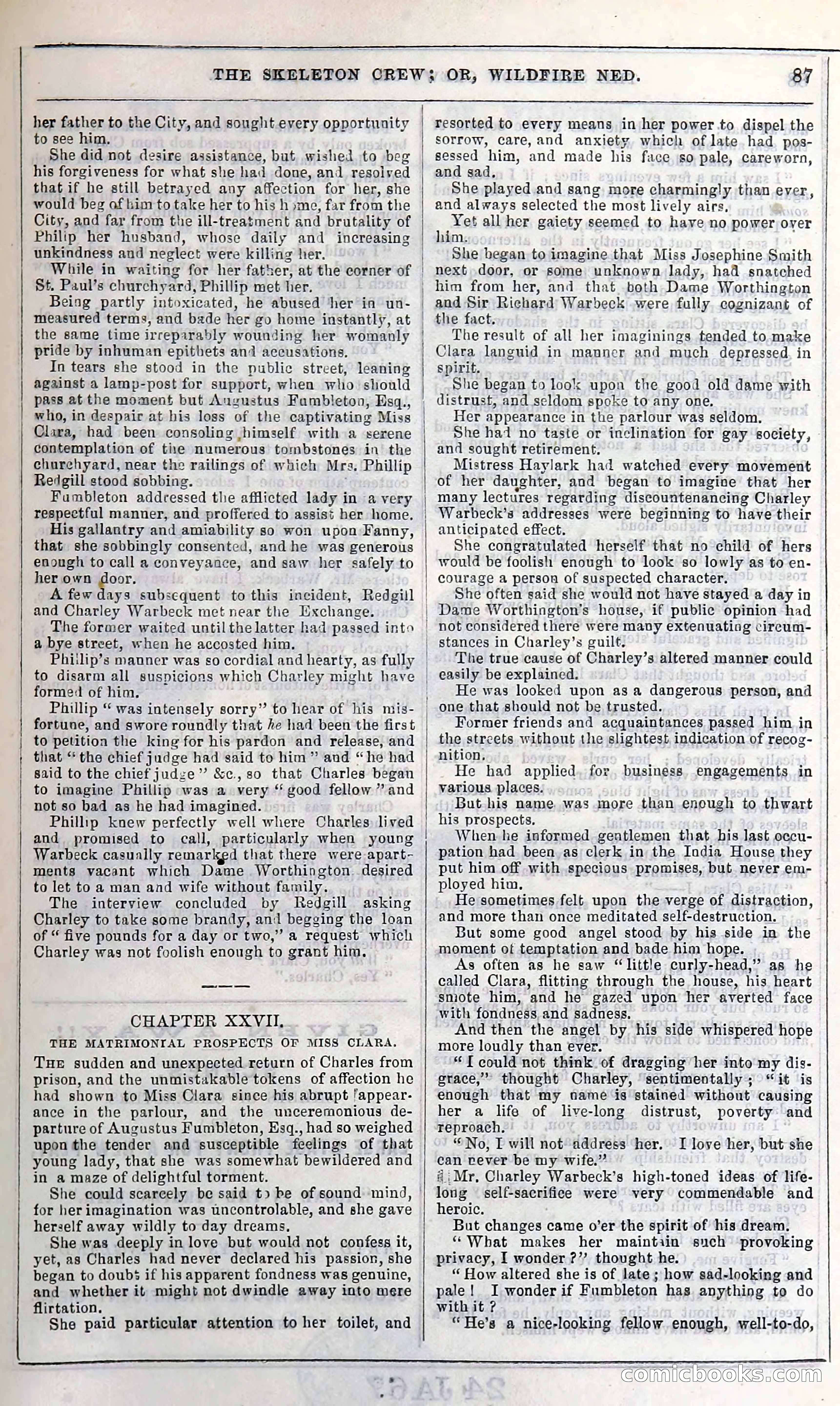
A restored page from Penny Dreadfuls, 1867. Page through the whole issue in the reader above.
📄 Transcribed text from this page (OCR, searchable)
Machine-transcribed from the original scan — historical spelling and the odd misread are preserved.
THE SKELETON CREW; OR, WILDFIRE NED. 87 her father to the City, and sought every opportunity to see him. She did not desire assistance, but wished to beg his forgiveness for what she had done, and resolved that if he still betrayed any affection for her, she would beg of kim to take her to his h »me, far from the City, and far from the ill-treatment and brutality of Philip her husband, whose daily and increasing unkindness and neglect were killing her. While in waiting for her father, at the corner of Sf, Paul’s churchyard, Phillip met her. Being partly intoxicated, he abused ‘her in un- measured terms, and bade her go home instantly, at the same time irreparably wounding her womanly pride by inhuman epithets and accusations. In tears she stood in the public street, leaning against a lamp-post for support, when whio should pass af the moment but Augustus Fambleton, Esq., who, in despair at his loss of the captivating Miss Clara, had been consoling himself with a serene contemplation of tiie numerous tombstones in the churehyard, near the railings of which Mrs. Phillip Redgiil stood sobbing. Fumbleton addressed the afflicted lady in a very respectful manner, and proffered to assist her home. His gallantry and amiability so won upon Fanny, that she sobbingly consented, and he was generous enough to call a conveyance, and saw her safely to her own door, A few days subsequent to this incident, Redgill and Charley Warbeck met near the Exchange. The former waited untilthelatter had passed into a bye street, when he accosted him. Phiilip’s manner was so cordial and hearty, as fully | to disarm all suspicions which Charley might have formed of him. Phillip “ was intensely sorry” to hear of his mis- fortune, and swore roundly that he had been the first to petition the king for his pardon and release, and that “the chief judge had said to him” and “he had said to the chief judze”’ &c.,s0 that Charles began to imagine Phillip was a very ‘‘ good fellow ’’ and not so bad as he had imagined. Phillip knew perfectly well where Charles lived and promised to call, particularly when young Warbeck casually remarked that there were apart- ments vacant which Dame Worthington. desired to let to a man and wife without family. The interview concluded by Redgill asking Charley to take some brandy, and begging the loan of “ five pounds for a day or two,” a request which Charley was not foolish enough to grant him. CHAPTER XXVIII, THE MATRIMONIAL PROSPECTS OF MISS CLARA. THe sudden and unexpected return of Charles from prison, and the unmistakable tokens of affection he had shown to Miss Clara since his abrupt fappear- ance in the parlour, and the unceremonious de- parture of Augustus Fumbleton, Hsq., had so weighed upon the tender and susceptible feelings of that young lady, that she was somewhat bewildered and in a maze of delightful torment. She could scarcely be said t» be of sound mind, | for her imagination was uncontrolable, and she gave herself away wildly to day dreams. She was deeply in love but would not confess it, yet, as Charles had never declared his passion, she began to doubs if his apparent fondness was genuine, and whether it might not dwindle away into mere flirtation. She paid particular attention to her toilet, and resorted to every means in her power.to dispel the sorrow, care,and anxiety which of late had. pos- sessed him, and made his face so pale, careworn, and sad, She played and sang more charmingly than ever, and always selected the most lively airs, tat all her gaiety seemed to haye no power over 1im. She began to imagine that Miss Josephine Smith next door, or some unknown lady, had snatched him from her, and that both Dame Worthington and Sir Richard Warbeck were fully cognizant of the fact, The result of all her imaginings tended to make Clara languid in manner and much depressed. in Spirit. She began to look upon the good old dame with distrust, and seldom spoke to any one. Her appearance in the parlour was seldom. She had no taste or inclination for gay society, and sought retirement. Mistress Haylark had watched every movement of her daughter, and began to imagine that her many lectures regarding discountenancing Charley Warbeck’s addresses were beginning to have their anticipated effect. She congratulated herself that no child of hers would be foolish enough to look so lowly as to en- courage a person of suspected character. She often said she would not have stayed a day in Dame Worthington’s house, if public opinion had not considered there were many extenuating cireum- stances in Charley’s guilt. The true cause of Charley’s altered manner could easily be explained. He was looked upon as a dangerous person, and ' one that should not be trusted. Former friends and acquaintances passed him in the streets without the slightest indication of recog- nition, He had applied. for. business. engagements. in various places. But his name. was more than enough to thwart his prospects. When he informed gentlemen that bis last occu- pation had been as clerk in the India House they put him off with specious promises, but never em- ployed him. He sometimes felt upon the verge of distraction, and more than once meditated self-destruction. But some good angel stood by his side in the moment of temptation and bade him hope. As often as he saw “little curly-head,” as he called Clara, flitting through the house, his heart smote him, and he gazed upon her averted face with fondness and sadness. And then the angel by his side whispered hope more loudly than ever. * T could not think of dragging her into my dis- grace,” thought Charley, sentimentally; “it is enough that my name is stained without causing her a life of live-long distrust, poverty and Teproach. “No, I will not: address her. can rever be my wife.” ai Mr, Charley Warbeck’s high-toned ideas of life- long self-sacrifice were very commendable and heroic. But changes came o’er the spirit of his dream. “What makes her maintain such provoking privacy, I wonder ?” thought he. “ How altered she is of late; how sad-looking and pale! I wonder if Fumbleton has anything to do with it ? “He’s a nice-looking fellow enough, well-to-do, I love her, but she AMILCCLOCIC) S,CoOnn