
Penny Dreadfuls, 1867 · page 92 of 196
The Skeleton Crew; Or, Wildfire Ned — page 92: what you’re looking at
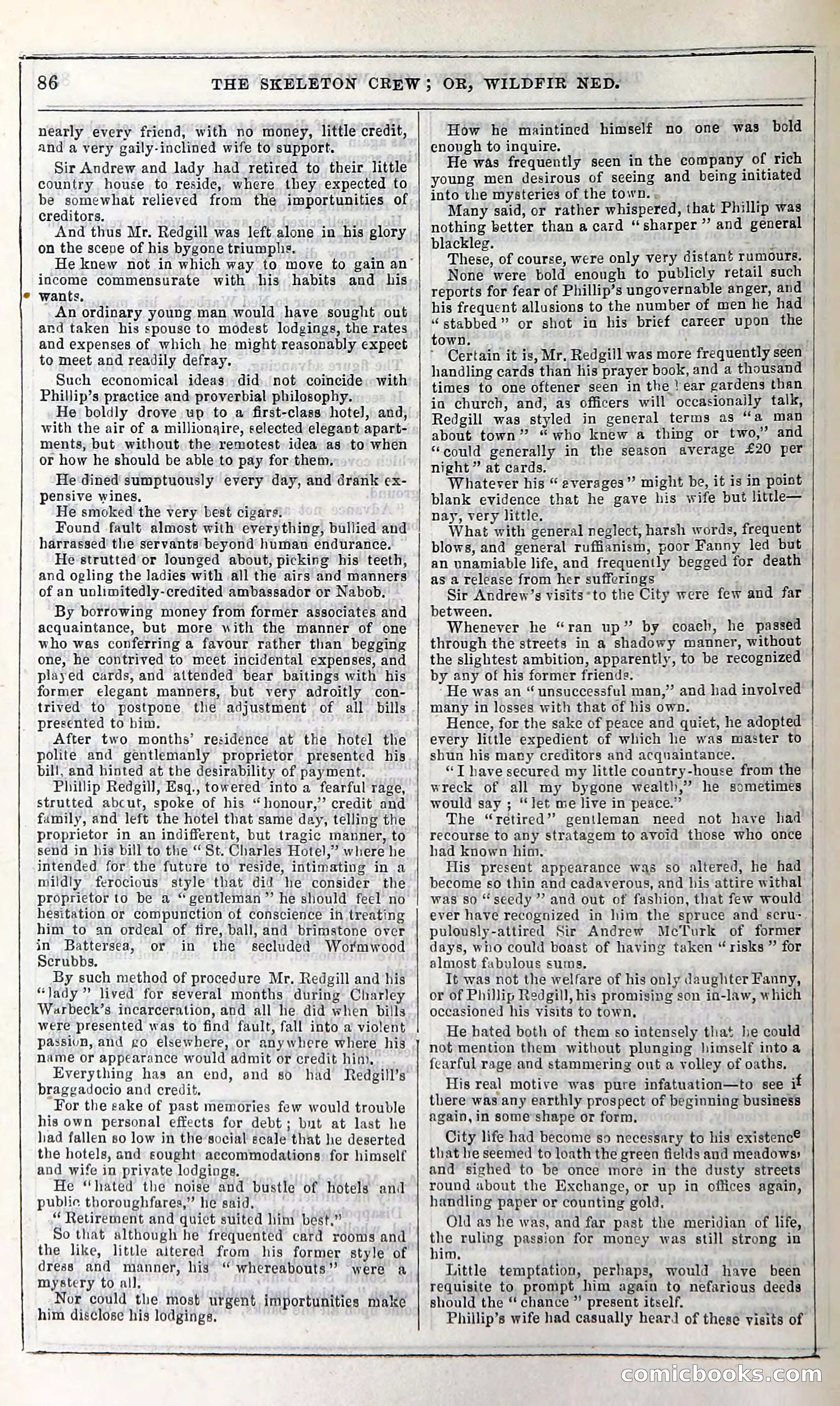
A restored page from Penny Dreadfuls, 1867. Page through the whole issue in the reader above.
📄 Transcribed text from this page (OCR, searchable)
Machine-transcribed from the original scan — historical spelling and the odd misread are preserved.
THE SKELETON CREW; OR, WILDFIR NED. nearly every friend, with no money, little credit, and a very gaily-inclined wife to support. Sir Andrew and lady had retired to their little country house to reside, where they expected to be somewhat relieved from the importunities of creditors. : And thus Mr. Redgill was left alone in his glory on the scene of his bygone triumphs. He knew not in which way to move to gain an’ income commensurate with his habits and his wants, An ordinary young man would have sought out ard taken his spouse to modest lodgings, the rates and expenses of which he might reasonably expect to meet and readily defray. Such economical ideas did not coincide with Phillip’s practice and proverbial philosophy. He boldly drove up to a first-class hotel], and, with the air of a milliongire, selected elegant apart- ments, but without the remotest idea as to when or how he should be able to pay for them. He dined sumptuously every day, and drank ex- pensive wines, He smoked the very best cigars. Found fault almost with everything, bullied and harrassed the servants beyond human endurance. He strutted or lounged about, picking his teeth, and ogling the ladies with all the airs and manners of an unlimitedly-credited ambassador or Nabob. By borrowing money from former associates and acquaintance, but more with the manner of one who was conferring a favour rather than begging one, he contrived to meet incidental expenses, and played cards, and attended bear baitings with his former elegant manners, but very adroitly con- trived to postpone the adjustment of all bills presented to him. After two months’ residence at the hotel the polite and gentlemanly proprietor presented his bill, and hinted at the desirability of payment. Phillip Redgill, Esq., towered into a fearful rage, strutted abcut, spoke of his “honour,” credit and family, and left the hotel that same day, telling the proprietor in an indifferent, but tragic manner, to send in his bill to the “St. Charles Hotel,” where he intended for the future to reside, intimating in a mildly ferocious style that did he consider the proprietor to be a “gentleman” he should feel no hesitation or compunction of conscience in treating him to an ordeal of fire, ball, and brimstone over in Battersea, or in the secluded Wormwood Scrubbs. By such method of procedure Mr. Redgill and his “lady” lived for several months during Charley Warbeck’s incarceration, and all he did when bills were presented was to find fault, fall into a violent passion, and go elsewhere, or anywhere where his name or appearance would admit or credit hin), Everything has an end, and sod had Redgill’s braggadocio and credit, For the eake of past memories few would trouble his own personal effects for debt; but at last he liad fallen so low in the social scale that he deserted the hotels, and sought: accommodations for himself and wife in private lodgings. He “hated the noise and bustle of hotels and public thoroughfares,” he said, “ Retirement and quict suited him best,” So that although he frequented card rooms and the like, little altered from his former style of dress and manner, his “ whereabouts” were a mystery to all. Nor could the most urgent importunities make him disclose his lodgings. How he maintined himself no one was bold enough to inquire. : He was frequently seen in the company of rich young men desirous of seeing and being initiated into the mysteries of the town... ane? Many said, or rather whispered, that Phillip was nothing better than a card “sharper” and general blackleg. . Sol - These, of course, were only very distant rumours. None were bold enough to publicly retail such reports for fear of Phillip’s ungovernable anger, and his frequent allusions to the number of men he had “stabbed” or shot in his brief career upon the town. Certain it is, Mr. Redgill was more frequently seen handling cards than his prayer book, and a thousand times to one oftener seen in the ! ear gardens than in church, and, as officers will occasionaily talk, Redgill was styled in general terms as “a man about town” “who knew a thing or two,” and “could generally in the season average £20 per night” at cards. be Whatever his “ everages”’ might be, it is in point blank evidence that he gave his wife but little— nay, very little. What with general neglect, harsh words, frequent blows, and general ruffianism, poor Fanny led but an unamiable life, and frequently begged for death as a release from her sufferings Sir Andrew’s visitsto the City were few and far | between. , Whenever he “ran up” by coach, he passed through the streets in a shadowy manner, without the slightest ambition, apparently, to be recognized by any of his former friends: ‘He was an “ unsuccessful man,” and had involved many in losses with that of his own. Hence, for the sake of peace and quiet, he adopted every little expedient of which he was master to shun his many creditors and acquaintance. “T have secured my little country-house from the wreck of all my bygone wealth,” he sometimes would say ; “Jet me live in peace.” The “retired”? gentleman need not have had recourse to any stratagem to avoid those who once had known him. His present appearance was so altered, he had become so thin and cadaverous, and his attire withal was so “seedy ” and out of fashion, that few would ever have recognized in him the spruce and scru-. pulously-attired Sir Andrew McTurk of former days, wio could boast of having taken “risks ” for almost fabulous sums. It was not the welfare of his only daughter Fanny, or of Phillip Redgill, his promising son in-law, which occasioned his visits to town, He hated both of them so intensely that he could not mention them without plunging himself into a fearful rage and stammering out a volley of oaths, His real motive was pure infatuation—to see if there was any earthly prospect of beginning business again, in some shape or form, City life had become so necessary to his existenc® that he seemed to loath the green fields and meadows: and sighed to be once more in the dusty streets round about the Exchange, or up in offices again, handling paper or counting gold, Old as he was, and far past the meridian of life, the ruling passion for money was still strong in him, ; Little temptation, perhaps, would have been requisite to prompt him again to nefarious deeds should the “ chance ” present itself. Phillip’s wife had casually heard of these visits of (E(0) nA Ehboo (E(0) cS