
Penny Dreadfuls, 1867 · page 82 of 300
Roving Jack, The Pirate Hunter — page 82: what you’re looking at
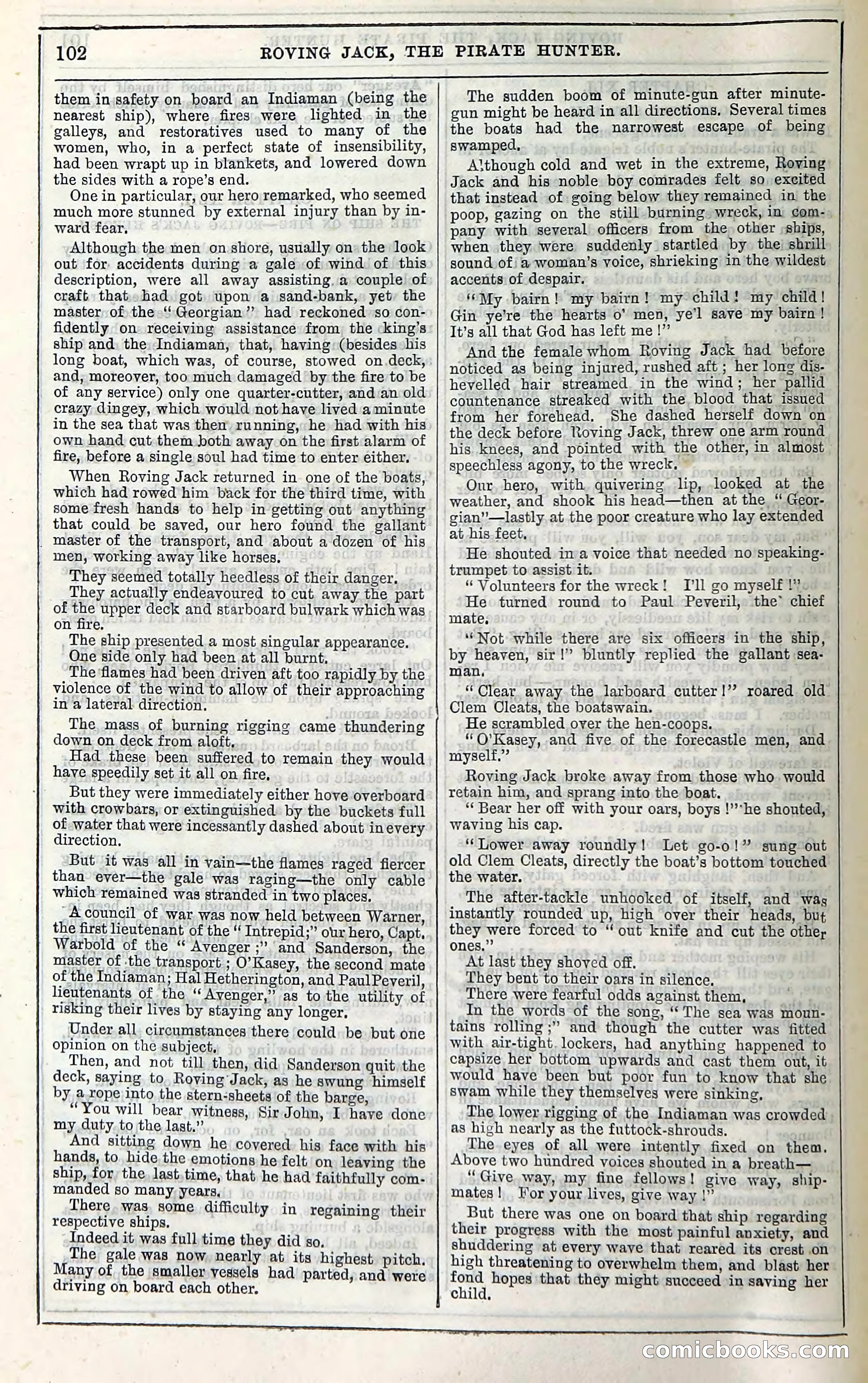
A restored page from Penny Dreadfuls, 1867. Page through the whole issue in the reader above.
📄 Transcribed text from this page (OCR, searchable)
Machine-transcribed from the original scan — historical spelling and the odd misread are preserved.
102 ROVING JACK, THE PIRATE HUNTER. aaa ea eee them injsafety on board an Indiaman (being the nearest ship), where fires were lighted in the galleys, and restoratives used to many of the women, who, in a perfect state of insensibility, had been wrapt up in blankets, and lowered down the sides with a rope’s end. One in particular, our hero remarked, who seemed much more stunned by external injury than by in- ward fear, Although the men on shore, usually on the look out for accidents during a gale of wind of this description, were all away assisting. a couple of craft that. had got upon a sand-bank, yet the master of the ‘Georgian ’’ had reckoned so con- fidently on receiving assistance from the :king’s ship and. the: Indiaman, that, having (besides his long boat, which was, of course, stowed on.deck, and, moreover, too much damaged by the fire to be of any service) only one quarter-cutter, and:an old crazy dingey, which would not have lived a minute in the sea that was then running, he had with his own hand cut them both away on the first: alarm of fire, before a single soul had time to enter either. When Roving Jack returned in one of the boats, which had rowed him back for the third time, with some fresh hands to help in getting out anything that could be saved, our hero found the gallant _ master of the transport, and about a dozen of his men, working away like horses. They seemed totally heedless of their danger. They actually endeavoured to cut. away the part of the upper deck and starboard bulwark which was on fire, The ship presented a most singular appearance. One side only had been at all burnt, The ‘flames had been driven aft too rapidly by the violence of the wind to allow of their approaching in a lateral direction. The mass of burning rigging came thundering down on deck from aloft, Had these been suffered to remain they would have speedily set it all on fire, But they were immediately either hove overboard with crowbars, or extinguished by the buckets full of water that were incessantly dashed about in every direction. But it was all in vain—the flames raged fiercer than ever—the gale was raging—the only cable which remained was stranded in two places, _Accouncil of war was now held between Warner, the first lieutenant of the “ Intrepid;” our hero, Capt, Warbold of the “ Avenger ;” and Sanderson, the master of .the transport ; O’Kasey, the second mate of the Indiaman; Hal Hetherington, and PaulPeyvyeril, lieutenants of the ‘‘ Avenger,” as to the utility of risking their lives by staying any longer, Under all circumstances there could be but one opinion on the subject, Then, and not till then, did Sanderson quit the deck, saying to Roving Jack, as he swung himself by axope into the stern-sheets of the barge, “You will bear witness, Sir John, I have done my duty to the last.” And sitting down he covered his face with his hands, to hide the emotions he felt on leaving the ship, for the last.time, that he had faithfully com- manded so many years, There was some difficulty in regaining their respective ships, Indeed it was full time they did so. The gale was now nearly at its highest pitch. Many of the smaller vessels had parted, and were driving on board each other. ae ee The sudden boom of minute-gun after minute- gun might be heard in all directions. Several times the boats had the narrowest escape of being swamped, iq oa Although cold and wet in the extreme, Roving Jack and his noble boy comrades felt so, excited that instead of going below they remained in the poop, gazing on the still burning wreck, in com-» pany with several officers from the other ships, when they were suddenly startled by the) shrill sound of! a woman’s voice, shrieking in the wildest accents of despair. d ova ‘My bairn! my bairn! my child! my child! Gin ye’re the hearts o’ men, ye’l save my bairn ! It’s all that God has left me!” ' ee And the female whom Roving Jack had before noticed as being injured, rushed aft ; her long dis- hevelled hair streamed in the wind; her pallid countenance streaked with the blood that issued from her forehead. She dashed herself down on the deck before Roving Jack, threw one arm round his knees, and pointed with the other, in almost speechless agony, to the wreck. © ee: Our hero, with quivering lip, looked at the weather, and shook his head—then at the. “ Geor- gian’’—lastly at the poor creature who lay extended at his feet, He shouted inva voice that needed no speaking- trumpet to assist it. “ Volunteers for the wreck! I'll go myself lc He turned round to Paul Peveril, the chie mate, ‘“Not while there are six officers in the ship, by heaven, sir!” bluntly replied the gallant sea- man, “Clear away the larboard cutter!” roared old Clem Oleats, the boatswain. He scrambled over the hen-coops. Cl “O’Kasey, and five of the forecastle men, and myself,” Roving Jack broke away from those who. would retain him, and sprang into the boat. 79 ‘“* Bear her off with your oars, boys !’"he shouted, waving his cap. ‘‘Lower away roundly! Let go-o!” sung out old Clem Cleats, directly the boat’s bottom touched the water. The after-tackle unhooked of itself, and Wag instantly rounded up, high over their heads, but they were forced to “out knife and cut the othe, ones.”’ At last they shoved off, They bent to their oars in silence, There were fearful odds against them, be In the words of the song, “The sea was mouu- tains rolling ;” and though the cutter was fitted with air-tight. lockers, had anything happened to capsize her bottom upwards and cast them out, it would have been but poor fun to know that she swam while they themselves were sinking, The lower rigging of the Indiaman was crowded - as high nearly as the futtock-shrouds. , The eyes of all were intently fixed on them. Above two hundred voices shouted in a breath— ‘Give way, my fine fellows! give way, ship- — mates! Jor your lives, give way |” But there was one on board that ship regarding their progress with the most painful anxiety, and shuddering at every wave that reared its crest .on high threatening to overwhelm them, and blast her at hopes that they might succeed in saving her child, oO Eomichookszecom