
Penny Dreadfuls, 1867 · page 81 of 300
Roving Jack, The Pirate Hunter — page 81: what you’re looking at
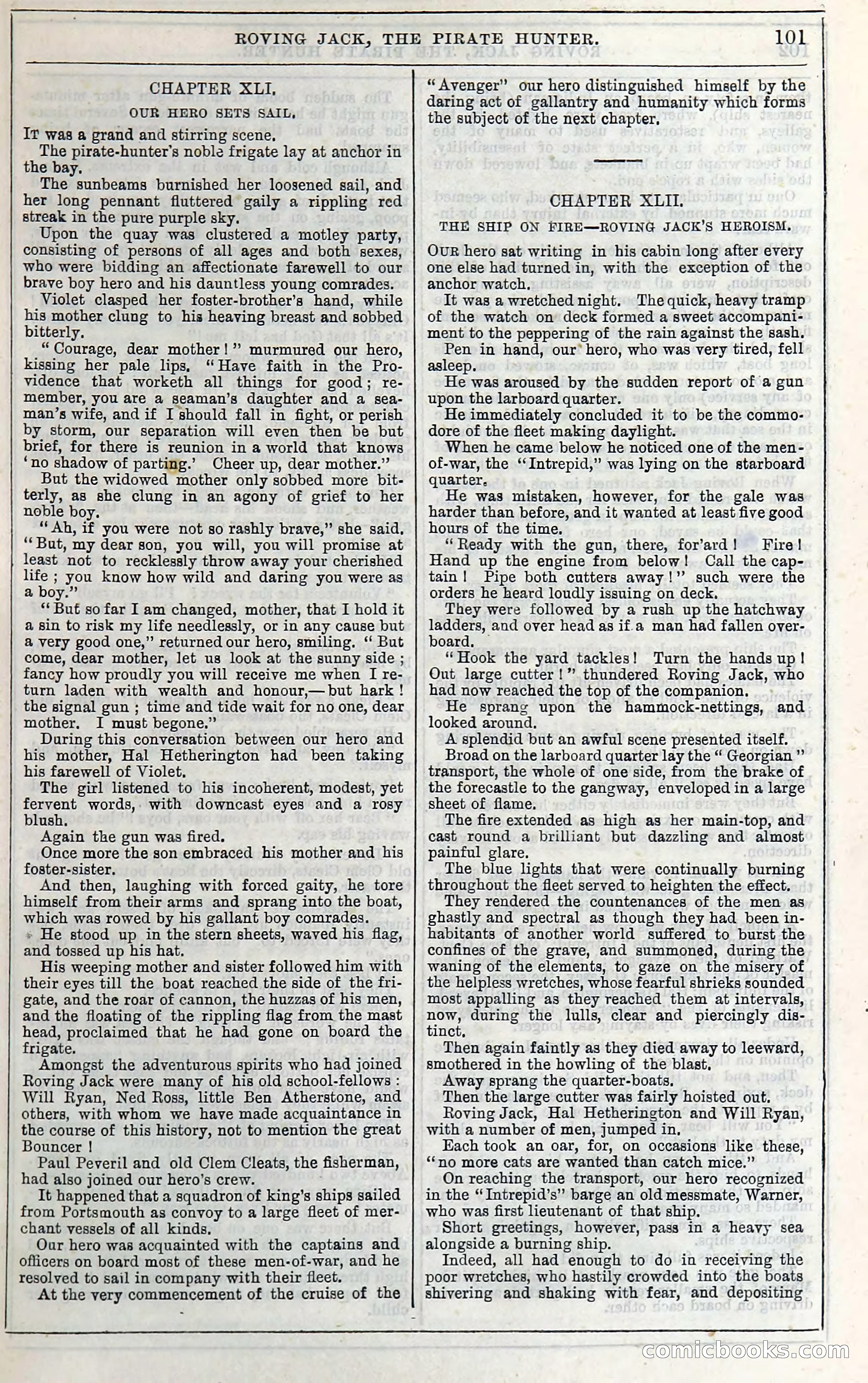
A restored page from Penny Dreadfuls, 1867. Page through the whole issue in the reader above.
📄 Transcribed text from this page (OCR, searchable)
Machine-transcribed from the original scan — historical spelling and the odd misread are preserved.
ROVING JACK, THE PIRATE HUNTER. 101 CHAPTER XLI, OUR HERO SETS SAIL, If was a grand and stirring scene, The pirate-hunter’s noble frigate lay at anchor in the bay, The sunbeams burnished her loosened sail, and her long pennant fluttered gaily a rippling red streak in the pure purple sky. Upon the quay was clustered a motley party, consisting of persons of all ages and both sexes, who were bidding an affectionate farewell to our brave boy hero and his dauntless young comrades. Violet clasped her foster-brother’s hand, while his mother clung to his heaving breast and sobbed bitterly. “Courage, dear mother!” murmured our hero, kissing her pale lips, “Have faith in the Pro- vidence that worketh all things for good; re- member, you are a seaman’s daughter and a sea- man’s wife, and if I should fall in fight, or perish by storm, our separation will even then be but brief, for there is reunion in a world that knows “no shadow of parting.’ Cheer up, dear mother.” But the widowed mother only sobbed more bit- terly, as she clung in an agony of grief to her noble boy. ‘Ah, if you were not so rashly brave,” she said, ‘‘But, my dear son, you will, you will promise at least not to recklessly throw away your cherished ae ; you know how wild and daring you were as a boy.” “But so far I am changed, mother, that I hold it a sin to risk my life needlessly, or in any cause but a very good one,” returned our hero, smiling. ‘“‘ But come, dear mother, let us look at the sunny side ; fancy how proudly you will receive me when I re- turn laden with wealth and honour,—but hark! the signal gun ; time and tide wait for no one, dear mother. I must begone.” During this conversation between our hero and his mother, Hal Hetherington had been taking his farewell of Violet, The girl listened to his incoherent, modest, yet fervent words,. with downcast eyes and a rosy blush. Again the gun was fired. Once more the son embraced his mother and his foster-sister. And then, laughing with forced gaity, he tore himself from their arms and sprang into the boat, which was rowed by his gallant boy comrades. » He stood up in the stern sheets, waved his flag, and tossed up his hat, His weeping mother and sister followed him with their eyes till the boat reached the side of the fri- gate, and the roar of cannon, the huzzas of his men, and the floating of the rippling flag from the mast head, proclaimed that he had gone on board the frigate. Amongst the adventurous spirits who had joined Roving Jack were many of his old school-fellows : Will Ryan, Ned Ross, little Ben Atherstone, and others, with whom we have made acquaintance in the course of this history, not to mention the great Bouncer |! Paul Peveril and old Clem Cleats, the fisherman, had also joined our hero’s crew. It happened that a squadron of king’s ships sailed from Portsmouth as convoy to a large fleet of mer- chant vessels of all kinds, Our hero was acquainted with the captains and officers on board most of these men-of-war, and he resolved to sail in company with their fleet. At the very commencement of the cruise of the “ Avenger” our hero distinguished himself by the ~ daring act of gallantry and humanity which forms the subject of the next chapter, CHAPTER XLII, THE SHIP ON FIRE—ROVING JACK’S HEROISM. OUR hero sat writing in his cabin long after every one else had turned in, with the exception of the anchor watch. It was a wretched night. Thequick, heavy tramp of the watch on deck formed a sweet accompani- ment to the peppering of the rain against the sash. Pen in hand, our’ hero, who was very tired, fell asleep. He was aroused by the sudden report of a gun upon the larboard quarter. He immediately concluded it to be the commo- dore of the fleet making daylight. When he came below he noticed one of the men- of-war, the ‘‘Intrepid,” was lying on the starboard quarter, He was mistaken, however, for the gale was harder than before, and it wanted at least five good hours of the time, “Ready with the gun, there, for’ard! Fire! Hand up the engine from below! Call the cap- tain! Pipe both cutters away!’ such were the orders he heard loudly issuing on deck, They were followed by a rush up the hatchway ladders, and over head as ifa man had fallen over- board. ~ “Hook the yard tackles! Turn the hands up! Out large cutter!” thundered Roving Jack, who had now reached the top of the companion, He sprang upon the hammock-nettings, and looked around. A splendid but an awful scene presented itself. Broad on the larboard quarter lay the “ Georgian ”’ transport, the whole of one side, from the brake of the forecastle to the gangway, enveloped in a large sheet of flame. The fire extended as high as her main-top, and cast round a brilliant but dazzling and almost painful glare. The blue lights that were continually burning throughout the fleet served to heighten the effect. They rendered the countenances of the men as ghastly and spectral as though they had been in- habitants of another world suffered to burst the confines of the grave, and summoned, during the waning of the elements, to gaze on the misery of the helpless wretches, whose fearful shrieks sounded most appalling as they reached them at intervals, now, during the lulls, clear and piercingly dis- tinct, Then again faintly as they died away to leeward, smothered in the howling of the blast, Away sprang the quarter-boats, Then the large cutter was fairly hoisted out. Roving Jack, Hal Hetherington and Will Ryan, with a number of men, jumped in, Each took an oar, for, on occasions like these, “‘no more cats are wanted than catch mice.” On reaching the transport, our hero recognized in the “Intrepid’s” barge an old messmate, Warner, who was first lieutenant of that ship. Short greetings, however, pass in a heavy sea alongside a burning ship. Indeed, all had enough to do in receiving the poor wretches, who hastily crowded into the boats shivering and shaking with fear, and depositing EOMIGIOOkKSIEO