
Penny Dreadfuls, 1866 · page 84 of 276
Ivan the Terrible; or, Dark Deeds of Night — page 84: what you’re looking at
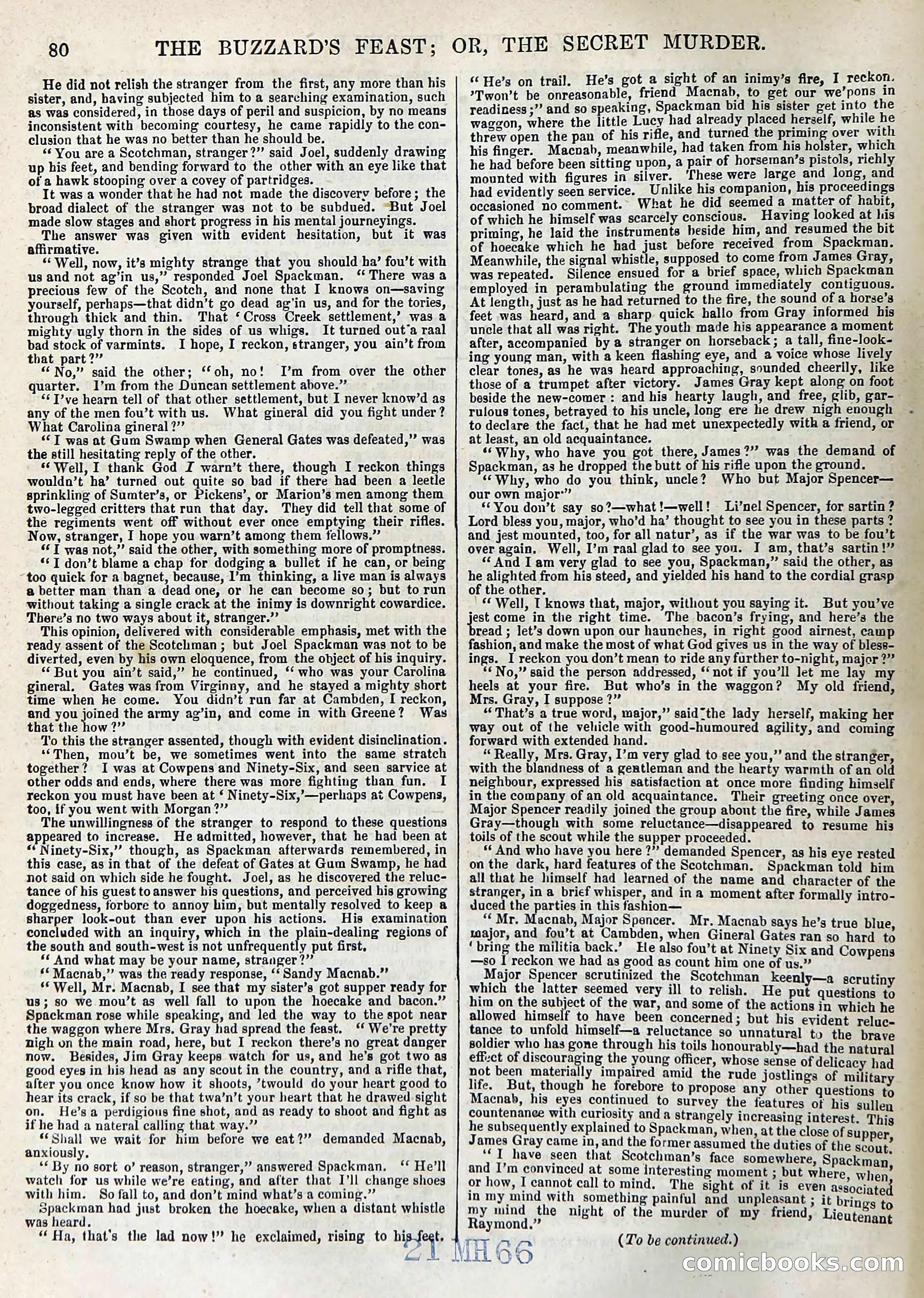
A restored page from Penny Dreadfuls, 1866. Page through the whole issue in the reader above.
📄 Transcribed text from this page (OCR, searchable)
Machine-transcribed from the original scan — historical spelling and the odd misread are preserved.
80 He did not relish the stranger from the first, any more than his sister, and, having subjected him to a searching examination, such as was considered, in those days of peril and suspicion, by no means inconsistent with becoming courtesy, he came rapidly to the con- clusion that he was no better than he should be. ‘6 You are a Scotchman, stranger?” said Joel, suddenly drawing up his feet, and bending forward to the other with an eye like that of a hawk stooping over a covey of partridges. It was a wonder that he had not made the discovery before; the broad dialect of the stranger was not to be subdued. “But Joel made slow stages and short progress in his mental journeyings. The answer was given with evident hesitation, but it was affirmative. “Well, now, it’s mighty strange that you should ha’ fou’t with us and not ag’in us,” responded Joel Spackman. ‘‘ There was a precious few of the Scotch, and none that I knows on—saving yourself, perhaps—that didn’t go dead ag’in us, and for the tories, through thick and thin. That ‘Cross Creek settlement,’ was a mighty ugly thorn in the sides of us whigs. It turned out’a raal bad stock of varmints. I hope, I reckon, stranger, you ain’t from that part?” “No,” said the other; ‘‘oh, no! I’m from over the other quarter. I’m from the Duncan settlement above.” ‘¢T’ve hearn tell of that other settlement, but I never know’d as any of the men fou’t with us. What gineral did you fight under? What Carolina gineral ?”’ <‘T was at Gum Swamp when General Gates was defeated,” was the still hesitating reply of the other. ‘¢ Well, I thank God ZI warn’t there, though I reckon things wouldn’t ha’ turned out quite so bad if there had been a leetle sprinkling of Sumter’s, or Pickens’, or Marion’s men among them two-legged critters that run that day. They did tell that some of the regiments went off without ever once emptying their rifles. Now, stranger, I hope you warn’t among them fellows.” “T was not,”’ said the other, with something more of promptness. *¢ I don’t blame a chap for dodging a bullet if he can, or being too quick for a bagnet, because, I’m thinking, a live man is always a better man than a dead one, or he can become so; but to run without taking a single crack at the inimy is downright cowardice. There’s no two ways about it, stranger.” This opinion, delivered with considerable emphasis, met with the ready assent of the Scotchman; but Joel Spackman was not to be diverted, even by his own eloquence, from the object of his inquiry. “* But you ain’t said,’”’ he continued, ‘‘ who was your Carolina gineral. Gates was from Virginny, and he stayed a mighty short time when he come. You didn’t run far at Cambden, I reckon, and you joined the army ag’in, and come in with Greene? Was that the how ?” To this the stranger assented, though with evident disinclination. ‘‘Then, mou’t be, we sometimes went into the same stratch together? I was at Cowpens and Ninety-Six, and seen sarvice at other odds and ends, where there was more fighting than fun. I reckon you must have been at ‘ Ninety-Six,’—perhaps at Cowpens, too, if you went with Morgan?” The unwillingness of the stranger to respond to these questions appeared to increase. He admitted, however, that he had been at “* Ninety-Six,”’ though, as Spackman afterwards remembered, in this case, as in that of the defeat of Gates at Gum Swamp, he had not said on which side he fought. Joel, as he discovered the reluc- tance of his guest to answer his questions, and perceived his growing doggedness, forbore to annoy him, but mentally resolved to keep a sharper look-out than ever upon his actions. His examination concluded with an inquiry, which in the plain-dealing regions of the south and south-west is not unfrequently put first, ‘€ And what may be your name, stranger?” ‘“Macnab,”’ was the ready response, ‘‘ Sandy Macnab.” ‘‘ Well, Mr. Macnab, I see that my sister’s got supper ready for — us; sO we mou’t as well fall to upon the hoecake and bacon.” Spackman rose while speaking, and led the way to the spot near the waggon where Mrs, Gray had spread the feast. ‘* We’re pretty nigh on the main road, here, but I reckon there’s no great danger now. Besides, Jim Gray keeps watch for us, and he’s got two as good eyes in his head as any scout in the country, and a rifle that, after you once know how it shoots, ’twould do your heart good to hear its crack, if so be that twa’n’t your heart that he drawed sight on. He’sa perdigious fine shot, and as ready to shoot and fight as if he had a nateral calling that way.”’ ‘*Shall we wait for him before we eat?’? demanded Macnab, anxiously. ‘* By no sort o’ reason, stranger,” answered Spackman. ‘“ He’ll watch for us while we’re eating, and after that I’ll change shoes with him. So fall to, and don’t mind what’s a coming.” spackman had just broken the hoecake, when a distant whistle was heard. “Ha, that’s the lad now!” he exclaimed, rising to nes bcd LY \: wal THE BUZZARD’S FEAST; OR, THE SECRET MURDER. ‘ He’s on trail. He’s got a sight of an inimy’s fire, I reckon. *Twon’t be onreasonable, friend Macnab, to get our we’pons In readiness ;”? and so speaking, Spackman bid his sister get into the waggon, where the little Lucy had already placed herself, while he threw open the pan of his rifle, and turned the priming over with his finger. Macnab, meanwhile, had taken from his holster, which he had before been sitting upon, a pair of horseman’s pistols, riehly mounted with figures in silver. ‘These were large and long, and had evidently seen service. Unlike his companion, his proceedings occasioned no comment. What he did seemed a matter of habit, of which he himself was scarcely conscious. Having looked at his priming, he laid the instruments beside him, and resumed the bit of hoecake which he had just before received from _Spackman. Meanwhile, the signal whistle, supposed to come from James Gray, was repeated. Silence ensued for a brief space, which Spackman employed in perambulating the ground immediately contiguous. At length, just as he had returned to the fire, the sound of a horse’s feet was heard, and a sharp quick hallo from Gray informed his uncle that all was right. The youth made his appearance a moment after, accompanied by a stranger on horseback; a tall, fine-look- ing young man, with a keen flashing eye, and a voice whose lively — clear tones, as he was heard approaching, sounded cheerily, like those of a trumpet after victory. James Gray kept along on foot — beside the new-comer : and his hearty laugh, and free, glib, gar- rulous tones, betrayed to his uncle, long ere he drew nigh enough to declare the fact, that he had met unexpectedly with a friend, or at least, an old acquaintance. ‘‘Why, who have you got there, James?”” was the demand of Spackman, as he dropped the butt of his rifle upon the ground. ‘©Why, who do you think, uncle? Who but Major Spencer— our own major’” “‘You don’t say so?—what!—well! Li’nel Spencer, for sartin ? Lord bless you, major, who’d ha’ thought to see you in these parts ? and jest mounted, too, for all natur’, as if the war was to be fou’t over again. Well, I’m raal glad to see you. I am, that’s sartin!” “‘ And I am very glad to see you, Spackman,” said the other, as he alighted from his steed, and yielded his hand to the cordial grasp of the other. '“ Well, I knows that, major, without you saying it. But you’ve jest come in the right time. The bacon’s frying, and here’s the read ; let’s down upon our haunches, in right good airnest, camp fashion, and make the most of what God gives us in the way of bless- ings. I reckon you don’t mean to ride any further to-night, major ?” ‘*No,” said the person addressed, ‘‘ not if you’ll let me lay my heels at your fire. But who’s in the waggon? My old friend, Mrs. Gray, I suppose ?” ““That’s a true word, major,” said“the lady herself, making her way out of the vehicle with good-humoured agility, and coming forward with extended hand. “Really, Mrs. Gray, I’m very glad to see you,”’ and the stranger, with the blandness of a gentleman and the hearty warmth of an old neighbour, expressed his satisfaction at once more finding himself in the company of an old acquaintance. Their greeting once over Major Spencer readily joined the group about the fire, while J ames Gray—though with some reluctance—disappeared to resume his toils of the scout while the supper proceeded. ‘And who have you here ?” demanded Spencer, as his eye rested on the dark, hard features of the Scotchman. Spackman told him all that he himself had learned of the name and character of the stranger, in a brief whisper, and ina moment after formally intro- lucent the arties in this pe ea r. Macnab, Major Spencer. Mr. Macnab says he’s t laajor, and fou’t at Cambden, when Gineral Gates ran ae he ‘bring the militia back.’ Fle also fou’t at Ninety Six and Cowpens sao I reckon we had as good as count him one of us.” ajor Spencer scrutinized the Scotchman k — ; which the latter seemed very ill to relish. He out quaatiense him on the subject of the war, and some of the actions in which he allowed himself to have been concerned ; but his evident reluc- tance to unfold himself—a reluctance so unnatural to the brave soldier who has gone through his toils honourably—had the natural eff-ct of discouraging the young officer, whose sense of delicacy had not been materially impaired amid the rude jostlings of mrilitas life. But, though he forebore to propose any other questions ty Macnab, his eyes continued to survey the features of his sullen countenanee with curiosity anda strangely increasing interest This he subsequently explained to Spackman, when, at the close of su “ James Gray came in, and the former assumed the duties of the a a ‘““I have seen that Scotchman’s face somewhere Spackm a and I’m convinced at some interesting moment ; but where wl on or how, I cannot call to mind. The sight of it is even associat a in my mind with Something painful and unpleasant ; it brin at my mind the night of the murder of my friend, Lieutenant Raymond.” fH Ae (To be continued.) ik OO comicbooksreom