
Penny Dreadfuls, 1866 · page 83 of 276
Ivan the Terrible; or, Dark Deeds of Night — page 83: what you’re looking at
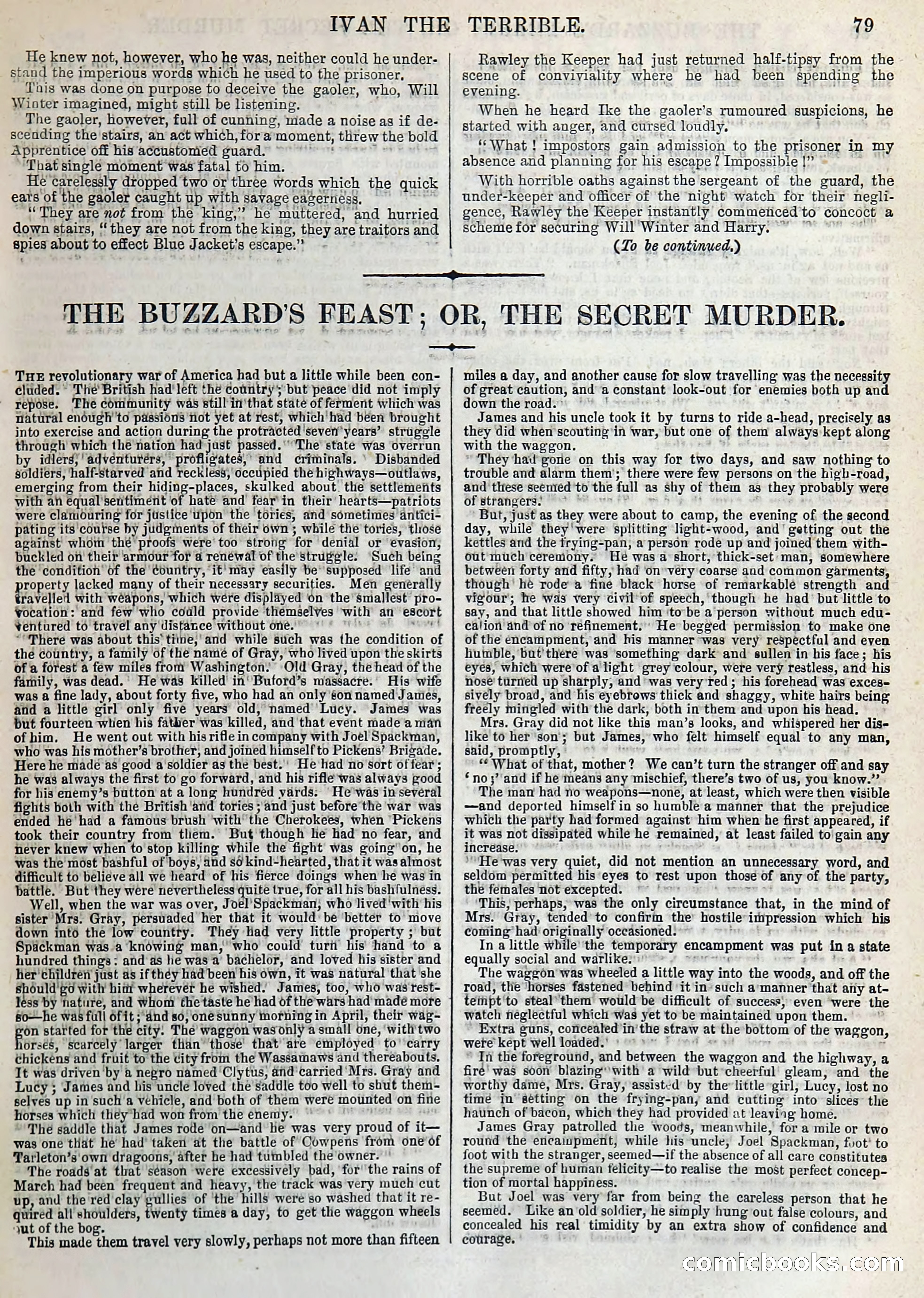
A restored page from Penny Dreadfuls, 1866. Page through the whole issue in the reader above.
📄 Transcribed text from this page (OCR, searchable)
Machine-transcribed from the original scan — historical spelling and the odd misread are preserved.
IVAN THE TERRIBLE. He knew not, however, who he was, neither could he under- stand the imperious words which he used to the prisoner, Tais was done on purpose to deceive the gaoler, who, Will Winter imagined, might still be listening. The gaoler, however, full of cunning, made a noise as if de- scending the stairs, an act which, fora moment, threw the bold Apprentice off his accustomed guard. rae | ‘That single moment was fatal to him. He carelessly dropped two or three words which the quick eats of the gaoler caught up with savageeasernéss, _ “They are not from the king,” he muttered, and hurried down stairs, ‘they are not from the king, they are traitors and spies about to effect Blue Jacket’s escape.” , 19 Rawley the Keeper had just returned half-tipsy from the scene of conviyiality where he had been spending the evening. . are When he heard Ike the gaoler’s rumoured suspicions, he started with anger, and cursed loudly, ‘What ! impostors gain admission to the prisoner in my absence and planning for his escape? Impossible |” ~ With horrible oaths against the sergeant of the guard, the under-keeper and officer of the night watch for their negli- gence, Rawley the Keeper instantly commeiicéd'to concoct a scheme for securing Will Winter and Harry. ~ “ ~" ~* (Zo be continued.) SSE ap THE BUZZARD'S FEAST; OR, THE SECRET MURDER. - THE revolutionary war of America had but a little while been con- eltided. © The’ British had’ left the country; but peace did not imply repose. The community was still in'that state of ferment which was natural endugh''to passibns fot yet at rest, which'had been brought into exercise and action during the protracted'seven’ years’ strugele through which the nation had just passed.'’Lhe state was overrun by idlers;'adventurérs, profligate’, and criminals. \ Disbanded soldiers, ‘half-starved and reckless,’ occupied the highways—outlaws, emerging from their hiding-places, skulked about. the settlements with an équal’sentiment of hate and fear'in their hearts—patriots were clamouring for justice'upon the tories, and sometimes antici- pating its'coutse by judginents of their own ; while the tories, those against whom thé proofs were too strong for denial or evasion, buckled on their armour for & renéwal of the Struggle. Such being the ‘condition’ of the ¢buntry, it'may easily be supposed life and roperty lacked many of their necessary securities. Men generally ravelled with weapons, which were displayed on the’ smallest’ pro- vocation: and few who could provide themselves with an escort ventured to travel any distance without one. * 5 'Povet “There was about this’ tiine,’and while such was the condition of the country, a family of the name of Gray, who lived upon the skirts of a forest a few miles from Washington! Old Gray, the head of the family, was dead.' He was killed in‘ Buford’s massacre.’ His wife was a fine lady, about forty five, who had an only son named James, and a little girl only five years old, named Lucy. James was but fourteen wien his father was killed, and that event made a man of him. He went out with his rifle in company with Joel Spackman, who was his mother’s brother, and joined himself to Pickens’ Brigade. Here he made a8 good a'soldier as the best.'' He had no sort of fear; he was always the first to go forward, and his rifle was always good for his enemy’s button at a long hundred yards. He'was in several fichts both with the British ‘and tories ;and just before the war was ended he'had a famous brush ‘with’ the Cherokees, when ‘Pickens took their country from tliem. But though he had no fear, and never knew when to stop killing while the fight was going'on, he was the most bashful of boys, ind so kind-hearted, that it was almost difficult to bélieve all we heard of his fierce doings when he was in battle. But'they were nevertheless quite true, for all his bashfulness. Well, when the war was over, Joel’Spackman; who lived ‘with his sister Mrs: Gray, persuaded her that it would be ‘better to’ move down into the low country. They Had very little property ; but Spackman was a knowing man,’ who could turn his’ ‘hand to a hundred things: and as he was ‘a’ bachelor, and loved his sister and her'children just as if they had been his own, it was natural that she shduld'fo with hint wherever he wished! James, too, who was rest- léss by fature, and Whom fhe taste he had of the wars had made more Bo—he was fill 6fit ;'dnd so; onesSunny morning in April, their wag- eon started for the city: The waggon was only a small one, ‘with'two horses, “scarcely larger tlian’ those’ that’ are employed to’ carry chickéns and fruit to the vity from the Wassamaws and thereabouts. It was driven ‘by a nepro named ‘Clytus, and'carried ‘Mrs. Gray and Lucy ; James and his uncle loved the saddle too well to shut them- selves up in such'a vehicle, and both of them were mounted on fine horses which they had won from the enemy. | Pam 4 ~The saddle that James rode on—and he was very proud of it— was one that he’ had’ taken at the battle of Cowpens from one of Tarleton’s own dragoons, after he had tumbled the owner.) ~ The roads'at that séason were excessively bad, for''the rains of March had been frequent and heavy, the track was very much cut up, and the red'clay gullies of ‘the hills were so washed that it re- quired all shoulders, fienty times a day, to get the waggon wheels ‘yut of the bog. This made them travel very slowly, perhaps not more than fifteen miles a day, and another cause for slow travelling was the necessity of great caution, and a constant look-out for enemies both up and down the road.° . James and his uncle took it by turns to ride a-head, precisely as they did when scouting in war, but one of them always kept along with the waggon. They had gone on this way for two days, and saw nothing to trouble and alarm them’; there were few persons on the high-road, and these seented to the full as shy of them as they probably were OF HtFanicerss ee) son FY aS ' | But, just as they were about to camp, the evening of the second day, while they'were splitting light-wood, and’ getting out the kettles and the frying-pan, a person rode up and joined them with- out much ceremony. He was a short, thick-set: man, somewhere between forty and fifty, had on-very coarse and common garments, though’ he rode a fine black horse of remarkable strength and vigour; he was very civil of speech, though he had’ but little to say, and that little showed him ‘to-be a person without much edu- calion and of no refinement. He begged permission to make one of the encampment, and his manner was very respectful and eyen humble, but'there was ‘something dark and sullen in his face; his eyes, which were of alight grey colour, were very restless, and his nose’ turned up sharply, and was very red; his forehead was exces- sively broad, and his eyebrows thick and shaggy, white hairs being freely mingled with the dark, both in them and upon his head. Mrs. Gray did not like this man’s looks, and whispered her dis- like to her son’; but James, who felt himself equal to any man, said, promptly yw ts “What of that, mother? We can’t turn the stranger off and say ‘no;’ and if he means any mischief, there’s two of us, you know.”’ The man had no weapons—none, at least, which were then visible —and deported himself in so humble a manner that the prejudice which the party had formed against’ him when he first appeared, if it was not dissipated while he remained, at least failed to'gain any increase. | ‘He 'was very quiet, did not mention an unnecessary word, and seldom permitted his eyes to rest upon those of any of the party, the females not excepted. © ‘= ™ \ Soiree sf ‘This, perhaps, was the only circumstance that, in the mind of Mrs. Gray, tended’ to confirm the’ hostile’ impression which his coming had originally occasioned. rv OF | In a little while’ the temporary encampment was put in a state equally social and warlike: Pernehed: wee pte Ts The waggon was wheeled a little way into the woods, and off the road, tlie ‘horses fastened behind it in» such a’manner that any at- teinpt'to steal’ them would be difficult of success; even ‘were th watch neglectful which was yet to be maintained upon them. ' Extra guns, concealed in'the straw at the bottom of the waggon, were kept well loaded.' | 9)" ) 0 © pe * In the foreground, and between the waggon and the highway, a firé' was soon blazing’ with a wild but*cheerful’ gleam, and the worthy dame, Mrs. Gray, assisted by the” little girl, Lucy, lost no timé in sétting on the frying-pan, and cutting into slices the haunch of bacon, which they had provided at leaviag home. James Gray patrolled the woods, meanwhile, for a mile or two round the encainpment, while his uncle, Joel Spackman, foot’ to foot with the stranger, seemed—if the absence of all care constitutes the supreme of human felicity—to realise the most perfect concep- tion of mortal happiness. : But Joel was very far from being the careless person that he seemed. Like an old soldier, he simply hung out false colours, and concealed his real timidity by an extra show of confidence and courage. GCOMIIGDOoks COLA