
Penny Dreadfuls, 1866 · page 236 of 276
Ivan the Terrible; or, Dark Deeds of Night — page 236: what you’re looking at
A restored page from Penny Dreadfuls, 1866. Page through the whole issue in the reader above.
📄 Transcribed text from this page (OCR, searchable)
Machine-transcribed from the original scan — historical spelling and the odd misread are preserved.
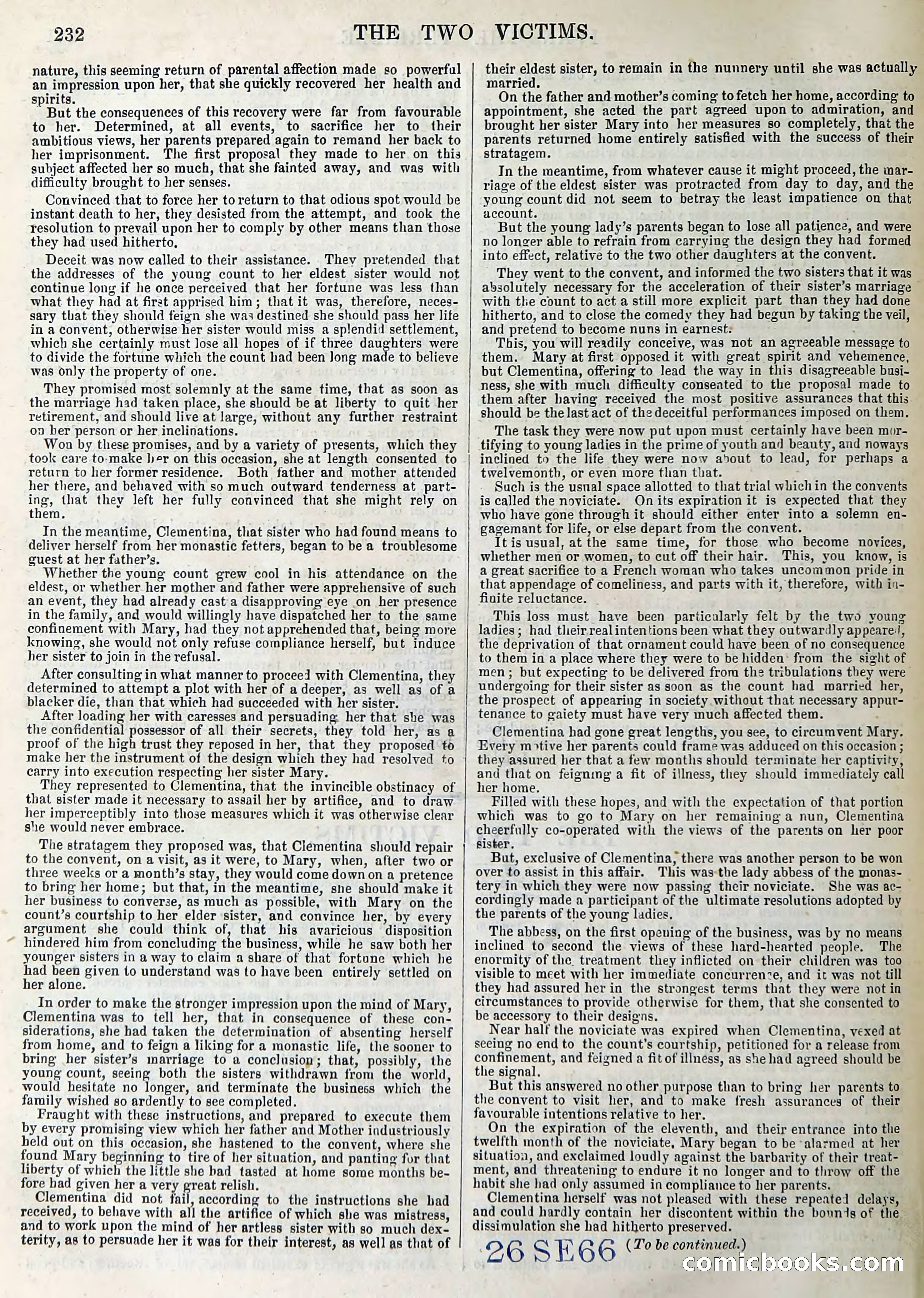
232 nature, this seeming return of parental affection made so powerful an impression upon her, that she quickly recovered her health and spirits. eat the consequences of this recovery were far from favourable to her. Determined, at all events, to sacrifice her to their ambitious views, her parents prepared again to remand her back to her imprisonment. The first proposal they made to her on this subject affected her so much, that she fainted away, and was with difficulty brought to her senses. Convinced that to force her to return to that odious spot would be instant death to her, they desisted from the attempt, and took the resolution to prevail upon her to comply by other means than those they had used hitherto, Deceit was now called to their assistance. They pretended that the addresses of the young count to her eldest sister would not continue long if he once perceived that her fortune was less than what they had at first apprised him; that it was, therefore, neces- sary that they should feign she was destined she should pass her life in a convent, otherwise her sister would miss a splendid settlement, which she certainly must Jose all hopes of if three daughters were to divide the fortune which the count had been Jong made to believe was only the property of one. They promised most solemnly at the same time, that as soon as the marriage had taken place, she should be at liberty to quit her retirement, and should live at large, without any further restraint on ber person or her inclinations. Won by these promises, and by a variety of presents, which they took care to-make })*r on this occasion, she at length consented to return to her former residence. Both father and mother attended her there, and behaved with so much outward tenderness at part- ing, that they left her fully convinced that she might rely on them. In the meantime, Clementina, that sister who had found means to deliver herself from her monastic fetters, began to be a troublesome guest at her father’s. Whether the young count grew cool in his attendance on the eldest, or whether her mother and father were apprehensive of such an event, they had already casta disapproving eye on her presence in the family, and would willingly have dispatched her to the same confinement with Mary, had they not apprehended that, being more knowing, she would not only refuse compliance herself, but induce her sister to join in the refusal. After consulting in what manner to proceed with Clementina, they determined to attempt a plot with her of a deeper, as well as of a blacker die, than that which had succeeded with her sister. After loading her with caresses and persuading. her that she was the confidential possessor of all their secrets, they told her, as a proof of the high trust they reposed in her, that they proposed to make her the instrument of the design which they had resolved to ~ carry into execution respecting her sister Mary. They represented to Clementina, that the invincible obstinacy of that sister made it necessary to assail her by artifice, and to draw her imperceptibly into those measures which it was otherwise clear she would never embrace. The stratagem they proposed was, that Clementina should repair to the convent, on a visit, as it were, to Mary, when, after two or three weeks or a month’s stay, they would come downon a pretence to bring her home; but that, in the meantime, she should make it her business to converge, as much as possible, with Mary on the count’s courtship to her elder sister, and convince her, by every argument she could think of, that his avaricious disposition hindered him from concluding the business, while he saw both her younger sisters in a way to claim a share of that fortune which he nad been given to understand was to have been entirely settled on er alone. In order to make the stronger impression upon the mind of Mary, Clementina was to tell her, that in consequence of these con- siderations, she had taken the determination of absenting herself from home, and to feign a liking for a monastic life, the sooner to bring her sister’s marriage to a conclusion; that, possibly, the young count, seeing both the sisters withdrawn from the world, would hesitate no longer, and terminate the business which the family wished so ardently to see completed. Fraught with these instructions, and prepared to execute them by every promising view which her father and Mother industriously held out on this occasion, she hastened to the convent, where she found Mary beginning to tire of her situation, and panting for that liberty of which the little she bad tasted at home some months be- fore had given her a very great relish. Clementina did not fail, according to the instructions she bad received, to behave with all the artifice of which she was mistress, and to work upon the mind of her artless sister with so much dex- terity, as to persuade her it was for their interest, as well as that of THE TWO VICTIMS. their eldest sister, to remain in the nunnery until she was actually married. On the father and mother’s coming to fetch her home, according to appointment, she acted the part agreed upon to admiration, and brought her sister Mary into her measures so completely, that the parents returned home entirely satisfied with the success of their stratagem. In the meantime, from whatever cause it might proceed, the mar- riage of the eldest sister was protracted from day to day, and the young count did not seem to betray the least impatience on that account. : But the young lady’s parents began to lose all patience, and were no longer able to refrain from carrying the design they had formed into effect, relative to the two other daughters at the convent. They went to the convent, and informed the two sisters that it was absolutely necessary for the acceleration of their sister’s marriage — with tlie count to act a still more explicit part than they had done hitherto, and to close the comedy they had begun by taking the veil, and pretend to become nuns in earnest: : This, you will readily conceive, was not an agreeable message to them. Mary at first opposed it with great spirit and vehemence, but Clementina, offering to lead the way in thi3 disagreeable busi- ness, she with much difficulty conseated to the proposal made to them after having received the most positive assurances that this. should be the last act of the deceitful performances imposed on them. The task they were now put upon must certainly have been mor- tifying to young ladies in the prime of youth and beauty, and noways inclined to the life they were now about to lead, for perhaps a twelvemonth, or even more ftlian that. : Such is the usual space allotted to that trial which in the convents is called the noviciate. Onits expirationit is expected that they who have gone through it should either enter into a solemn en- gagemant for life, or else depart from the convent. Itis usual, at the same time, for those who become novices, whether men or women, to cut off their hair. This, you know, is a great sacrifice to a Frencli woman who takes uncommon pride in that appendage of comeliness, and parts with it, therefore, with in- finite reluctance. This loss must have been particularly felt by the two young ladies; had tlieirrealintentions been what they outwardly appeare:l, the deprivation of that ornament could have been of no consequence to them in a place where they were to be hidden from the sight of men; but expecting to be delivered from the tribulations they were undergoing for their sister as soon as the count had married her, the prospect of appearing in society without that necessary appur- tenance to gaiety must have very much affected them. : Clementina had gone great lengths, you see, to circumvent Mary. Every m»tive her parents could frame was adduced on this occasion ; they assured her that a few months should terminate her captivity, and that on feigning a fit of illness, they should immediately call her home. Filled with these hopes, and with the expectation of that portion which was to go to Mary on her remaining a nun, Clementina cheerfully co-operated with the views of the parents on her poor sister. But, exclusive of Clementina, there was another person to be won over to assist in this affair. tery in which they were now passing their noviciate. She was ac- cordingly made a participant of the ultimate resolutions adopted by the parents of the young ladies. The abbess, on the first opening of the business, was by no means inclined to second the views of these hard-hearted people. The enormity of the treatment they inflicted on their children was too visible to meet with her immediate concurrenze, and it was not till they had assured her in the strongest terms that they were not in circumstances to provide otherwise for them, that she consented to be accessory to their designs. Near half the noviciate was expired when Clementina, vexed at seeing no end to the count’s courtship, petitioned for a release from se A and feigned a fit of illness, as she had agreed should be ie signal. But this answered no other purpose than to bring her parents to the convent to visit her, and to make fresh assurances of their favourable intentions relative to her. On the expiration of the eleventh, and their entrance into the twelfth month of the noviciate, Mary began to be alarmed at her situation, and exclaimed loudly against the barbarity of their treat- ment, and threatening to endure it no longer and to throw off the habit she had only assumed in compliance to her parents. Clementina herself was not pleased with these repeated delays, and could hardly contain her discontent within the bounds of the dissimulation she had hitherto preserved. 7 yes G6 S it G 6 (To be continued.) Gomichoo <S7iGom This was-the lady abbess of the monas- — * “7 = LP, ‘