
Penny Dreadfuls, 1866 · page 235 of 276
Ivan the Terrible; or, Dark Deeds of Night — page 235: what you’re looking at
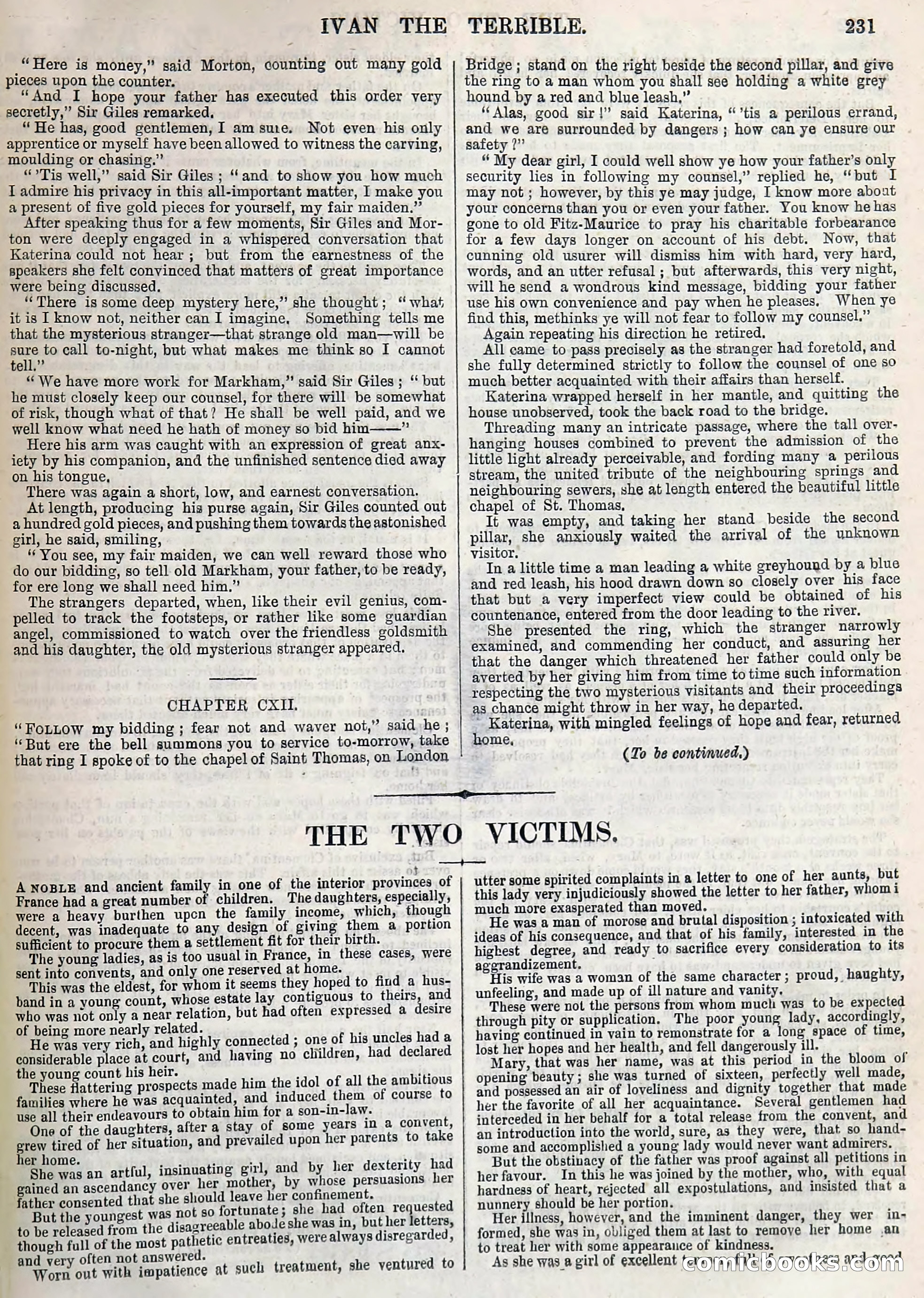
A restored page from Penny Dreadfuls, 1866. Page through the whole issue in the reader above.
📄 Transcribed text from this page (OCR, searchable)
Machine-transcribed from the original scan — historical spelling and the odd misread are preserved.
IVAN “Here is money,” said Morton, counting out many gold pieces upon the counter. “And I hope your father has executed this order very secretly,” Sir Giles remarked, “He has, good gentlemen, I am sure. Not even his only apprentice or myself have been allowed to witness the carving, moulding or chasing.” as ‘Tis well,” said Sir Giles; “‘and to show you how much 1 admire his privacy in this all-important matter, I make you a present of five gold pieces for yourself, my fair maiden.” After speaking thus for a few moments, Sir Giles and Mor- ton were deeply engaged in a whispered conversation that Katerina could not hear; but from the earnestness of the speakers she felt convinced that matters of great importance were being discussed. hes There is some deep mystery here,” she thought; “ what it is I know not, neither can I imagine, Something tells me that the mysterious stranger—that strange old man—will he pure to call to-night, but what makes me think so I cannot e 32 “We have more work for Markham,” said Sir Giles; ‘ but he must closely keep our counsel, for there will be somewhat of risk, though what of that? He shall be well paid, and we well know what need he hath of money so bid him 2 _ Here his arm was caught with an expression of great anx- iety by his companion, and the unfinished sentence died away on his tongue, There was again a short, low, and earnest conversation. At length, producing his purse again, Sir Giles counted out a hundred gold pieces, and pushing them towards the astonished girl, he said, smiling, ‘You see, my fair maiden, we can well reward those who do our bidding, so tell old Markham, your father, to be ready, for ere long we shall need him.” The strangers departed, when, like their evil genius, com- pelled to track the footsteps, or rather like some guardian angel, commissioned to watch over the friendless goldsmith and his daughter, the old mysterious stranger appeared. CHAPTER CXII. “FoLLow my bidding ; fear not and waver not,” said he ; ‘But ere the bell summons you to service to-morrow, take that ring I spoke of to the chapel of Saint Thomas, on London THE TERRIBLE. 231 Bridge ; stand on the right beside the second pillar, and give the ring to a man whom you shall see holding a white grey hound by a red and blue leash,” ‘Alas, good sir!” said Katerina, “’tis a perilous errand, and we are surrounded by dangers; how can ye ensure our safety 2” “ My dear girl, I could well show ye how your father’s only security lies in following my counsel,” replied he, “but I may not; however, by this ye may judge, I know more about your concerns than you or even your father. You know he has gone to old Fitz-Maurice to pray his charitable forbearance for a few days longer on account of his debt. Now, that cunning old usurer will dismiss him with hard, very hard, words, and an utter refusal ; but afterwards, this very night, will he send a wondrous kind message, bidding your father use his own convenience and pay when he pleases, When ye find this, methinks ye will not fear to follow my counsel.” Again repeating his direction he retired. All came to pass precisely as the stranger had foretold, and she fully determined strictly to follow the counsel of one so much better acquainted with their affairs than herself. Katerina wrapped herself in her mantle, and quitting the house unobserved, took the back road to the bridge. Threading many an intricate passage, where the tall over- hanging houses combined to prevent the admission of the little light already perceivable, and fording many a perilous stream, the united tribute of the neighbouring springs and neighbouring sewers, she at length entered the beautiful little chapel of St. Thomas, It was empty, and taking her stand beside the second pillar, she anxiously waited the arrival of the ynknown visitor. In a little time a man leading a white greyhound by a blue and red leash, his hood drawn down so closely over his face that but a very imperfect view could be obtained of his countenance, entered from the door leading to the river. She presented the ring, which the stranger narrowly examined, and commending her conduct, and assuring her that the danger which threatened her father could only be averted by her giving him from time to time such information respecting the two mysterious visitants and their proceedings as chance might throw in her way, he departed. aa with mingled feelings of hope and fear, returned me, (To be continued.) THE TWO VICTIMS. ——_4+—— . A NOBLE and ancient family in one of the interior provinces of France had a great number of children. The daughters, especially, were a heavy burthen upen the family income, which, though decent, was inadequate to any design of giving them a portion sufficient to procure them a settlement fit for their birth. The young ladies, as is too usual in France, in these cases, were sent into convents, and only one reserved at home. This was the eldest, for whom it seems they hoped to find a hus- band in a young count, whose estate lay contiguous to theirs, and who was not only a near relation, but had often expressed a desire of being more nearly related. He was very rich, and highly connected ; one of his uncles had a considerable place at court, and having no cliildren, had declared the young count his heir. fs. These flattering prospects made him the idol of all the ambitious families where he was acquainted, and induced them of course to use all their endeavours to obtain him for a son-in-law. One of the daughters, after a stay of some years in a convent, Be tired of her situation, and prevailed upon her parents to take er home. ; She was an artful, insinuating girl, and by her dexterity had gained an ascendancy over her mother, by whose persuasions her father consented that she should leave her confinement. But the youngest was not so fortunate; she had often requested to be released from the disagreeable abode she was in, but her letters, though full of the most pales entreaties, were always disregarded, often not answered. Be ct out with impatience at such treatment, she ventured to utter some spirited complaints in a letter to one of her aunts, but this lady very injudiciously showed the letter to her father, whomi much more exasperated than moved. He was a man of morose and brutal disposition ; intoxicated with ideas of his consequence, and that of his family, interested in the highest degree, and ready to sacrifice every consideration to its agerandizement, ; His wife was a woman of the same character; proud, haughty, unfeeling, and made up of ill nature and vanity, These were not the persons from whom much was to be expected through pity or supplication. The poor young, lady, accordingly, having continued in vain to remonstrate for a long space of time, lost her hopes and her health, and fell dangerously ill. Mary, that was her name, was at this period in the bloom of opening beauty; she was turned of sixteen, perfectly well made, and possessed an air of loveliness and dignity together that made her the favorite of all her acquaintance. Several gentlemen had ;nterceded in her behalf for a total release from the convent, and an introduction into the world, sure, as they were, that so hand- some and accomplished a young lady would never want admirers. But the obstinacy of the father was proof against all petitions in her favour. In this he was joined by the mother, who, with equal hardness of heart, rejected all expostulations, and insisted that a nunnery should be her portion. Her illness, however, and the imminent danger, they wer in- formed, she was in, obliged them at last to remoye her home .an to treat her with some appearauice of kindness. As she was a girl of excellent tereyan fel aovol "23 Karen