
Penny Dreadfuls, 1866 · page 188 of 276
Ivan the Terrible; or, Dark Deeds of Night — page 188: what you’re looking at
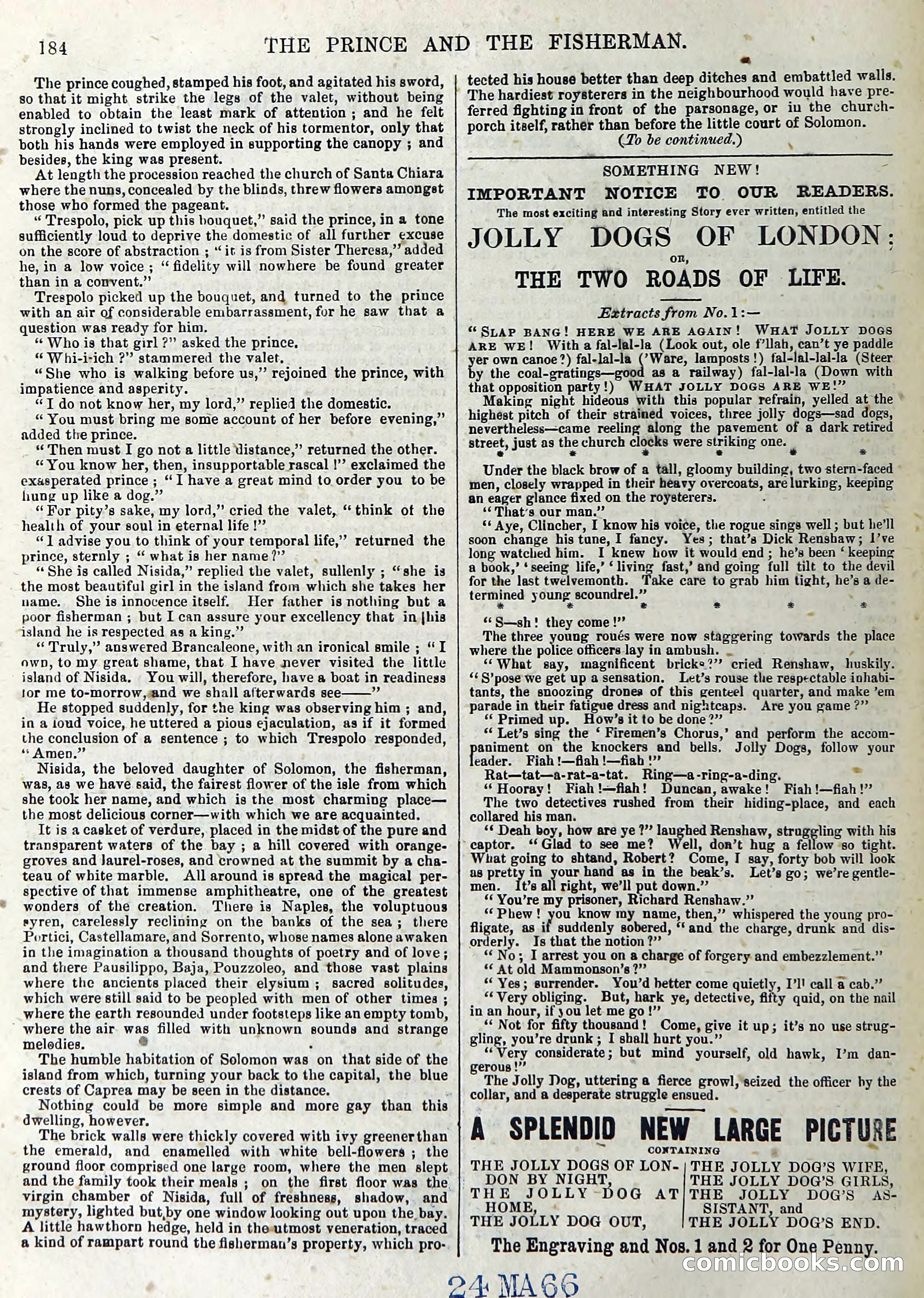
A restored page from Penny Dreadfuls, 1866. Page through the whole issue in the reader above.
📄 Transcribed text from this page (OCR, searchable)
Machine-transcribed from the original scan — historical spelling and the odd misread are preserved.
184 The prince coughed, stamped his foot, and agitated his sword, so that it might strike the legs of the valet, without being enabled to obtain the least mark of attention ; and he felt strongly inclined to twist the neck of his tormentor, only that both his hands were employed in supporting the canopy ; and besides, the king was present. At length the procession reached the church of Santa Chiara where the nuns, concealed by the blinds, threw flowers amongst those who formed the pageant. “ Trespolo, pick up this bouquet,” said the prince, in a tone sufficiently loud to deprive the domestic of all further excuse on the score of abstraction ; “it is from Sister Theresa,’’ added he, in a low voice ; “ fidelity will nowhere be found greater than in a convent.” Trespolo picked up the bouquet, and turned to the prince with an air of considerable embarrassment, for he saw that a question was ready for him. ** Who is that girl ?” asked the prince, ““'W hi-i-ich ?” stammered the valet, ““She who is walking before us,’ rejoined the prince, with impatience and asperity. “T do not know her, my lord,” replied the domestic. “ You must bring me some account of her before evening,” added the prince. “Then must I go not a little distance,’”’ returned the other. “You know her, then, insupportable rascal !’” exclaimed the exasperated prince ; ‘I have a great mind to order you to be hung up like a dog.” “For pity’s sake, my lord,’ cried the valet, ‘think of the health of your soul in eternal life !” “1 advise you to think of your temporal life,” returned the prince, sternly ; “‘ what is her name?”’ . ‘“‘ She is called Nisida,” replied the valet, sullenly ; “she is the most beautiful girl in the island from which she takes her uame. She is innocence itself. Her father is nothing but a poor fisherman ; but I can assure your excellency that in jhis island he is respected as a king.” ‘Truly,’ answered Brancaleone, with an ironical smile ; ‘I own, to my great shame, that I have never visited the little island of Nisida. You will, therefore, have a boat in readiness for me to-morrow,and we shall afterwards see——”’ He stopped suddenly, for the king was observing him ; and, in a loud voice, he uttered a pious ejaculation, as if it formed the conclusion of a sentence ; to which Trespolo responded, ‘* Amen.” Nisida, the beloved daughter of Solomon, the fisherman, was, as we have said, the fairest flower of the isle from which she took her name, and which is the most charming place— the most delicious corner—with which we are acquainted. It is a casket of verdure, placed in the midst of the pure and transparent waters of the bay ; a hill covered with orange- groves and Jaurel-roses, and crowned at the summit by a cha- teau of white marble. All around is spread the magical per- spective of that immense amphitheatre, one of the greatest wonders of the creation. There is Naples, the voluptuous syren, carelessly reclining on the banks of the sea; there Portici, Castellamare, and Sorrento, whose names alone awaken in the imagination a thousand thoughts of poetry and of love; and there Pausilippo, Baja, Pouzzoleo, and those vast plains where the ancients placed their elysium; sacred solitudes, which were still said to be peopled with men of other times ; where the earth resounded under footsteps like an empty tomb, where the air was filled with unknown sounds and strange melodies. ed ‘ The humble habitation of Solomon was on that side of the island from which, turning your back to the capital, the blue crests of Caprea may be seen in the distance. ' Nothing could be more simple and more gay than this dwelling, however. The brick walls were thickly covered with ivy greenerthan the emerald, and enamelled with white bell-flowers ; the ground floor comprised one large room, where the men slept and the family took their meals ; on the first floor was the. |: virgin chamber of Nisida, full of freshness, shadow, and mystery, lighted but,by one window looking out upon the bay. A little hawthorn hedge, held in the-utmost veneration, traced a kind of rampart round the fisherman’s property, which pro- © Lo! ’ captor. THE PRINCE AND THE FISHERMAN. ¢ tected his house better than deep ditches and embattled walls. The hardiest roysterers in the neighbourhood would have pre- ferred fighting in front of the parsonage, or iu the church- porch itself, rather than before the little court of Solomon. (To be continued.) \ SOMETHING NEW! 2; IMPORTANT NOTICE TO OUR READERS. The most exciting and interesting Story ever written, entitled the JOLLY DOGS OF LONDON: on, THE TWO ROADS OF LIFE. Extracts from No.1:— “SLAP BANG! HERE WE ARE AGAIN! WHAT JOLLY DOGS ARE WE! With a fal-lal-la (Look out, ole f’llah, can’t ye paddle er own canoe”) fal-lal-la Ve lamposts !) fal-lal-lal-la (Steer hy the coal-eratings—good as a railway) fal-lal-la (Down with that opposition party!) WHAT JOLLY DOGS ARE WE!” > Making night hideous with this popular refrain, yelled at the © highest pitch of their strained voices, three jolly dogs—sad dogs, nevertheless—came reeling along the pavement of a dark retired street, just as the church clocks were striking one. * * = = v * Under the black brow of a tall, gloomy building, two stern-faced © men, closely wrapped in their heavy overcoats, are lurking, keeping an eager glance fixed on the roysterers. ‘ ‘¢That’s our man.” “¢ Aye, Clincher, I know his voice, the rogue sings well ; but he’ll soon change his tune, I fancy. Yes; that’s Dick Renshaw; I’ve long watched him. I knew how it would end ; he’s been ‘ keeping a book,’ ‘ seeing life,’ ‘living fast,’ and going full tilt to the devil for the last twelvemonth. Take care to grab him tight, he’s a de- termined young scoundrel.” * * + = = * ‘*S—sh! they come!” . The three young roués were now staggering towards the place where the police officers lay in ambush. . P ‘‘What say, magnificent bricke?’’ cried Renshaw, huskily. ‘¢S’pose we get up asensation. Let’s rouse the respectable inhabi- tants, the snoozing dronea of this genteel quarter, and make ’em parade in their fatigue dress and nightcaps. Are you game ?” ‘‘ Primed up. How’s it to be done?” ‘* Let’s sing the ‘ Firemen’s Chorus,’ and perform the accom- animent on the knockers and bells, Jolly Dogs, follow your eader. Fiah!—fiah !—fiah !” Rat—tat—a-rat-a-tat. Ring—a-ring-a-ding. ” “Hooray! Fiah!—fiah! Duncan, awake! Fiah!—fiah!” The two detectives rushed from their hiding-place, and each collared his man. ‘© Deah boy, how are ye ?” laughed Renshaw, straggling with his ‘‘Glad to see me? Well, don’t hug a fellow ‘so tight. What going to shtand, Robert? Come, I say, forty bob will look as prety in your hand as in the beak’s. Let’s go; we’re gentle- men. It’s all right, we’ll put down.”’ ‘© You’re my prisoner, Richard Renshaw.” “Phew! qou know my name, then,” whispered the young pro- fligate, as if suddenly sobered, “‘and the charge, drunk and dis- orderly. Is that the notion?” ‘‘ No; I arrest you on a charge of forgery and embezzlement.” *¢ At old Mammonson’s 2?” “Yes; surrender. You'd better come quietly, I’l!' call a cab.” “Very obliging. But, hark ye, detective, filty quid, on the nail in an hour, if you let me go !’’ ‘* Not for fifty thousand! Come, give it up; it’s no use strug- gling, you’re drunk ; I shall hurt you.” of Very considerate; but mind yourself, old hawk, I’m dan- gerous!’ The Jolly Dog, uttering a fierce growl, seized the officer by the collar, and a desperate struggle ensued. A SPLENDID NEW LARGE PICTURE COXTAINING - THE JOLLY DOGS OF LON-| THE JOLLY DOG’S WIFE, DON BY NIGHT THE JOLLY DOG’S GIRLS, THE JOLLY-DOG AT|THE JOLLY DOGS AS- HOME, » SISTANT, and THE JOLLY DOG OUT, THE JOLLY DOG’S END. The Engraving and Nos. 1 and_2 for One Penny. EOmMmIEgDOOKS.G o A. MA GS6