
Penny Dreadfuls, 1866 · page 187 of 276
Ivan the Terrible; or, Dark Deeds of Night — page 187: what you’re looking at
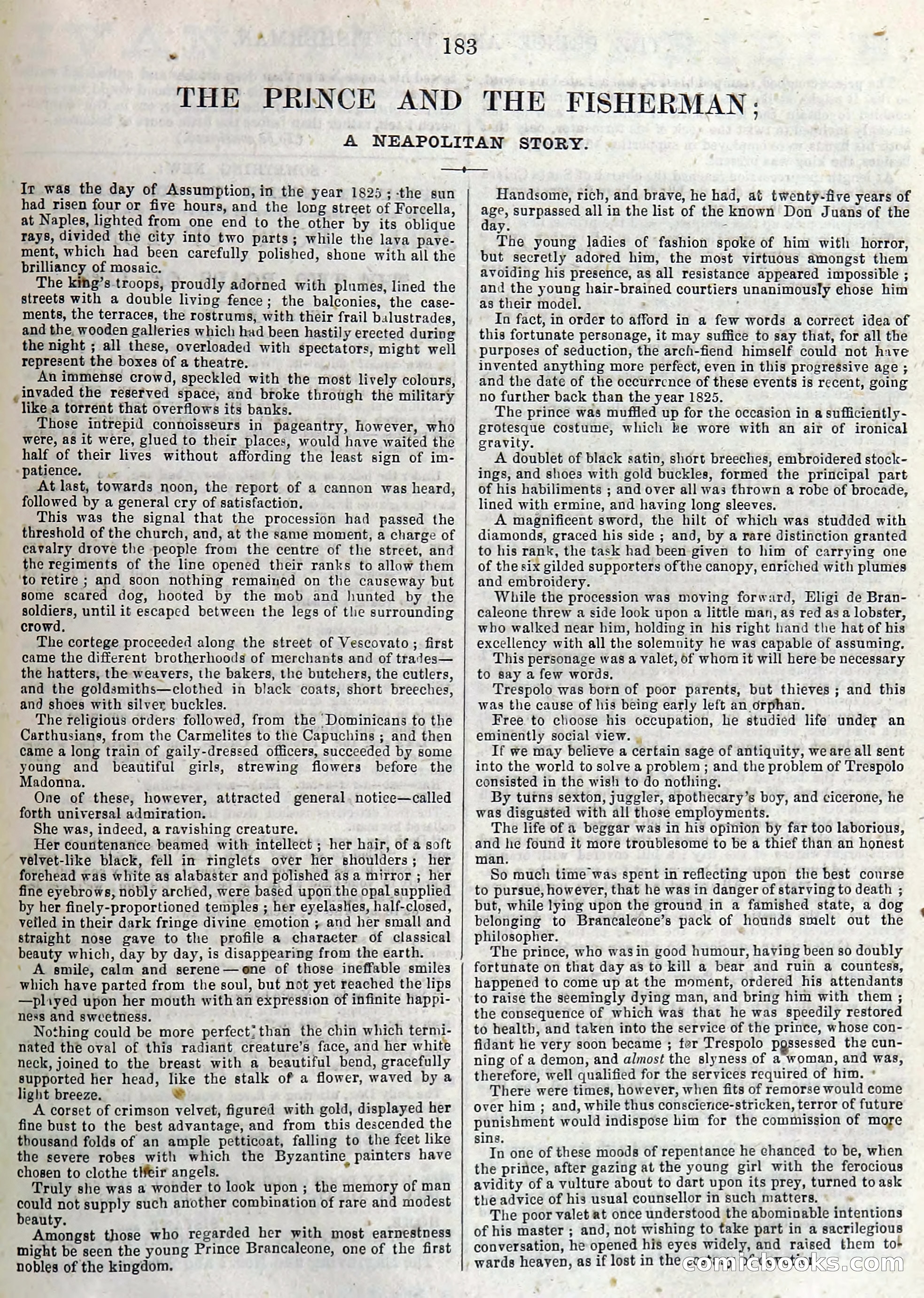
A restored page from Penny Dreadfuls, 1866. Page through the whole issue in the reader above.
📄 Transcribed text from this page (OCR, searchable)
Machine-transcribed from the original scan — historical spelling and the odd misread are preserved.
183 THE PRINCE AND THE FISHERMAN: A NEAPOLITAN STORY. —_—4—_—_ Ir was the day of Assumption, in the year 1825; -the sun had risen four or five hours, and the long street of Forcella, at Naples, lighted from one end to the other by its oblique rays, divided the city into two parts; while the lava pave- ment, which had been carefully polished, shone with all the brilliancy of mosaic. The king’s-troops, proudly adorned with plumes, lined the streets with a double living fence; the balconies, the case- ments, the terraces, the rostrums, with their frail balustrades, and the, wooden galleries which had been hastily erected during the night ; all these, overloaded with spectators, might well represent the boxes of a theatre. An immense crowd, speckled with the most lively colours, invaded the reserved space, and broke throtigh the military like.a torrent that overflows its banks. Those intrepid connoisseurs in pageantry, however, who were, as if were, glued to their places, would have waited the half of their lives without affording the least sign of im- “patience. _- At last, towards noon, the report of a cannon was heard, followed by a general cry of satisfaction. This was the signal that the procession had passed the threshold of the church, and, at the same moment, a charge of cavalry drove the people from the centre of the street, and the regiments of the line opened their ranks to allow them ‘to retire ; and soon nothing remained on the causeway but some scared dog, hooted by the mob and hunted by the pares until it escaped between the legs of tle surrounding crowd. The cortege proceeded along the street of Vescovato ; first came the different brotherhoods of merchants and of trades— the hatters, the weavers, the bakers, the butchers, the cutlers, and the goldsmiths—clothed in black coats, short breeches, and shoes with silver buckles. The religious orders followed, from the Dominicans to the Carthusians, from the Carmelites to the Capuchins ; and then came a long train of gaily-dressed officers, succeeded by some young and beautiful girls, strewing flowers before the Madonna. | One of these, however, attracted general. notice—called forth universal admiration. She was, indeed, a ravishing creature. Her countenance beamed with intellect ; her hair, of a soft velyet-like black, fell in ringlets over her shoulders; her forehead was white as alabaster and polished as a mirror ; her fine eyebrows, nobly arclied, were based upon the opal supplied by her finely-proportioned temples ; her eyelaslies, half-closed, veiled in their dark fringe divine emotion ; and her small and straight nose gave to the profile a character of classical beauty which, day by day, is disappearing from the earth. ' A smile, calm and serene —eone of those ineffable smiles which have parted from the soul, but not yet reached the lips —pliyed upon her mouth with 4n expression of infinite happi- ness and sweetness. Nothing could be more perfect? than the chin which termi- nated the oval of this radiant creature’s face, and her whit neck, joined to the breast with a beautiful bend, gracefully supported her head, like the stalk of a flower, waved by a light breeze. e A corset of crimson velvet, figured with gold, displayed her fine bust to the best advantage, and from this descended the thousand folds of an ample petticoat, falling to the feet like the severe robes with which the Byzantine painters have chosen to clothe tifeir angels. Truly she was a wonder to look upon ; the memory of man could not supply such another combination of rare and modest beauty. , , Amongst those who regarded her with most earnestness might be seen the young Prince Brancaleone, one of the first nobles of the kingdom. Handsome, rich, and brave, he had, at twenty-five years of age, surpassed all in the list of the known Don Juans of the ay. ; The young ladies of fashion spoke of him with horror, but secretly adored him, the most virtuous amongst them avoiding his presence, as all resistance appeared impossible ; and the young hair-brained courtiers unanimously chose him as their model. In fact, in order to afford in a few words a correct idea of this fortunate personage, it may suffice to say that, for all the purposes of seduction, the arch-fiend himself could not have invented anything more perfect, even in this progressive age ; and the date of the occurrence of these events is recent, going no further back than the year 1825. The prince was muffled up for the occasion in a sufficiently- grotesque costume, which he wore with an air of ironical gravity. A doublet of black satin, short breeches, embroidered stock- ings, and shoes with gold buckles, formed the principal part of his habiliments ; and over all was thrown a robe of brocade, lined with ermine, and having long sleeves. A magnificent sword, the hilt of which was studded with diamonds, graced his side ; and, by a rare distinction granted to his rank, the task had been given to him of carrying one of the six gilded supporters of the canopy, enriched with plumes and embroidery. While the procession was moving forward, Eligi de Bran- caleone threw a side look upon a little man, as red as a lobster, who walked near him, holding in his right hand the hat of his excellency with all the solemnity he was capable of assuming, This personage was a valet, of whom it will here be necessary to say a few words. Trespolo was born of poor parents, but thieves ; and this was the cause of his being early left an orphan. Free to choose his occupation, he studied life under an eminently social view. If we may believe a certain sage of antiquity, we are all sent into the world to solve a problem ; and the problem of Trespolo consisted in the wish to do nothing, By turns sexton, juggler, apothecary’s boy, and cicerone, he was disgusted with all those employments. The life of 8 beggar was in his opinion by far too laborious, and he found it more troublesome to be a thief than an honest man. So much time was spent in reflecting upon the best course to pursue, however, that he was in danger of starving to death ; but, while lying upon the ground in a famished state, a dog belonging to Brancaleone’s pack of hounds smelt out the philosopher. The prince, who wasin good humour, having been so doubly fortunate on that day as to kill a bear and ruin a countess, happened to come up at the moment, ordered his attendants to raise the seemingly dying man, and bring him with them ; the consequence of which was that he was speedily restored to health, and taken into the service of the prince, whose con- fidant he very soon became ; fer Trespolo possessed the cun- ning of a demon, and almost the slyness of a woman, and was, therefore, well qualified for the services required of him. * There were times, however, when fits of remorse would come over him ; and, while thus conscierice-stricken, terror of future punishment would indispose him for the commission of more sins. In one of these moods of repentance he ehanced to be, when the pririce, after gazing at the young girl with the ferocious avidity of a vulture about to dart upon its prey, turned toask the advice of his usual counsellor in such matters. The poor valet at once understood the abominable intentions of his master ; and, not wishing to take part in a sacrilegious conversation, he opened his eyes widely, and raised them to wards heayen, as if lost in theevo\fap) 1GbDoCOoO, <GEGOIn