
Penny Dreadfuls, 1866 · page 124 of 276
Ivan the Terrible; or, Dark Deeds of Night — page 124: what you’re looking at
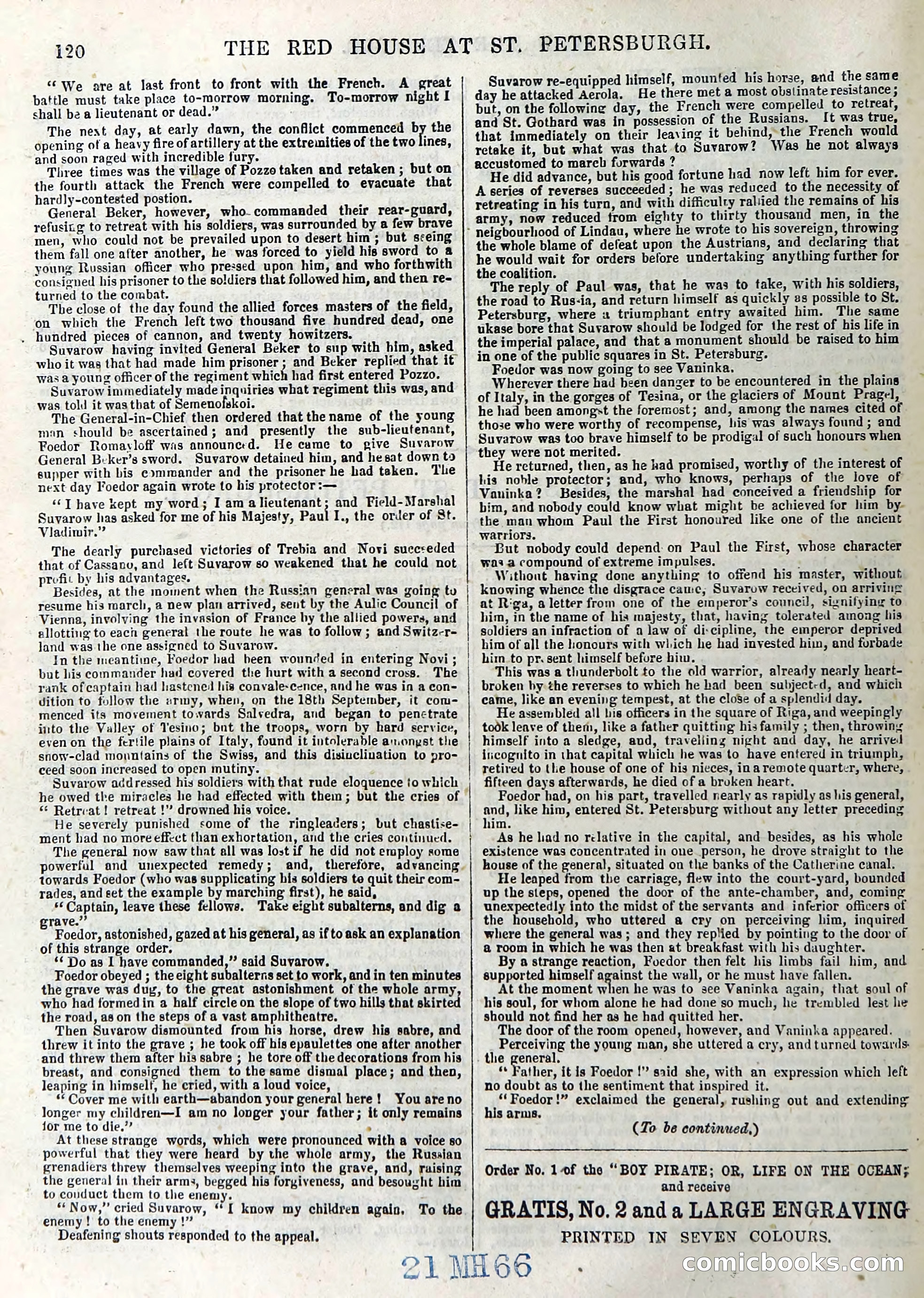
A restored page from Penny Dreadfuls, 1866. Page through the whole issue in the reader above.
📄 Transcribed text from this page (OCR, searchable)
Machine-transcribed from the original scan — historical spelling and the odd misread are preserved.
120 ‘© We are at last front to front with the French. A great battle must take place to-morrow morning. To-morrow night I shall be a lieutenant or dead.” The next day, at early dawn, the conflict commenced by opening of a heavy fire of artillery at the extremities of the two li and soon raged with incredible fury. Three times was the village of Pozzo taken and retaken ; but on the fourth attack the French were compelled to evacuate that hardly-contested postion. 5 General Beker, however, who-commanded their rear-guard, refusing to retreat with his soldiers, was surrounded by a few brave men, who could not be prevailed upon to desert him ; but seeing them fall one after another, he was forced to yield his sword to a young Russian officer who pressed upon him, and who forthwith consigned his prisoner to the soldiers that followed him, and then re- turned to the combat. The close of the day found the allied forces masters of the field, on which the French left two thousand five hundred dead, one . hundred pieces of cannon, and twenty howitzers. Suvarow having invited General Beker to sup with him, asked who it was that had made him prisoner; and Beker replied that it was a young officer of the regiment which had first entered Pozzo. Suvarow immediately made inquiries what regiment this was, and was told it was that of Semenofskoi. The General-in-Chief then ordered that the name of the young man should be ascertained; and presently the sub-lieutenant, Foedor Romavloff was announced. He came to give Suvarow General Beker’s sword. Suvarow detained him, and hesat down to supper with bis eymmander and the prisoner he had taken. The next day Foedor again wrote to his protector :— ‘‘T have kept my word; I am alieutenant; and Field- Marshal Suvarow has asked for me of his Majesty, Paul I., the order of St. Viadimir.” The dearly purchased victories of Trebia and Novi suecseded that of Cassanvu, and left Suvarow so weakened that he could not profit by his advantages. Besides, at the moment when the Russian general was going tu resume his march, a new plan arrived, sent by the Aulic Council of - Vienna, involving the invasion of France by the allied powers, and allotting to each general the route he was to follow; and Switz-r- land was the one assigned to Suvarow. In the meantime, Foedor had been wounded in entering Novi ; but his commander had covered the hurt with a second cross. The rank of captain had hastened his convale-cence, and he was in a con- dition to follow the urmy, when, on the 18th September, it com- menced its movement towards Salvedra, and began to penetrate into the Valley of Tesino; bnt the troops, worn by hard service, even on the fertile plains of Italy, found it intolerable amongst the snow-clad mountains of the Swiss, and this disinclination to pro- ceed soon increased to open mutiny. Suvarow addressed his soldiers with that rude eloquence to which the nes, he owed the miracles he had effected with them; but the cries of © “¢ Retrvat ! retreat !” drowned his voice. He severely punished some of the ringleaders; but chastise- ment had no more effect than exhortation, and the cries continued. The general now saw that all was lost if he did not employ some powerful and unexpected remedy ; towards Foedor (who was supplicating his soldiers te quit their com- rades, and set the example by marching first), he said, ‘© Captain, leave these fellows. Take eight subalterns, and dig a rave.” E Foedor, astonished, gazed at his general, as if to ask an explanation of this strange order, ‘¢ Do as I have commanded,” said Suvarow. Foedor obeyed ; the eight subalterns set to work, and in ten minutes the grave was duy, to the great astonishment of the whole army who had formedin a half circle on the slope of two hills that skirt the road, as on the steps of a vast amphitheatre. Then Suvarow dismounted from his horse, drew his sabre, and threw it into the grave ; he took off his epaulettes one after another and threw them after his sabre ; he tore off the decorations from his breast, and consigned them to the same dismal place; and then, leaping in himself, he cried, with a loud voice, “© Cover me with earth—abandon your general here! You areno longer my children—I am no longer your father; it only remains {or me to die.” . At these strange words, which were pronounced with a voice so powerful that they were heard by the whole army, the Russian grenadiers threw themselves weeping into the grave, and, raising the general in their arms, begged his forgiveness, and besought him to couduct them to the enemy. ** Now,” cried Suvarow, ‘I enemy! to the enemy !” Deafening shouts responded to the appeal. know my children again, To the 21 MH6O . and, therefore, advancing. ee SS * neigbourliood of Lindau, THE RED HOUSE AT ST. PETERSBURGH. Suvarow re-equipped himself, mounfed his horse, and the same day he attacked Aerola. He there met a most obstinate resistance 5 but, on the following day, the French were compelled to retreat, and St. Gothard was in possession of the Russians. It was true, that immediately on their Jeaving it behind, the Freneh would retake it, but what was that to Suvarow? Was he not always accustomed to mareb forwards ? : He did advance, but his good fortune had now left him for ever. A series of reverses succeeded ; he was reduced to the necessity of retreating in his turn, and with difficulty raliied the remains of his army, now reduced from eighty to thirty thousand men, in the where he wrote to his sovereign, throwing the whole blame of defeat upon the Austrians, and declaring that he would wait for orders before undertaking anything further for the coalition. Hime : The reply of Paul was, that he was to take, with his soldiers, the road to Rus-ia, and return himself as quickly as possible to St. Petersburg, where x triumphant entry awaited him. The same ukase bore that Suvarow should be lodged for the rest of his life in the imperial palace, and that a monument should be raised to him in one of the public squares in St. Petersburg. Foedor was now going to see Vaninka. Wherever there had been danger to be encountered in the plains of Italy, in the gorges of Tesina, or the glaciers of Mount Pragel, he had been amongst the foremost; and, among the names cited of those who were worthy of recompense, his was always found ; and Suvarow was too brave himself to be prodigal of such honours when they were not merited. He returned, then, as he had promised, worthy of the interest of his noble protector; and, who knows, perhaps of the love of Vaninka? Besides, the marshal had conceived a friendship for bim, and nobody could know what might be achieved for him by- the man whom Paul the First honoured like one of the ancient warriors. But nobody could depend: on Paul the First, whose character was a compound of extreme impulses. Without having done anything to offend his master, without knowing whence the disgrace came, Suvarow received, on arriving at Riga, aletter from one of the emperor’s council, signifying to him, in the name of his majesty, that, having tolerated among his soldiers an infraction of a law of di-cipline, the emperor deprived him of all the honours with which he had invested him, and forbade him to pr. sent himself before him. oh, This was a thunderbolt to the old warrior, already nearly heart- broken by the reverses to which he had been subject-d, and which came, like an evening tempest, at the clo8e of a splendid day. ' He assembled all his officers in the square of Riga, and weepingly todk leave of them, like a father quitting his family ; then, throwing himself into a sledge, and, travelling night and day, he arrived incognito in that capital which he was to have entered in triumph, © retired to tle house of one of his nieces, ina remote quarter, where, fifteen days afterwards, he died of a broken heart. Foedor had, on his part, travelled nearly as rapidly as his general, and, like him, entered St. Petersburg without any letter preceding 1im. As he liad no relative in the capital, and besides, as his whole existence was concentrated in one person, he drove straight to the house of the general, situated on the banks of the Catherine canal. He leaped from the carriage, flew into the court-yard, bounded up the steps, opened the door of the ante-chamber, and, coming unexpectedly into the midst of the servants and inferior officers of the household, who uttered a cry on perceiving him, inquired where the general was; and they replied by pointing to the door of a room in which he was then at breakfast with his daughter. By a strange reaction, Foedor then felt his limbs fail him, and supported himself against the wall, or he must have fallen. At the moment when he was to see Vaninka again, that soul of his soul, for whom alone he had done so much, he trembled lest he should not find her as he had quitted her. The door of the room opened, however, and Vaninka appeared. Perceiving the young man, she uttered a cry, and turned towards: _the general. ‘* Father, it is Foedor !” said she, with an expression which left no doubt as to the sentiment that inspired it. **Foedor!” exclaimed the general, rushing out and extending his arms. (To be continued,) Order No. 10f the “BOY PIRATE; OR, LIFE ON THE OCEAN; and receive GRATIS, No. 2 anda LARGE ENGRAVING | PRINTED IN SEVEN COLOURS. cComicbooks (le) im