
Penny Dreadfuls, 1866 · page 123 of 276
Ivan the Terrible; or, Dark Deeds of Night — page 123: what you’re looking at
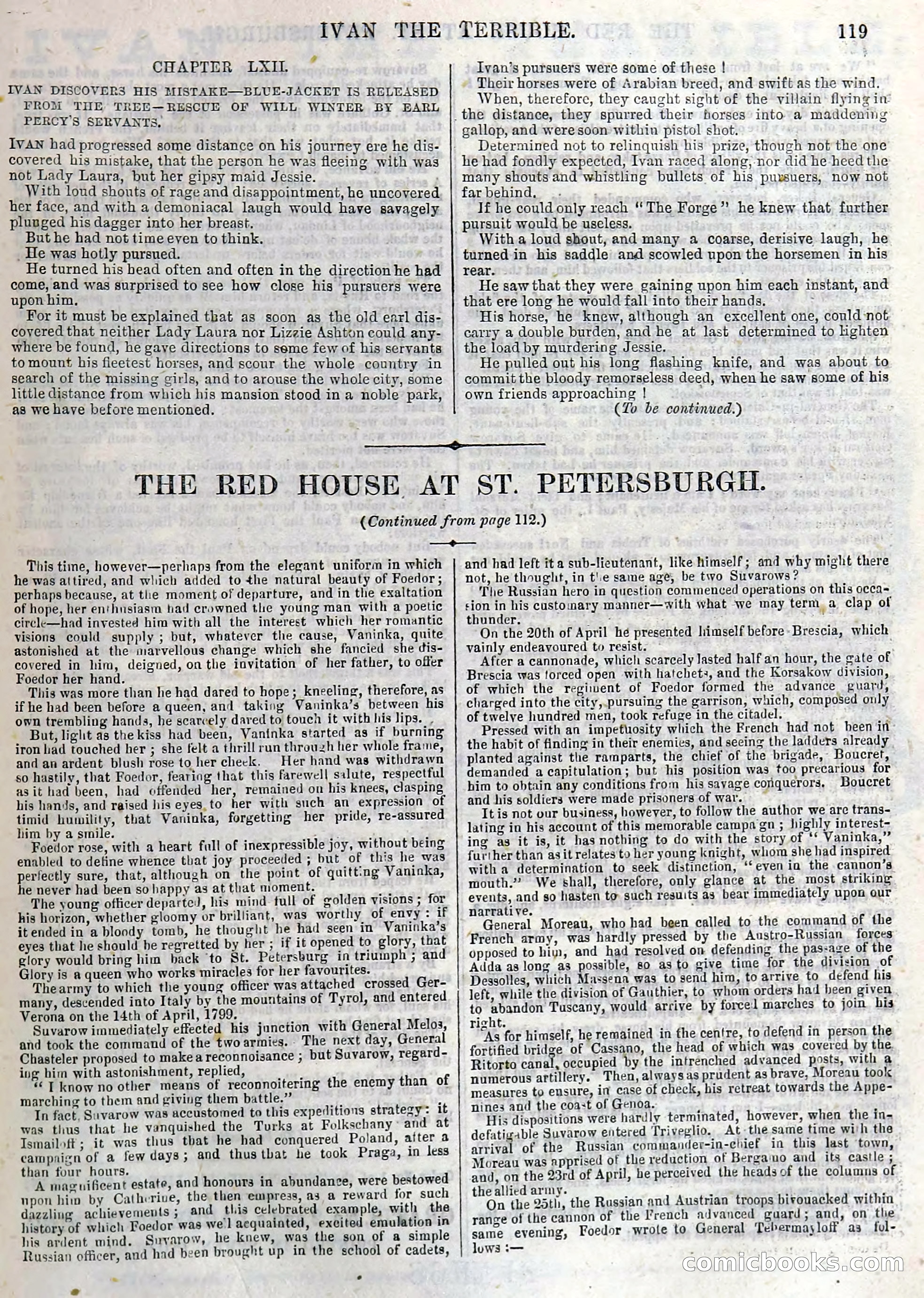
A restored page from Penny Dreadfuls, 1866. Page through the whole issue in the reader above.
📄 Transcribed text from this page (OCR, searchable)
Machine-transcribed from the original scan — historical spelling and the odd misread are preserved.
IVAN THE CHAPTER LXIL ~~ IVAN DISCOVERS HIS MISTAKE—BLUE-JACKET IS RELEASED FROM THE TREE—RESCUE OF WILL. WINTER BY EARL PERCY’S SERVANTS. ~ IVAN had progressed some distance on his journey ere he dis- covered his mistake, that the person he was fleeing with was not Lady Laura, but her gipsy maid Jessie. : With lond shouts of rage and disappointment, he uncovered her face, and with a demoniacal laugh would have savagely plunged his dagger into her breast, | But he had not time eyen to think. _ He was hotly pursued. He turned his head often and often in the direction he had come, and was surprised to see how close his pursuers were upon him. | For it must be explained that as soon as the old earl dis- coyered that neither Lady Laura nor Lizzie Ashton could any- where be found, he gaye directions to seme few of his servants to mount his fieetest horses, and scour the whole country in search of the missing girls, and to arouse the whole city, some little distance from which his mansion stood in a noble park, as we have before mentioned. TERRIBLE. 119 Iyan’s pursuers were some of these ! » Their horses were of Arabian breed, and swift as the wind. When, therefore, they caught sight of the villain’ flying in _the distance, they spurred their fiorses into a maddening gallop, and were soon within pistol shot. Determined not to relinquish his prize, though not the one he had fondly expected, Ivan raced along,-nor did he heed the many shouts and whistling bullets of his puysuers, now not far behind, _. ; If he could only reach “ The Forge’’ he knew that further pursuit would be useless. With a loud shout, and many a Coarse, derisive laugh, he turned in his saddle and scowled upon the horsemen in his rear. a He saw that they were gaining upon him each instant, and that ere long he would fall into their hands. ‘His horse, he knew, although an excellent one, conld not carry a double burden, and he at last determined to hghten the load by murdering Jessie. He pulled out his. long flashing knife, and was about to commit the bloody remorseless deed, when he saw some of his own friends approaching |! (To be continued.) a THE RED HOUSE AT ST. PETERSBURGH. (Continued from page 112.) ——_4—— This time, however—perhaps from the elegant uniform in which he was attired, and which added to the natural beauty of Foedor ; perhaps because, at tle moment of departure, and in the exaltation of hope, her enthusiasm had crowned the young man with a poetic circle-—had invested him with all the interest which her romantic visions could supply ; but, whatever the cause, Vaninka, quite astonished at the marvellous change which she fancied she dis- covered in him, deigned, on the invitation of her father, to offer Foedor her hand. This was more than he had dared to hope; kneeling, therefore, as if he had been before a queen, and taking Vaninka’s between his own trembling hands, he scarcely dared to touch it with his lips. | But, light as the kiss had been, Vaninka started as if burning iron liad touched her ; she felt a thrill run throuzh her whole frame, and an ardent blush rose to her cheek. Her hand was withdrawn so hastily, that Foedor, fearing that this farewell salute, respectful as it had been, had offended her, remained on his knees, clasping his hands, and raised his eyes.to her with such an expression of timid huwility, that Vaninka, forgetting her pride, re-assured him by a smile. eae , Foedor rose, with a heart full of inexpressible joy, without being enabled to define whence that joy proceeded; but of this he was perfectly sure, that, although on the point of quitting Vaninka, he never had been so happy as at that moment. ; The young officer departed, his mind full of golden visions 5 for his horizon, whether gloomy or brilliant, was worthy of envy : if it ended in a bloody tomb, he thought he had seen in Vaninka’s eyes that he should be regretted by her ; if it opened to glory, that elory would bring him back ‘to St. Petersburg in triumph ; and Glory is a queen who works miracles for her favourites. Thearmy to which the young officer was attached crossed Ger- many, descended into Italy by the mountains of Tyrol, and entered Verona on the 14th of April, 1799. : Suvarow immediately effected his junction with General Melos, and took the command of the two armies. The next day, General Chasteler proposed to make a reconnoisance ; but Suvarow, regard- ing him with astonishment, replied, ‘I know no other means of reconnoitering the enemy than of marching to them and giving them battle.” : In fact. Suvarow was accustomed to this expeditions strategy: it was thus that he vanquished the Turks at Folkschany and at Ismailoft; it was thus that he had conquered Poland, atter a campaizn of a fewdays; and thus tbat he took Praga, in less than four hours. A mazuificent estate, and honours in abundance, were bestowed upon him by Catheriue, the then empress, a3 a reward for such dazzling achievements; and this celebrated example, with the history of which Foedor was we'l acquainted, excited emulation in his ardent mind. Suvarow, he knew, was the son of a simple Russian officer, and had been brought up in the school of cadets, and had left ita sub-licutenant, like himself; and why might there not, he thought, in te same age, be two Suvarows? The Russian hero in question commenced operations on this occa- sion in his customary manner—with what we may term a clap of thunder. ay as On the 20th of April he presented ltimself before Brescia, which vainly endeavoured to resist. After a cannonade, which scarcely Jasted half an hour, the gate of Brescia was forced open with hatchets, and the Korsakow division, of which the regiment of Foedor formed the advance guard, charged into the city,.pursuing the garrison, which, composed only of twelve hundred men, took refuge in the citadel. . Pressed with an impetuosity which the French had not heen in the habit of finding in their enemies, and seeing the ladders already planted against the ramparts, the chiet of the brigade, Boucret, demanded a capitulation; but his position was too precarious for him to obtain any conditions from his sayage conquerors, Boucret and his soldiers were made prisoners of war. It is not our business, however, to follow the author we are trans- lating in his account of this memorable campa gn ; highly interest- ing as it is, it has nothing to do with the story of ‘* Vaninka,” further than asitrelates to her young knight, whom she had inspired with a determination to seek distinction, ‘‘evenin the cannon’s mouth.” We shall, therefore, only glance at the most striking events, and so hasten to such resuits as bear immediately upon our narrative. a General Moreau, who had been called to the command of the French army, was hardly pressed by the Austro-Russian forces opposed to hi, and had resolved on defending the pas-aze of the Adda as long as possible, so as to give time for the division of ' Dessolles, which Massena was to send him, to arrive to defend his left, while the division of Gauthier, to whom orders had heen given to abandon Tuscany, would arrive by force:l marches to join his right. “As for himself, he remained in the centre, to defend in person the fortified bridge of Cassano, the head of which was covered by the. Ritorto canal, occupied by the intrenched advanced posts, with a numerous artillery. Then, alwaysas prudent as brave, Moreau took measures to ensure, in case of check, his retreat towards the Appe- nines and the coast of Genoa. . His dispositions were hardly terminated, however, when the in- defatigable Suvarow entered Triveglio. At the same time with the arrival of the Russian commander-in-chief in this last town, Moreau was apprised of the reduction of Bergaino and its castle ; and, on the 23rd of April, be perceived the heads of the columns of the allied army. ; wie ; On the 2atli, the Russian and Austrian troops bivouacked within range of the cannon of the French advanced guard; and, on the same evening, Foedor wrote to General Tebermayloff as ful- luws :— | CONnicaoe® com S