
Penny Dreadfuls, 1857 · page 79 of 394
Agnes, or, Beauty and Pleasure — page 79: what you’re looking at
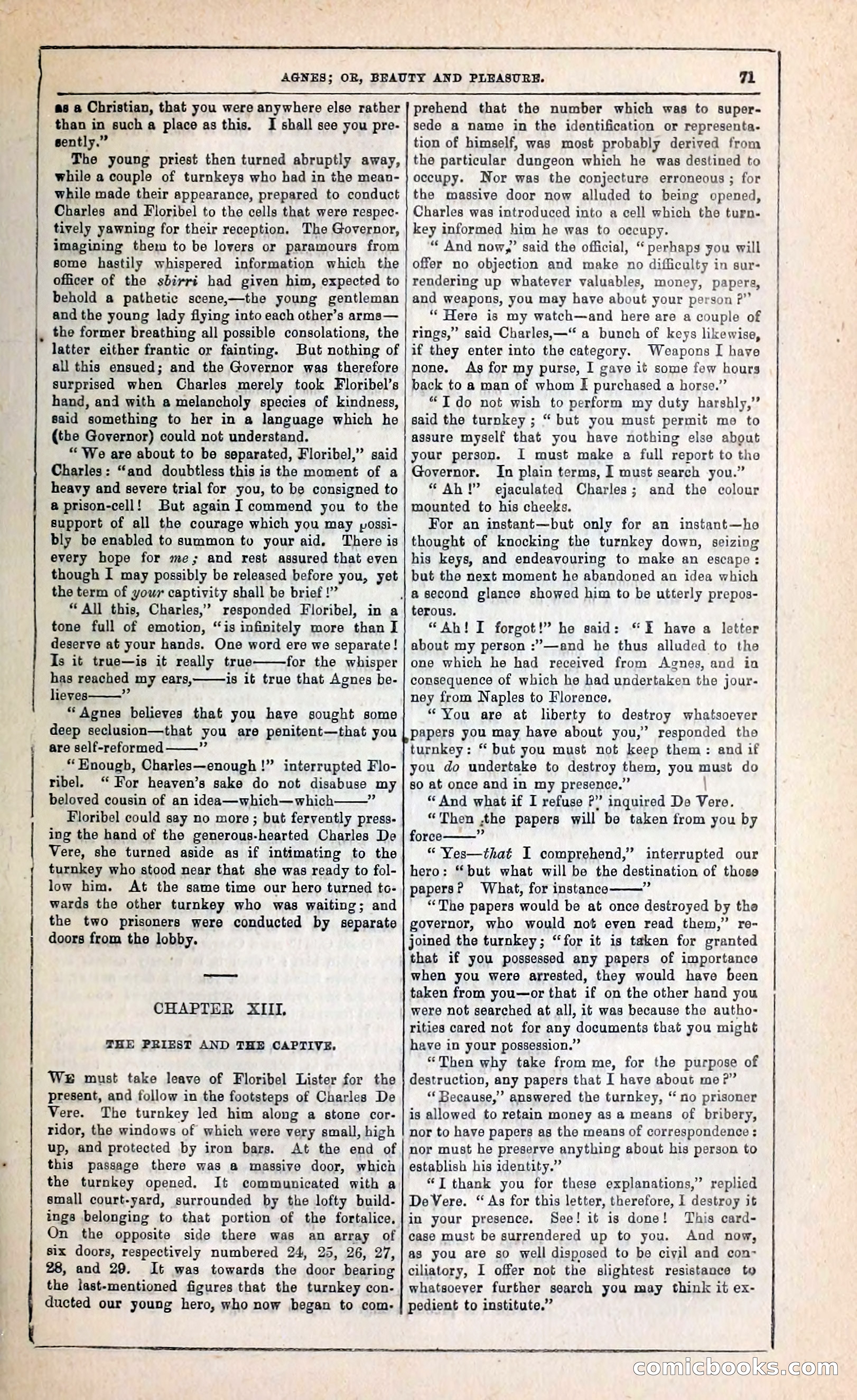
A restored page from Penny Dreadfuls, 1857. Page through the whole issue in the reader above.
📄 Transcribed text from this page (OCR, searchable)
Machine-transcribed from the original scan — historical spelling and the odd misread are preserved.
AGNES; OR, BEAUTY AND PLEASURE. 71 as a Christian, that you were anywhere else rather than in such a place as this. I shall see you pre- sently.” The young priest then turned abruptly away, while a couple of turnkeys who had in the mean- while made their appearance, prepared to conduct Charles and Floribel to the cells that were respec- tively yawning for their reception. The Governor, imagining them to be lovers or paramours from some hastily whispered information which the officer of the sbirri had given him, expected to behold a pathetic scene,—the young gentleman and the young lady flying into each other’s arms— the former breathing all possible consolations, the latter either frantic or fainting. But nothing of all this ensued; and the Governor was therefore surprised when Charles merely took Floribel’s hand, and with a melancholy species of kindness, said something to her in a language which he (the Governor) could not understand. “We are about to be separated, Floribel,” said Charles: “and doubtless this is the moment of a heavy and severe trial for you, to be consigned to @ prison-cell! But again 1 commend you to the support of all the courage which you may possi- bly be enabled to summon to your aid. There is every hope for me; and rest assured that even though I may possibly be released before you, yet the term of your captivity shall be brief !” “All this, Charles,” responded Floribel, in a tone full of emotion, “is infinitely more than I deserve at your hands. One word ere we separate! Is it true—is it really true for the whisper has reached my ears, is it true that Agnes be- lieves 4 “Agnes believes that you have sought some deep seclusion—that you are penitent—that you are self-reformed dg “Enough, Charles—enough !” interrupted Flo- ribel. “For heayen’s sake do not disabuse my beloved cousin of an idea—which—which a4 Floribel could say no more; but fervently press- ing the hand of the generous-hearted Charles De Vere, she turned aside as if intimating to the turnkey who stood near that she was ready to fol- low him. At the same time our hero turned to- wards the other turnkey who was waiting; and the two prisoners were conducted by separate doors from the lobby. CHAPTER XIII, THE PRIEST AND THE CAPTIVE, We must take leave of Floribel Lister for the present, and follow in the footsteps of Charles De Vere. The turnkey led him along a stone cor- ridor, the windows of which were very small, high up, and protected by iron bars. At the end of this passage there was @ massive door, which the turnkey opened. It communicated with a small court-yard, surrounded by the lofty build- ings belonging to that portion of the fortalice, On the opposite side there was an array of six doors, respectively numbered 24, 25, 26, 27, 28, and 29. It was towards the door bearing the last-mentioned figures that the turnkey con- ducted our young hero, who now began to com- prehend that the number which was to super- sede a name in the identification or representa- tion of himself, was most probably derived from the particular dungeon which he was destined to occupy. Nor was the conjecture erroneous ; for the massive door now alluded to being opened, Charles was introduced into a cell which the turn- key informed him he was to occupy. “‘ And now,’ said the official, “ perhaps you will offer no objection and make no difficulty in sur- rendering up whatever valuables, money, papers, and weapons, you may have about your person P”” “Here is my watch—and here are a couple of rings,” said Charles,—“ a bunch of koys likewise, if they enter into the category. Weapons I have mone. As for my purse, I gave it some few hours back to a man of whom I purchased a borse.” “Ido not wish to perform my duty harshly,” said the turnkey ; “ but you must permit me to assure myself that you have nothing else about your person. I must make a full report to the Governor. In plain terms, I must search you.” “Ah!” ejaculated Charles; and the colour mounted to his cheeks. For an instant—but only for an instant—ho thought of knocking the turnkey down, seizing his keys, and endeayouring to make an escape: but the next moment he abandoned an idea which a second glance showed him to be utterly prepos- terous. ; “Ah! I forgot!” he said: “I have a letter about my person :”—and he thus alluded to the one which he had received from Agnes, and in consequence of which he had undertaken the jour- ney from Naples to Florence, “You are at liberty to destroy whatsoever papers you may have about you,” responded the turnkey: “ but you must not keep them: and if you do undertake to destroy them, you must do so at once and in my presence.” “And what if I refuse ?” inquired De Vere. “Then ,the papers will be taken from you by force ms “ Yes—that I comprehend,” interrupted our hero: “but what will be the destination of those papers? What, for instance o “The papers would be at once destroyed by the governor, who would not even read them,” re- joined the turnkey; “for it is taken for granted that if you possessed any papers of importance when you were arrested, they would have been taken from you—or that if on the other hand you were not searched at all, it was because the autho- rities cared not for any documents that you might have in your possession.” “Then why take from me, for the purpose of destruction, any papers that I have about me?” *“‘ Because,” answered the turnkey, “ no prisoner is allowed to retain money as a means of bribery, nor to have papers as the means of correspondence : nor must he preserve anything about his person to establish his identity.” “JT thank you for these explanations,” replied DeVere. “As for this letter, therefore, I destroy it in your presence. See! it is done! This card- case must be surrendered up to you. And now, as you are so well disposed to be ciyil and con- ciliatory, I offer not the slightest resistance to whatsoever further search you may think it ex- pedient to institute.” Comichboo co 5}