
Penny Dreadfuls, 1857 · page 78 of 394
Agnes, or, Beauty and Pleasure — page 78: what you’re looking at
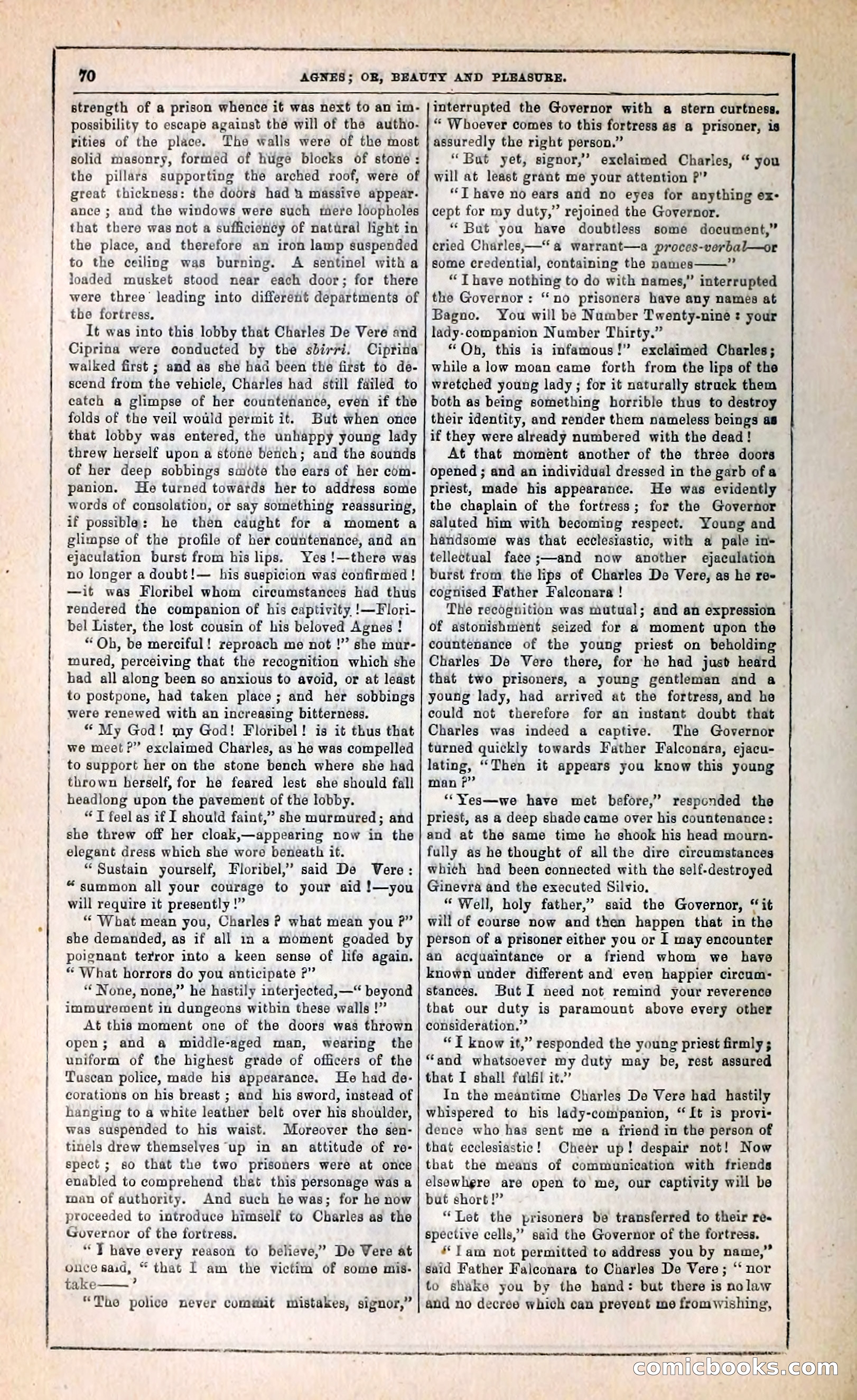
A restored page from Penny Dreadfuls, 1857. Page through the whole issue in the reader above.
📄 Transcribed text from this page (OCR, searchable)
Machine-transcribed from the original scan — historical spelling and the odd misread are preserved.
70 AGNES; OR, BEAUTY AND PLEASURE. strength of a prison whence it was next fo an im- possibility to escape against the will of the autho- rities of the place. The walls were of the most solid masonry, formed of huge blocks of stone: the pillars supporting the arched roof, were of great thickness: the dodrs had h massive appear- ance ; aud the windows were such there loopholes that there was not a sufficiency of natural light in the place, and therefore an iron lamp suspended to the ceiling was burning. A sentinel witha loaded musket stood near each door; for there were three leading into different departments of the fortress. It was into this lobby that Charles De Vere and Ciprina were conducted by the sbirri. Cipritia walked first ; and as she had been the first to de- scend from the vehicle, Charles had still failed to eatch a glimpse of her countenance, even if the folds of the veil would permit it. But when once that lobby was entered, the unhappy young lady threw herself upon a stone bench; and the sounds of her deep sobbings smote the ears of her cbm- panion. He turned towards her to addtess some words of consolation, or say something reassuring, if possible: he then caught for a moment a glimpse of the profile of her countenance, and an ejaculation burst from his lips. Yes !—there was no longer a doubt!— his suspicion was confirmed ! —it was Floribel whom circumstances had thus rendered the companion of his captivity, !—Flori- bel Lister, the lost cousin of his beloved Agnes ! “Ob, be merciful! reproach me not !” she mur- mured, perceiving that the recognition which she had all along been so anxious to avoid, or at least to postpone, had taken place ; and her sobbings were renewed with an increasing bitterness. “ My God! my God! Floribel! is it thus that we meet?” exclaimed Charles, as he was compelled to support her on the stone bench where she had thrown herself, for he feared lest she should fall headlong upon the pavement of the lobby. * T feel as if I should faint,” she murmured; and she threw off her cloak,—appearing now in the elegant dress which she wore beneath if. “Sustain yourself, Floribel,” said De Vere: “summon all your courage to your aid !—you will require it presently !” “What mean you, Charles ? what mean you ?” she demanded, as if all 1n a moment goaded by poignant terror into a keen sense of life again. “What horrors do you anticipate P” ‘* None, none,” he hastily interjected,—“ beyond immurement in dungeons within these walls !” At this moment one of the doors was thrown open; and a middle-aged man, wearing the uniform of the highest grade of officers of the Tuscan police, made his appearance. He had de- corations on his breast ; and his sword, instead of hanging to a white leather belt over his shoulder, was suspended to his waist. Moreover the sen- tinels drew themselves up in an attitude of ro- spect ; so that the two prisoners were at once enabled to comprehend that this personage was a roan of authority. And such he was; for he now proceeded to introduce himself to Charles as the Governor of the fortress. “J have every reason to believe,” Do Vere at once said, “ that I am the victim of some mis- take , “The police never comemit mistakes, signor,” — me ee $LIST aa a interrupted the Governor with a stern curtness, “ Whoever comes to this fortress as a prisoner, is assuredly the right person.” “But yet, signor,”’ exclaimed Charles, “ you will at least grant me your attention P” ‘“‘T have no ears and no eyes for anything ex- cept for my duty,” rejoined the Governor. “But you have doubtless some document,” eried Charles,—“ a warrant—a proces-vorbal—or some credential, containing the names Pe “ Thave nothing to do with names,” interrupted the Governor: ‘no prisonera have any names at Bagno. You will be Number Twenty-nine : your lady-companion Number Thirty.” “Oh, this is infamous!” exclaimed Charles; while a low moan came forth from the lips of the wretched young lady; for it naturally strack them both as being something horrible thus to destroy their identity, and render them nameless beings as if they were already numbered with the dead! At that moment another of the three doors opened ; and an individual dressed in the garb ofa priest, made his appearance. the chaplain of the fortress; for the Governor saluted him with becoming respect. Young and handsome was that ecclesiastic, with a pale in+ tellectual face ;—and now another ejacalation burst from the lips of Charles De Vere, as he re- cognised Father Falconara ! The recognition was mutual; and an expression © of astonishment seized for a moment upon the countenance of the young priest on beholding Charles De Vere there, for he had just heard that two prisoners, a young gentleman and a young lady, had arrived at the fortress, and he could not therefore for an instant doubt that Charles was indeed a captive. The Governor turned quickly towards Father Falconara, ejacu- lating, “Then it appears you know this young man P” ‘*Yes—we have met before,” responded the priest, as a deep shade came over his countenance: and at the same time he shook his head mourn. fully as he thought of all the dire circumstances which had been connected with the self-destroyed Ginevra and the executed Silvio. “ Well, holy father,” said the Governor, “it will of course now and then happen that in the person of a prisoner either you or I may encounter an acquaintance or a friend whom we have known under different and even happier circum: © stances. But I need not remind your reverence that our duty is paramount above every other consideration.” “T know it,” responded the young priest firmly ; “and whatsoever my duty may be, rest assured that I shall fulfil it.” In the meantime Charles De Vere had hastily whispered to his lady-companion, “ {t is provi- dence who has sent me a friend in the person of that ecclesiastic! Cheer up! despair not! Now that the means of communication with friends elsowhgre are open to me, our captivity will be but short!” “Let the prisoners be transferred to their re. spective cells,’ said the Governor of the fortress. “Tam not permitted to address you by name,” said Father Faleonara to Charles De Vere; ‘‘ nor to shake you by the hand: but there is nolaw and no decree which can prevent me fromwishing, =e all (EO) DOOKS (a) He was evidently .