
Penny Dreadfuls, 1857 · page 366 of 394
Agnes, or, Beauty and Pleasure — page 366: what you’re looking at
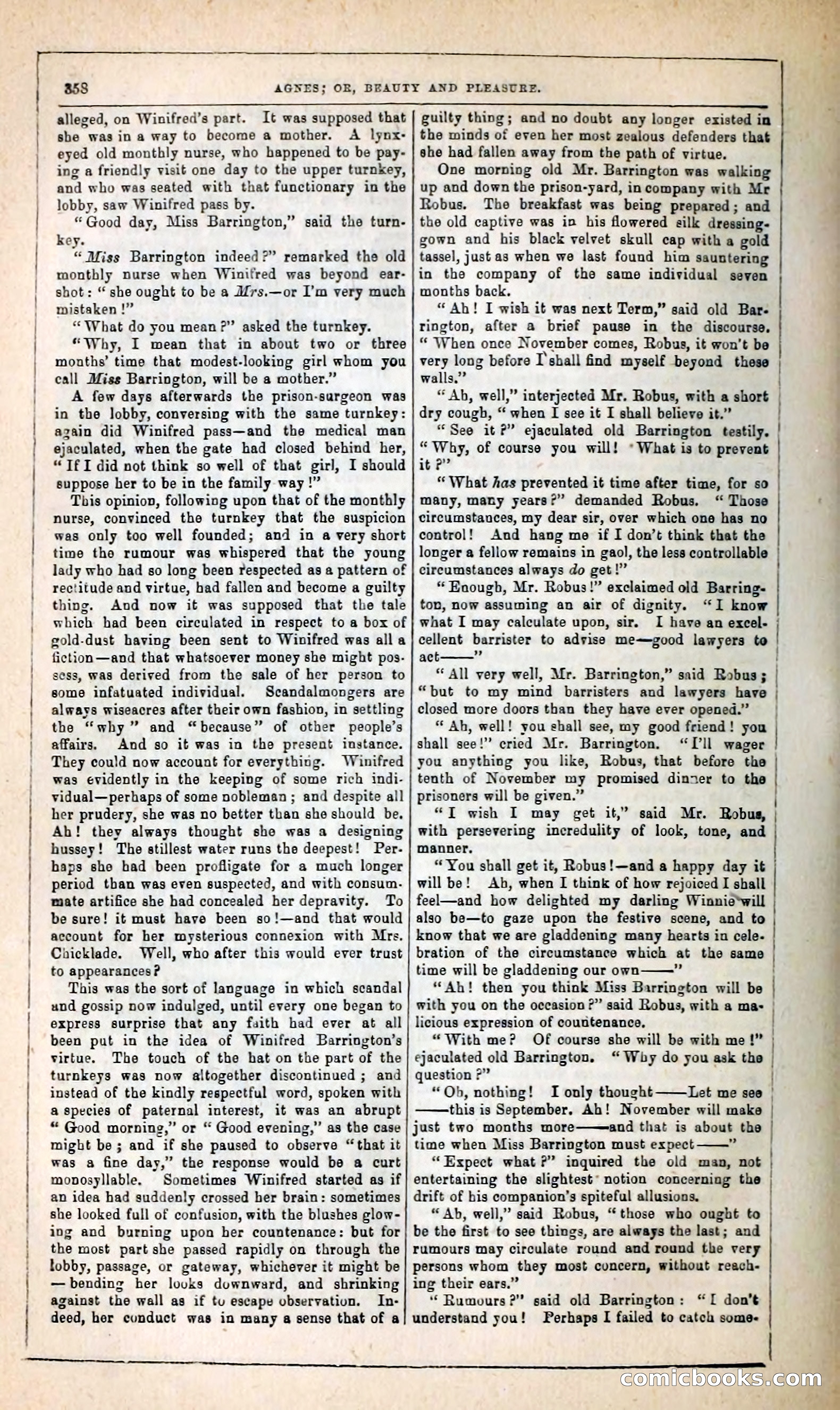
A restored page from Penny Dreadfuls, 1857. Page through the whole issue in the reader above.
📄 Transcribed text from this page (OCR, searchable)
Machine-transcribed from the original scan — historical spelling and the odd misread are preserved.
———— ee _ _ — o< Ss ee sss ssn ————— — — — 358 alleged, on Winifred’s part. It was supposed that she was in a way to become a mother. A lynx- eyed old monthly nurse, who happened to be pay- ing a friendly visit one day to the upper turnkey, and who was seated with that functionary in the lobby, saw Winifred pass by. “Good day, Miss Barrington,” said the turn- key. “ Miss Barrington indeed?” remarked the old monthly nurse when Winifred was beyond ear- shot: “ she ought to be a M7ys.—or I’m very much mistaken !” “What do you mean?” asked the turnkey. “Why, I mean that in about two or three mouths’ time that modest-looking girl whom you call Miss Barrington, will be a mother.” A few days afterwards the prison-sargeon was in the lobby, conversing with the same turnkey: again did Winifred pass—and the medical man ejaculated, when the gate had closed behind her, “Tf I did not think so well of that girl, I should suppose her to be in the family way !” This opinion, following upon that of the monthly nurse, convinced the turnkey that the suspicion was only too well founded; and in a very short time the rumour was whispered that the young lady who had so long been respected as a pattern of rectitude and virtue, had fallen and become a guilty thing. And now it was supposed that the tale which had been circulated in respect to a box of gold-dust having been sent to Winifred was alla fiction —and that whatsoever money she might pos- sess, was derived from the sale of her person to some infatuated individual. Scandalmongers are always wiseacres after their own fashion, in settling the “why” and “because” of other people’s affairs. And so if was in the present instance. They could now account for everything. Winifred was evidently in the keeping of some rich indi- vidual—perhaps of some nobleman; and despite all her prudery, she was no better than she should be. Ah! they always thought she was a designing hussey! The stillest water runs the deepest! Per- haps she had been profligate for a much longer period than was even suspected, and with consum.- mate artifice she had concealed her depravity. To be sure! it must have been so!—and that would account for her mysterious connexion with Mrs. Chicklade. Well, who after this would ever trust to appearances? This was the sort of language in which scandal und gossip now indulged, until every one began to express surprise that any faith bad ever at all been put in the idea of Winifred Barrington’s virtue. The touch of the hat on the part of the turnkeys was now altogether discontinued ; and instead of the kindly respectful word, spoken with a species of paternal interest, it was an abrupt “ Good morning,” or “ Good evening,” as the case might be ; and if she paused to observe “that it was a fine day,” the response would be a curt monosyllable. Sometimes Winifred started as if an idea had suddenly crossed her brain: sometimes she looked full of confusion, with the blushes glow- ing and burning upon her countenance: but for the most part she passed rapidly on through the lobby, passage, or gateway, whichever it might be — bending her lovuks downward, and shrinking against the wall as if tu escape observation. In- deed, her cunduct was in many a sense that of a AGNES; OR, BEAUTY AND PLEASURE. guilty thing; and no doubt any longer existed in the minds of even her most zealous defenders that she had fallen away from the path of virtue. One morning old Mr. Barrington was walking up and down the prison-yard, in company with Mr Robus. The breakfast was being prepared; and the old captive was in his flowered ailk dressing- gown and his black velvet skull cap with a gold tassel, just as when we last found him sauntering in the company of the same individual seven months back. “ Ah! I wish it was next Term,” said old Bar rington, after a brief pause in the discourse. “ When once November comes, Robus, it won't be very long before I'shall find myself beyond these walls,” “Ab, well,” interjected Mr. Robus, with a short dry cough, “ when I see it I shall believe it.” “See it?” ejaculated old Barrington teatily. “Why, of course you will! * What is to prevent it ?” “ What fas prevented it time after time, for so many, many years?” demanded Robus. “ Those circumstances, my dear sir, over which one has no control! And hang me if I don’t think that the longer a fellow remains in gaol, the less controllable circumstances always do get!” “Enough, Mr. Robus!” exclaimed old Barring- ton, now assuming an air of dignity. “I know what I may calculate upon, sir. I have an excel- cellent barrister to advise me—good lawyers to act ” * All very well, Mr. Barrington,” said Robus ; “but to my mind barristers and lawyers have closed more doors than they have ever opened.” * Ah, well! you ehall see, my good friend! you shall see!” cried Mr. Barrington. “I'll wager you anything you like, Robus, that before the | tenth of November my promised dinner to the prisoners will be given.” “T wish I may get it,” said Mr. Robus, with persevering incredulity of look, tone, and manner. “You shall get it, Robus!—and a happy day it will be! Ab, when I think of how rejoiced I shall feel—and how delighted my darling Winnie*will also be—to gaze upon the festive scene, and to know that we are gladdening many hearts in cele- bration of the circumstance which at the same time will be gladdening our own wa ‘Ah! then you think Miss Barrington will be with you on the occasion?” said Robus, with a ma- licious expression of countenance, “With me? Of course she will be with me!” ejaculated old Barrington. “Why do you ask the question ?” “Ob, nothing! I only thought Let me see | this is September. Ah! November will make | just two months more and that is about the time when Miss Barrington must expect y “Expect what ?” inquired the old man, not entertaining the slightest’ notion concerning the | drift of bis companion’s spiteful allusions. | * Ab, well,” said Robus, “those who ought to be the first to see things, are always the last; and rumours may circulate round and round the very persons whom they most concern, without reach- ing their ears.” ‘‘ Rumours ?” said old Barrington: “I don’t understand you! Perhaps I failed to catch some- COMMIG LOCO <S