
Penny Dreadfuls, 1857 · page 365 of 394
Agnes, or, Beauty and Pleasure — page 365: what you’re looking at
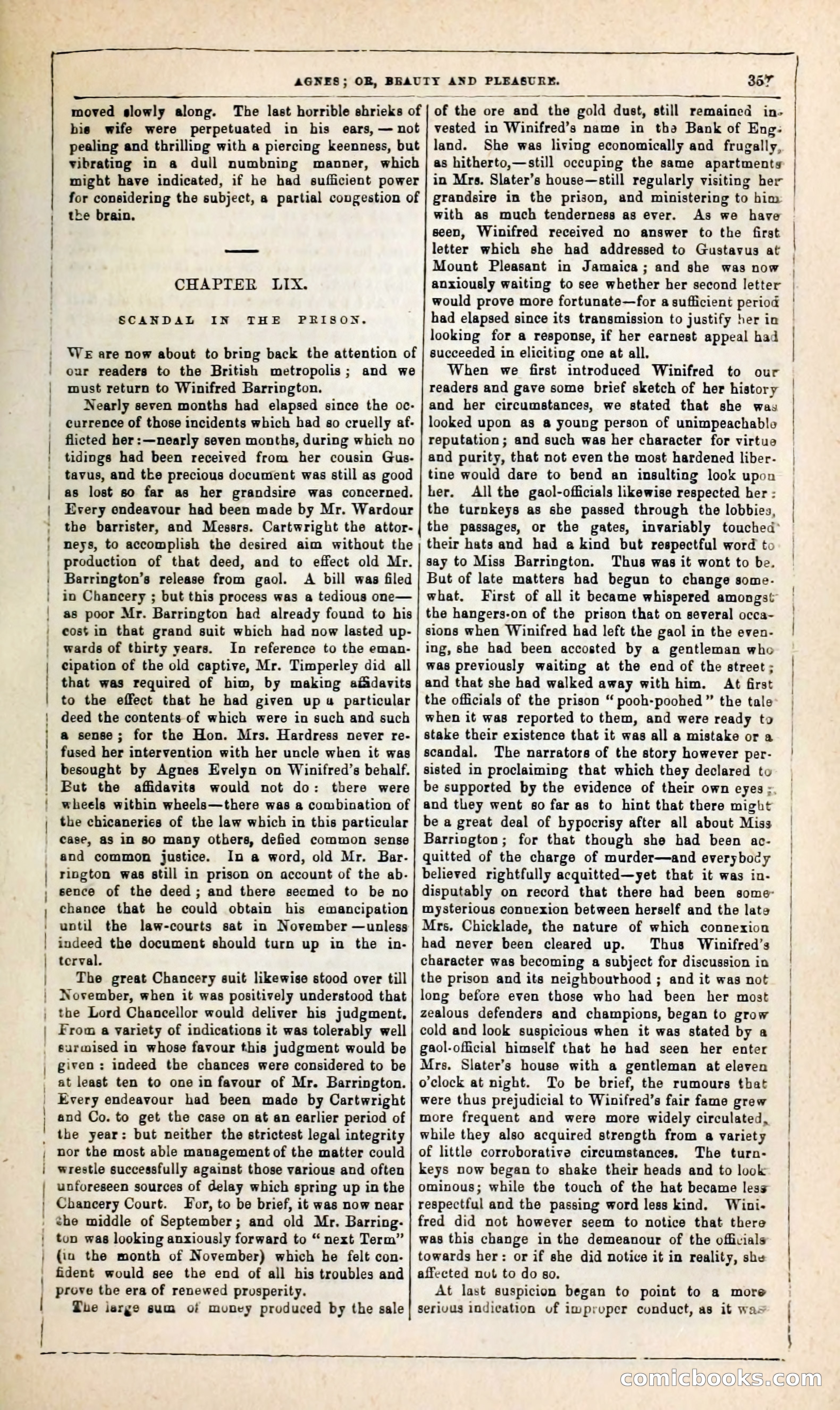
A restored page from Penny Dreadfuls, 1857. Page through the whole issue in the reader above.
📄 Transcribed text from this page (OCR, searchable)
Machine-transcribed from the original scan — historical spelling and the odd misread are preserved.
SE EO Paka . dm! —— ee ee ee | eee Se ee ee SE ON i, deen - \— AGNES; OR, BEAUTY AND PLEASURE. 367 moved slowly along. The last horrible shrieks of bie wife were perpetuated in his ears, — not pealing and thrilling with a piercing keenness, but vibrating in a dull numbning manner, which might have indicated, if he had sufficient power for considering the subject, a partial congestion of the brain. CHAPTER LIX. SCANDAL IN THE PRISON. We are now about to bring back the attention of our readers to the British metropolis; and we must return to Winifred Barrington. Nearly seven months had elapsed since the oc- currence of those incidents which had go cruelly af- flicted her:—nearly seven months, during which no tidings had been received from her cousin Gus- tavus, and tke precious document was still as good as lost so far as her grandsire was concerned. Every endeavour had been made by Mr. Wardour the barrister, and Messrs. Cartwright the attor- neys, to accomplish the desired aim without the production of that deed, and to effect old Mr. Barrington’s release from gaol. A Dill was filed in Chancery ; but this process was a tedious one— as poor Mr. Barrington had already found to his cost in that grand suit which had now lasted up- wards of thirty years. In reference to the eman- cipation of the old captive, Mr. Timperley did all that was required of him, by making aéidavits to the effect that he had given up 4 particular deed the contents of which were in such and such a sense; for the Hon. Mrs. Hardress never re- fused her intervention with her uncle when it was besought by Agnes Evelyn on Winifred’s behalf. But the affidavits would not do: there were wheels within wheels—there was a combination of the chicaneries of the law which in this particular case, as in 80 many others, defied common sense and common justice. In a word, old Mr. Bar- rington was still in prison on account of the ab- sence of the deed; and there seemed to be no chance that he could obtain his emancipation until the law-courts sat in November —unless indeed the document should turn up in the in- terval. The great Chancery suit likewise stood over till November, when it was positively understood that the Lord Chancellor would deliver his judgment. From a variety of indications it was tolerably well surmised in whose favour this judgment would be given: indeed the chances were considered to be at least ten to one in favour of Mr. Barrington. Every endeavour had been made by Cartwright and Co. to get the case on at an earlier period of the year: but neither the strictest legal integrity nor the most able management of the matter could wrestle successfully against those various and often unforeseen sources of delay which spring up in the Chancery Court. For, to be brief, it was now near the middle of September; and old Mr. Barring: tun was looking anxiously forward to “ next Term” (ia the month of November) which he felt con- fident would see the end of all his troubles and prove the era of renewed prosperity. Phe iarge sum of muney produced by the sale of the ore and the gold dust, still remained in- vested in Winifred’s name in tha Bank of Eng- land. She was living economically and frugally, as hitherto,—still occuping the same apartments in Mrs. Slater’s house—still regularly visiting her grandsire in the prison, and ministering to him with as much tenderness as ever. As we have seen, Winifred received no answer to the first letter which she had addressed to Gustavus at Mount Pleasant in Jamaica; and she was now anxiously waiting to see whether her second letter would prove more fortunate—for a sufficient period had elapsed since its transmission to justify her in looking for a response, if her earnest appeal had succeeded in eliciting one at all. When we first introduced Winifred to our readers and gave some brief sketch of her history and her circumstances, we stated that she was looked upon as a young person of unimpeachable reputation; and such was her character for virtue and purity, that not even the most hardened liber- tine would dare to bend an insulting look upon her. All the gaol-officials likewise respected her : the turnkeys as she passed through the lobbies, the passages, or the gates, invariably touched’ their hats and had a kind but respectful word to say to Miss Barrington. Thus was it wont to be. But of late matters had begun to change some- what. First of all it became whispered amongst the hangers-on of the prison that on several occa- sions when Winifred had left the gaol in the even- ing, she had been accosted by a gentleman who was previously waiting at the end of the street ; and that she had walked away with him. At first the officials of the prison “ pooh-poohed” the tale when it was reported to them, and were ready to stake their existence that it was all a mistake or a scandal. The narrators of the story however per- sisted in proclaiming that which they declared to be supported by the evidence of their own eyes ;. and they went so far as to hint that there might be a great deal of hypocrisy after all about Miss Barrington; for that though she had been ac- quitted of the charge of murder—and everybocy believed rightfully acquitted—yet that it was in- disputably on record that there had been some- mysterious connexion between herself and the late Mrs. Chicklade, the nature of which connexion had never been cleared up. Thus Winifred’s character was becoming a subject for discussion in the prison and its neighbourhood ; and it was not long before even those who had been her most zealous defenders and champions, began to grow cold and look suspicious when it was stated by a gaol-official himself that he had seen her enter Mrs. Slater’s house with a gentleman at eleven o'clock at night. To be brief, the rumours that were thus prejudicial to Winifred’s fair fame grew more frequent and were more widely circulated, while they also acquired strength from a variety of little corroborative circumstances, The turn- keys now began to shake their heads and to look ominous; while the touch of the hat became less respectful and the passing word less kind. Wini- fred did not however seem to notice that there was this change in the demeanour of the officials towards her: or if she did notice it in reality, she affected not to do so. At last suspicion began to point to a more seriuus indication uf improper conduct, as it was CoOMmicooolks } |