
Penny Dreadfuls, 1857 · page 284 of 394
Agnes, or, Beauty and Pleasure — page 284: what you’re looking at
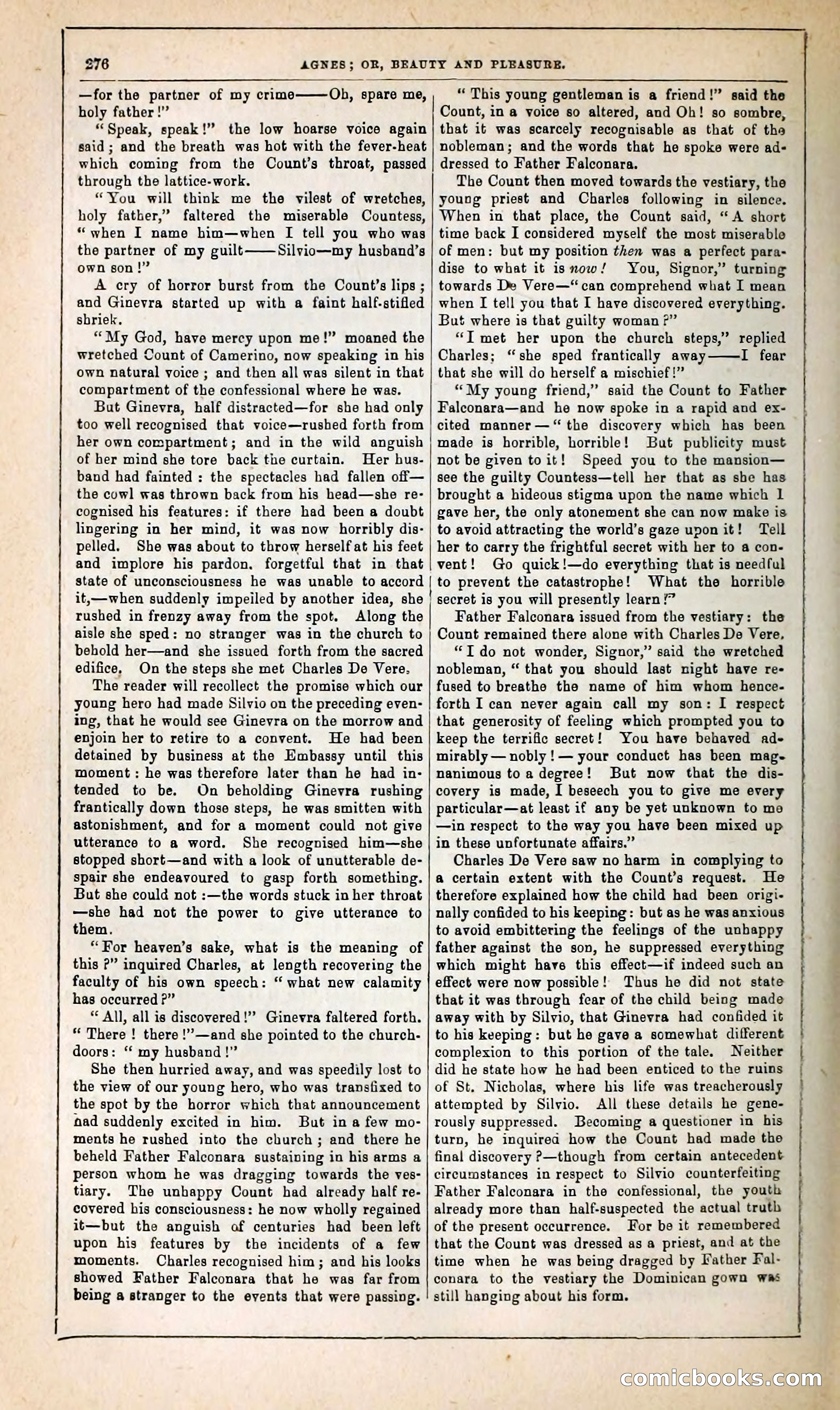
A restored page from Penny Dreadfuls, 1857. Page through the whole issue in the reader above.
📄 Transcribed text from this page (OCR, searchable)
Machine-transcribed from the original scan — historical spelling and the odd misread are preserved.
276 —for the partner of my crime——Ob, spare me, holy father !” “Speak, speak!” the low hoarse voice again said; and the breath was hot with the fever-heat which coming from the Count’s throat, passed through the lattice-work. “You will think me the vilest of wretches, holy father,” faltered the miserable Countess, “when I name him—when [I tell you who was the partner of my guilt Silvio—my husband’s own son!” A ery of horror burst from the Count’s lips ; and Ginevra started up with a faint half-stifled shriek. “My God, have mercy upon me!” moaned the wretched Count of Camerino, now speaking in his own natural voice ; and then all was silent in that compartment of the confessional where he was. But Ginevra, half distracted—for she had only too well recognised that voice—rushed forth from her own compartment; and in the wild anguish of her mind she tore back the curtain. Her hus- band had fainted : the spectacles had fallen off— the cowl was thrown back from his head—she re- cognised his features: if there had been a doubt lingering in her mind, it was now horribly dis- pelled. She was about to throw herself at his feet and implore his pardon. forgetful that in that state of unconsciousness he was unable to accord it,—when suddenly impeiled by another idea, she rushed in frenzy away from the spot. Along the aisle she sped: no stranger was in the church to behold her—and she issued forth from the sacred edifice, On the steps she met Charles De Vere. The reader will recollect the promise which our young hero had made Silvio on the preceding even- ing, that he would see Ginevra on the morrow and enjoin her to retire to a convent. He had been detained by business at the Embassy until this moment : he was therefore later than he had in- tended to be. On beholding Ginevra rushing frantically down those steps, he was smitten with astonishment, and for a moment could not give utterance to a word. She recognised him—she stopped short—and with a look of unutterable de- spair she endeavoured to gasp forth something. But she could not :—the words stuck in her throat —she had not the power to give utterance to them. “For heaven’s sake, what is the meaning of this ?” inquired Charles, at length recovering the faculty of his own speech: “ what new calamity has occurred ?” * All, all is discovered !’’ Ginevra faltered forth. “ There ! there !”—and she pointed to the church- doors: “‘ my husband !” She then hurried away, and was speedily lost to the view of our young hero, who was transfixed to the spot by the horror which that announcement nad suddenly excited in him. But in a few mo- ments he rushed into the church; and there he beheld Father Falconara sustaining in his arms a person whom he was dragging towards the ves- tiary. The unhappy Count had already half re- covered his consciousness: he now wholly regained it—but the anguish of centuries had been left upon his features by the incidents of a few moments. Charles recognised him; and his looks showed Father Falconara that he was far from being a stranger to the events that were passing. AGNES; OR, BEAUTY AND PLEASURE, “This young gentleman is a friend!” said the Count, in a voice so altered, and Oh! so sombre, that it was scarcely recognisable as that of the nobleman; and the words that he spoke were ad- dressed to Father Falconara. The Count then moved towards the vestiary, the young priest and Charles following in silence. When in that place, the Count said, “A short time back I considered myself the most miserable of men: but my position then was a perfect para- dise to what it is now! You, Signor,” turning towards De Vere—“ can comprehend what I mean when I tell you that I have discovered everything. But where is that guilty woman?” “T met her upon the church steps,” replied Charles; “she sped frantically away I fear that she will do herself a mischief!” *“My young friend,” said the Count fo Father Falconara—and he now spoke in a rapid and ex- cited manner—‘“ the discovery which has been made is horrible, horrible! But publicity must not be given toit! Speed you to the mansion— see the guilty Countess—tell her that as she has brought a hideous stigma upon the name which 1 gave her, the only atonement she can now make is to avoid attracting the world’s gaze upon it! Tell her to carry the frightful secret with her to a con- vent! Go quick!—do everything that is needful to prevent the catastrophe! What the horrible secret is you will presently learn!” Father Falconara issued from the vestiary: the Count remained there alone with Charles De Vere, “Tdo not wonder, Signor,” said the wretched nobleman, “ that you should last night have re- fused to breathe the name of him whom hence- forth I can never again call my son: I respect that generosity of feeling which prompted you to keep the terrific secret! You have behaved ade mirably — nobly !— your conduct has been mage nanimous to a degree! But now that the dis- covery is made, I beseech you to give me every particular—at least if any be yet unknown to me —in respect to the way you have been mixed up in these unfortunate affairs.” Charles De Vere saw no harm in complying to a certain extent with the Count’s request. He therefore explained how the child had been origi- nally confided to his keeping: but as he was anxious to avoid embittering the feelings of the unhappy father against the son, he suppressed everything which might have this effect—if indeed such an effect were now possible! Thus he did not state that it was through fear of the child being made away with by Silvio, that Ginevra had confided it to his keeping: but he gave a somewhat different complexion to this portion of the tale. Neither did he state how he had been enticed to the ruins of St. Nicholas, where his life was treacherously attempted by Silvio. All these details he gene- rously suppressed. Becoming a questioner in his turn, he inquired how the Count had made the final discovery ?—though from certain antecedent circumstances in respect to Silvio counterfeiting Father Falconara in the confessional, the youth already more than half-suspected the actual truth of the present occurrence. For be it remembered that the Count was dressed as a priest, and at the time when he was being dragged by Father Fal- conara to the vestiary the Dominican gown was still hanging about his form. Gomichooks, c om