
Penny Dreadfuls, 1857 · page 283 of 394
Agnes, or, Beauty and Pleasure — page 283: what you’re looking at
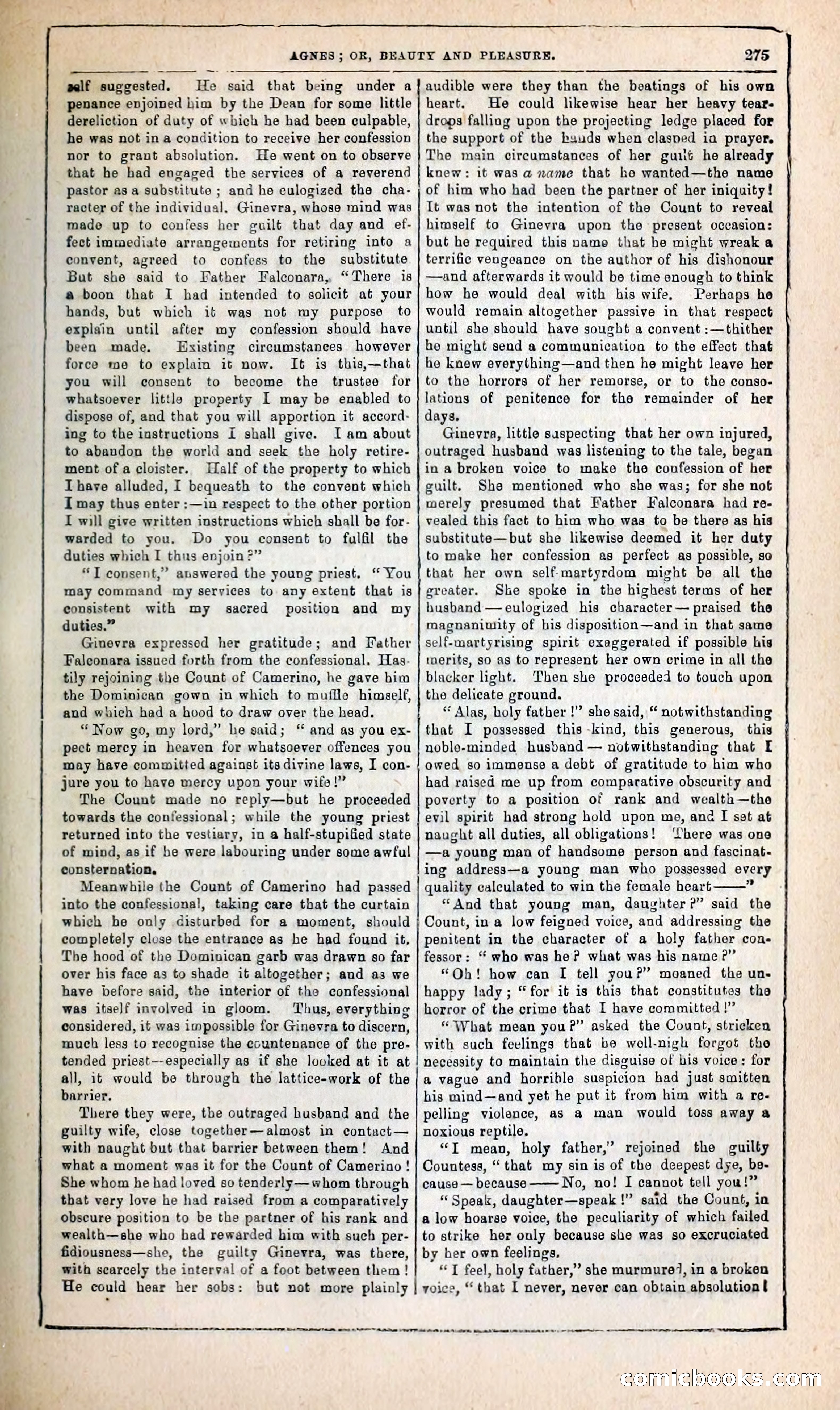
A restored page from Penny Dreadfuls, 1857. Page through the whole issue in the reader above.
📄 Transcribed text from this page (OCR, searchable)
Machine-transcribed from the original scan — historical spelling and the odd misread are preserved.
i 3 ’ ———— aslf suggested. He said that being under a penance enjoined him by the Dean for some little dereliction of duty of which he had been culpable, he was not ina condition to receive her confession nor to grant absolution. He went on to observe that he had engaged the services of a reverend pastor asa substitute ; and he eulogized the cha- racter of the individual. Ginevra, whose mind was made up to confess her guilt that day and ef- fect immediate arrangements for retiring into a convent, agreed to confess to the substitute But she said to Father Falconara,, “There is a@ boon that I had intended to solicit at your hands, but which it was not my purpose to explain until after my confession should have been made. MJHxisting circumstances however force me to explain it now. It is this,—that you will consent to become the trustee for whatsoever little property [ may be enabled to dispose of, and that you will apportion it accord- ing to the instructions I shall give. I am about to abandon the world and seek the holy retire- ment of a cloister. Half of the property to which Ihave alluded, I bequeath to the convent which I may thus enter :—in respect to the other portion I will give written instructions which shall be for- warded to you. Do you consent to fulfil the duties which I thus enjoin?” “TI consent,” answered the young priest. ‘ You may command my services to any extent that is consistent with my sacred position and my duties.” Ginevra expressed her gratitude; and Father Faleonara issued forth from the confessional. Has- tily rejoining the Count of Camerino, he gave bim the Dominican gown in which to muflile himself, and which had a hood to draw over the head. * Now go, my lord,” he said; ‘ and as you ex- pect mercy in heaven for whatsoever offences you may have committed against its divine laws, I con- jure you to have mercy upon your wife!” The Count made no reply—but he proceeded towards the confessional; while the young priest returned into the vestiary, in a half-stupified state of mind, as if he were labouring under some awful consternation, Meanwhile the Count of Camerino had passed into the confessional, taking care that the curtain which he only disturbed for a moment, should completely close the entrance as be had found it, The hood of the Domiuican garb was drawn so far over his face as to shade it altogether; and as we have before said, the interior of the confessional was itself involved in gloom. Thus, everything considered, it was impossible for Ginevra to discern, much less to recognise the countenance of the pre- tended priest—-especially as if she looked at it at all, it would be through the lattice-work of the barrier. There they were, the outraged husband and the guilty wife, close together—almost in contact— with naught but that barrier between them! And what a moment was it for the Count of Camerino! She whom he had loved so tenderly— whom through that very love he had raised from a comparatively obscure position to be the partner of his rank and wealth—she who had rewarded him with such per- fidiousness—she, the guilty Ginevra, was there, with scarcely the interval of a foot between them! AGNES ; OR, BEAUTY AND PLEASURE. 275 —— audible were they than the beatings of his own heart. He could likewise hear her heavy tears drops falling upon the projecting ledge placed for the support of the buds when clasned ia prayer. The main circumstances of her guué he already knew: it was a xame that he wanted—the name of him who had been the partner of her iniquity! It was not the intention of the Count to reveal himself to Ginevra upon the present occasion: but he required this name that he might wreak a terrific vengeance on the author of his dishonour —and afterwards it would be time enough to think how he would deal with his wife. Perhaps he would remain altogether passive in that respect until she should have sought a convent :—thither he might send a communication to the effect that he knew everything—and then he might leave her to the horrors of her remorse, or to the conso- lations of penitence for the remainder of her days, Ginevra, little suspecting that her own injured, outraged husband was listening to the tale, began in a broken voice to make the confession of her guilt, She mentioned who she was; for she not merely presumed that Father Falconara had re- vealed this fact to him who was to be there as his substitute—but she likewise deemed it her duty to make her confession as perfect as possible, so that her own self-martyrdom might be all the greater. She spoke in the highest terms of her husband —eulogized his character— praised the magnaniwity of his disposition—and in that same self-martyrising spirit exaggerated if possible his tnerits, so as to represent her own crime in all the blacker light. Then she proceeded to touch upon the delicate ground. “ Alas, holy father !” she said, “ notwithstanding that I possessed this -kind, this generous, this noble-minded husband — notwithstanding that I owed so immense a debt of gratitude to him who had raised me up from comparative obscurity and poverty to a position of rank and wealth—the evil spirit had strong hold upon me, and I sot at naught all duties, all obligations! ‘here was one —a young man of handsome person and fascinat- ing address—a young man who possessed every quality calculated to win the female heart i “And that young man, daughter?” said the Count, in a low feigned voice, and addressing the penitent in the character of a holy father con- fessor: “ who was he? what was his name?” “Qh! how can I tell you?” moaned the un- happy lady; “for it is this that constitutes the horror of the crime that I have committed !” “What mean you?” asked the Count, stricken with such feelings that be well-nigh forgot the necessity to maintain the disguise of his voice: for a vague and horrible suspicion had just smitten his mind—and yet he put it from him with a re- pelling violence, as a man would toss away a noxious reptile. “IT mean, holy father,” rejoined the guilty Countess, “that my sin is of the deepest dye, be- cause — because——— No, no! I cannot tell you!” “ Speak, daughter—speak !” said the Count, in a low hoarse voice, the peculiarity of which failed to strike her only because she was so excruciated by her own feelings, “T feel, holy futher,” she murmured, in a broken He could hear her sobs: but not more plainly voice, “that I never, never can obtain absolution lt rrr ery in is er er ee es ee en A ane Neel ile ae el et ee etl lt i A ee ee TT COMmiclooolks FS er eee ee a ee