
Penny Dreadfuls, 1857 · page 115 of 394
Agnes, or, Beauty and Pleasure — page 115: what you’re looking at
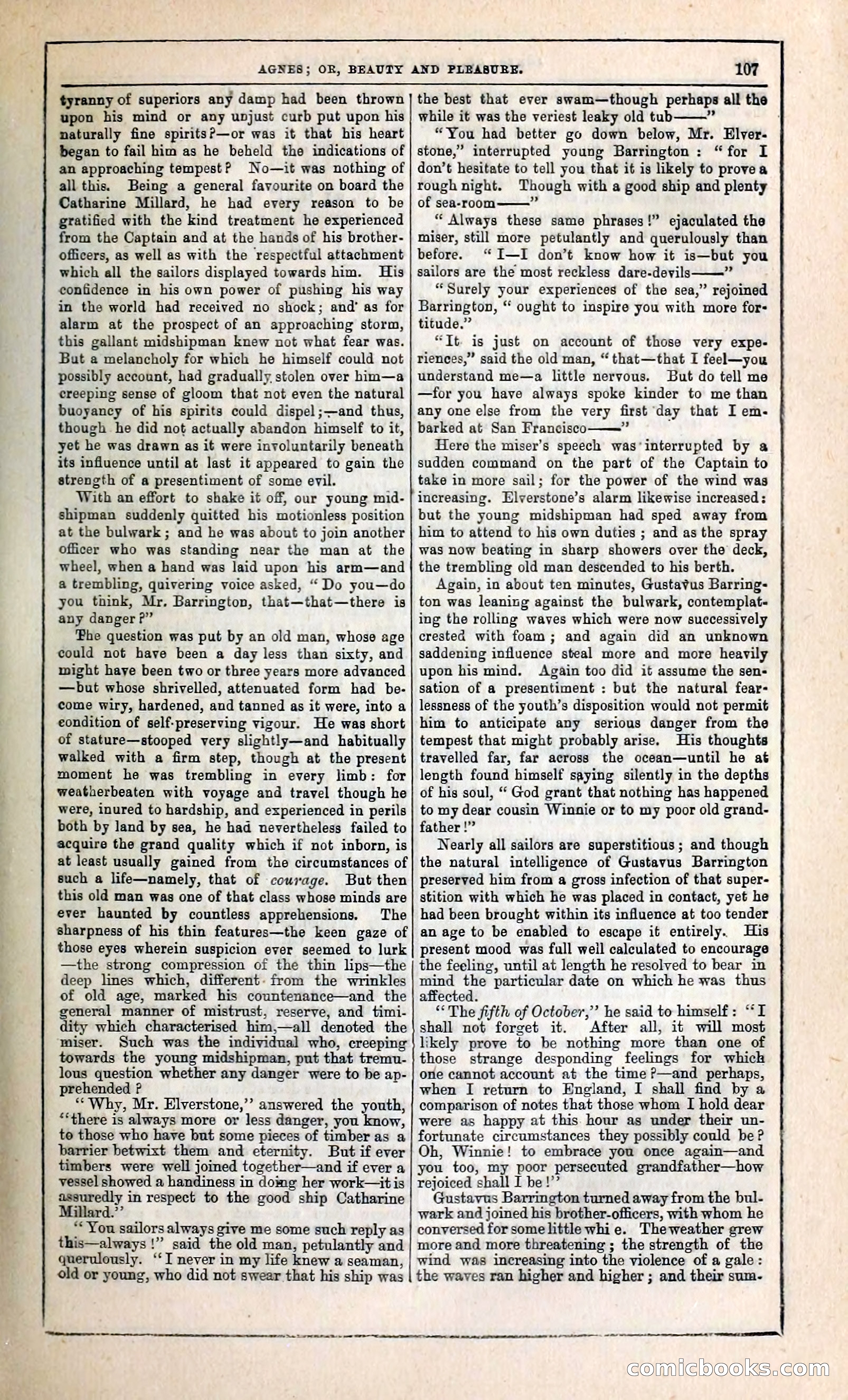
A restored page from Penny Dreadfuls, 1857. Page through the whole issue in the reader above.
📄 Transcribed text from this page (OCR, searchable)
Machine-transcribed from the original scan — historical spelling and the odd misread are preserved.
AGNES; OR, BEAUTY AND PLEASURE. 107 tyranny of superiors any damp had been thrown upon his mind or any unjust curb put upon his naturally fine spirits?—or was it that his heart began to fail him as he beheld the indications of an approaching tempest? No—it was nothing of all this. Being a general favourite on board the Catharine Millard, he had every reason to be gratified with the kind treatment he experienced from the Captain and at the hands of his brother- officers, as well as with the respectful attachment which all the sailors displayed towards him. His confidence in his own power of pushing his way in the world had received no shock; and’ as for alarm at the prospect of an approaching storm, this gallant midshipman knew not what fear was. But a melancholy for which he himself could not possibly account, had gradually stolen over him—a creeping sense of gloom that not even the natural buoyancy of his spirits could dispel;—and thus, though he did not actually abandon himself to it, yet he was drawn as it were involuntarily beneath its influence until at last it appeared to gain the strength of a presentiment of some evil. With an effort to shake it off, our young mid- shipman suddenly quitted his motionless position at the bulwark; and he was about to join another officer who was standing near the man at the wheel, when a hand was laid upon his arm—and a trembling, quivering voice asked, “Do you—do you think, Mr. Barrington, that—that—there is any danger ?”’ Phe question was put by an old man, whose age could not have been a day less than sixty, and might haye been two or three years more advanced —but whose shrivelled, attenuated form had be- come wiry, hardened, and tanned as it were, into a eondition of self-preserving vigour. He was short of stature—stooped very slightly—and habitually walked with a firm step, though at the present moment he was trembling in every limb: for weatherbeaten with voyage and travel though he were, inured to hardship, and experienced in perils both by land by sea, he had nevertheless failed to acquire the grand quality which if not inborn, is at least usually gained from the circumstances of such a life—namely, that of courage. But then this old man was one of that class whose minds are ever haunted by countless apprehensions, The sharpness of his thin features—the keen gaze of those eyes wherein suspicion ever seemed to lurk —the strong compression of the thin lips—the deep lines which, different. from the wrinkles of old age, marked his countenance—and the general manner of mistrust, reserve, and timi- dity which characterised him,—all denoted the miser. Such was the individual who, creeping towards the young midshipman, put that tremu- lous question whether any danger were to be ap- prehended P “Why, Mr. Elverstone,’’ answered the youth, “*there is always more or less danger, you know, te those who have but some pieces of timber as a barrier betwixt them and eternity. But if ever timbers were well joimed together—and if ever a vessel showed a handiness in dome her work—itis assuredly in respect to the good ship Catharine Millard.”’ ** You sailors always give me some such reply as this—always !” said the old man, petulantly and ely **T never in my life knew a seaman, old or young, who did not swear that his ship was rr eS eT eS ee ee - the best that ever swam—though perhaps all the ? while it was the veriest leaky old tub “You had better go down below, Mr. Elver- stone,” interrupted young Barrington: “for I don’t hesitate to tell you that it is likely to provea rough night. Though with a good ship and plenty of sea-room 1 “Always these same phrases!” ejaculated the miser, still more petulantly and querulously than before. “I—I don’t know how it is—but you sailors are the most reckless dare-devils———” “Surely your experiences of the sea,” rejoined Barrington, “ ought to inspire you with more for- titude.” “It is just on account of those very expe- riences,” said the old man, “ that—that I feel—you understand me—a little nervous. But do tell me —for you have always spoke kinder to me than any one else from the very first day that I em- barked at San Francisco 2 Here the miser’s speech was*interrupted by a sudden command on the part of the Captain to take in more sail; for the power of the wind was increasing. Elverstone’s alarm likewise increased: but the young midshipman had sped away from him to attend to his own duties ; and as the spray was now beating in sharp showers over the deck, the trembling old man descended to his berth. Again, in about ten minutes, Gustavus Barring- ton was leaning against the bulwark, contemplat- ing the rolling waves which were now successively crested with foam; and again did an unknown saddening influence steal more and more heavily upon his mind. Again too did it assume the sen- sation of a presentiment : but the natural fear- lessness of the youth’s disposition would not permit him to anticipate any serious danger from the tempest that might probably arise. His thoughts travelled far, far across the ocean—until he at length found himself saying silently in the depths of his soul, “‘ God grant that nothing has happened to my dear cousin Winnie or to my poor old grand- father !” Nearly all sailors are superstitious; and though the natural intelligence of Gustavus Barrington preserved him from a gross infection of that super- stition with which he was placed in contact, yet he had been brought within its influence at too tender an age to be enabled to escape it entirely. His present mood was full weil calculated to encourage the feeling, until at length he resolved to bear in mind the particular date on which he was thus affected. “The fifth of October,’ he said to himself: “I shall not forget it. After all, it will most likely prove to be nothing more than one of those strange desponding feelings for which one cannot account at the time ?—and perhaps, when I return to England, I shall find by a comparison of notes that those whom I hold dear were as happy at this hour as under their un- fortunate circumstances they possibly could be? Oh, Winnie! to embrace you once again—and you too, my poor persecuted grandfather—how rejoiced shall I be !’’ Gustavus Barrington turned away from the bul- wark and joined his brother-officers, with whom he conversed for some little whi e. Theweather grew more and more threatening ; the strength of the wind was increasing into the violence of a gale: the waves ran higher and higher ; and their sum- a+ en ees Com GDaooks (CO)