
Penny Dreadfuls, 1857 · page 114 of 394
Agnes, or, Beauty and Pleasure — page 114: what you’re looking at
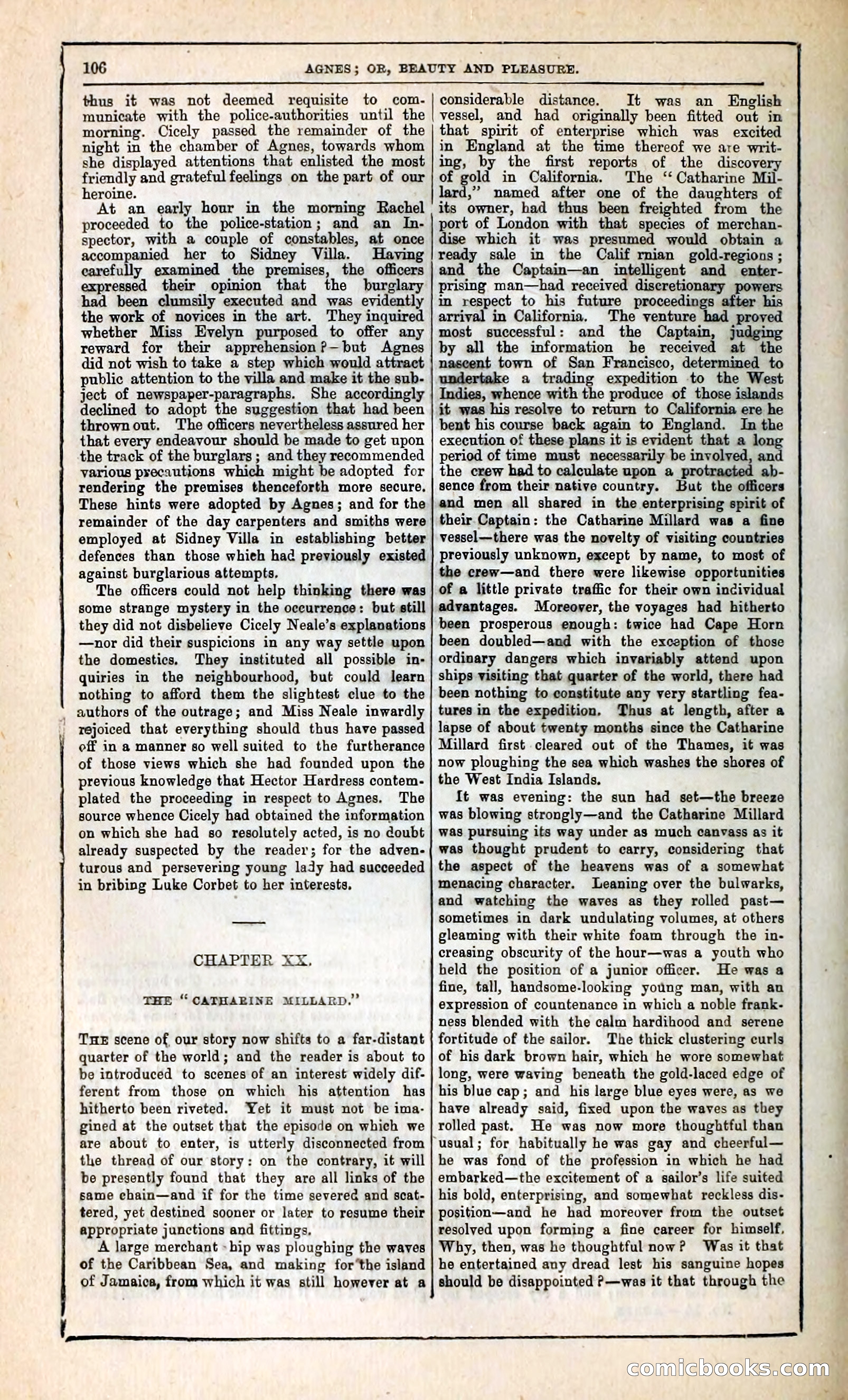
A restored page from Penny Dreadfuls, 1857. Page through the whole issue in the reader above.
📄 Transcribed text from this page (OCR, searchable)
Machine-transcribed from the original scan — historical spelling and the odd misread are preserved.
106 AGNES; OR, BEAUTY AND PLEASURE. thus it was not deemed requisite to com- municate with the police-authorities until the morning. Cicely passed the remainder of the night in the chamber of Agnes, towards whom she displayed attentions that enlisted the most friendly and grateful feelings on the part of our heroine. At an early hour in the morning Rachel proceeded to the police-station; and an In- spector, with a couple of constables, at once accompanied her to Sidney Villa. Having earefully examined the premises, the officers expressed their opinion that the burglary had been clumsily executed and was evidently the work of novices in the art. They inquired whether Miss Evelyn purposed to offer any reward for their apprehension?—but Agnes did not wish to take a step which would attract public attention to the villa and make it the sub- ject of newspaper-paragraphs. She accordingly declined to adopt the suggestion that had been thrownout. The officers nevertheless assured her that every endeavour should be made to get upon the track of the burglars; and they recommended various precautions which might be adopted for rendering the premises thenceforth more secure. These hints were adopted by Agnes; and for the remainder of the day carpenters and smiths were employed at Sidney Villa in establishing better defences than those whieh had previously existed against burglarious attempts, The officers could not help thinking there was some strange mystery in the occurrence: but still they did not disbelieve Cicely Neale’s explanations —nor did their suspicions in any way settle upon the domestics. They instituted all possible in- quiries in the neighbourhood, but could learn nothing to afford them the slightest clue to the _ authors of the outrage; and Miss Neale inwardly _ rejoiced that everything should thus have passed off in a manner so well suited to the furtherance of those views which she had founded upon the previous knowledge that Hector Hardress contem- plated the proceeding in respect to Agnes. The source whence Cicely had obtained the information on which she had so resolutely acted, is no doubt already suspected by the reader; for the adven- turous and persevering young lady had succeeded in bribing Luke Corbet to her interests, CHAPTER XxX, THE “CATHARINE MILLARD.” THE scene of our story now shifts to a far-distant quarter of the world; and the reader is about to be introduced to scenes of an interest widely dif- ferent from those on which his attention has hitherto been riveted. Yet it must not be ima- gined at the outset that the episode on which we are about to enter, is utterly disconnected from the thread of our story: on the contrary, it will be presently found that they are all links of the same ehain—and if for the time severed and scat- tered, yet destined sooner or later to resume their appropriate junctions and fittings, A large merchant > bip was ploughing the waves of the Caribbean Sea, and making forthe island of Jamaica, from which it was still however at a i ae EE Ea SREP nd PN SE Ns considerable distance. It was an English vessel, and had originally been fitted out in that spirit of enterprise which was excited in England at the time thereof we are writ- ing, by the first reports of the discovery of gold in California. The ‘‘ Catharine Mil- »’ named after one of the daughters of its owner, had thus been freighted from the port of London with that species of merchan- dise which it was presumed would obtain a ready sale in the Calif rnian gold-regions ; and the Captain—an intelligent and enter- prising man—had received diseretionary powers in respect to his future proceedings after his arrival in California, The venture had proved most successful: and the Captain, judging by all the information he received at the nascent town of San Francisco, determined to undertake a trading expedition to the West Indies, whence with the produce of those islands it was his resolve to return to California ere he bent his course back again to England. In the execution of these plans it is evident that a long period of time must necessarily be involved, and the crew had to calculate upon a protracted ab- sence from their native country. But the officers and men all shared in the enterprising spirit of their Captain: the Catharine Millard was a fine vessel—there was the novelty of visiting countries previously unknown, except by name, to most of the crew—and there were likewise opportunities of a little private traffic for their own incividual advantages. Moreover, the voyages had hitherto been prosperous enough: twice had Cape Horn been doubled—and with the exception of those ordinary dangers which invariably attend upon ships visiting that quarter of the world, there had been nothing to constitute any very startling fea- tures in the expedition, Thus at length, after a lapse of about twenty months since the Catharine Millard first cleared out of the Thames, it was now ploughing the sea which washes the shores of the West India Islands. It was evening: the sun had set—the breeze was blowing strongly—and the Catharine Millard was pursuing its way under as much canvass as it was thought prudent to carry, considering that the aspect of the heavens was of a somewhat menacing cheracter. Leaning over the bulwarks, and watching the waves as they rolled past— sometimes in dark undulating volumes, at others gleaming with their white foam through the in- creasing obscurity of the hour—was a youth who held the position of a junior officer. He was a fine, tall, handsome-looking young man, with an expression of countenance in which a noble frank- ness blended with the calm hardihood and serene fortitude of the sailor. The thick clustering curls of his dark brown hair, which he wore somewhat long, were waving beneath the gold-laced edge of his blue cap; and his large blue eyes were, as we have already said, fixed upon the waves as they rolled past. He was now more thoughtful than ‘usual; for habitually he was gay and cheerful— he was fond of the profession in which he had embarked—the excitement of a sailor’s life suited his bold, enterprising, and somewhat reckless dis- position—and he had moreover from the outset resolved upon forming a fine career for himself, Why, then, was he thoughtful now? Was it that he entertained any dread lest his sanguine hopes should be disappointed P—was it that through the CoMmicbooks —— (E(0)