
Life, 1929-07-26 · page 25 of 36
Life — July 26, 1929 — page 25: what you’re looking at
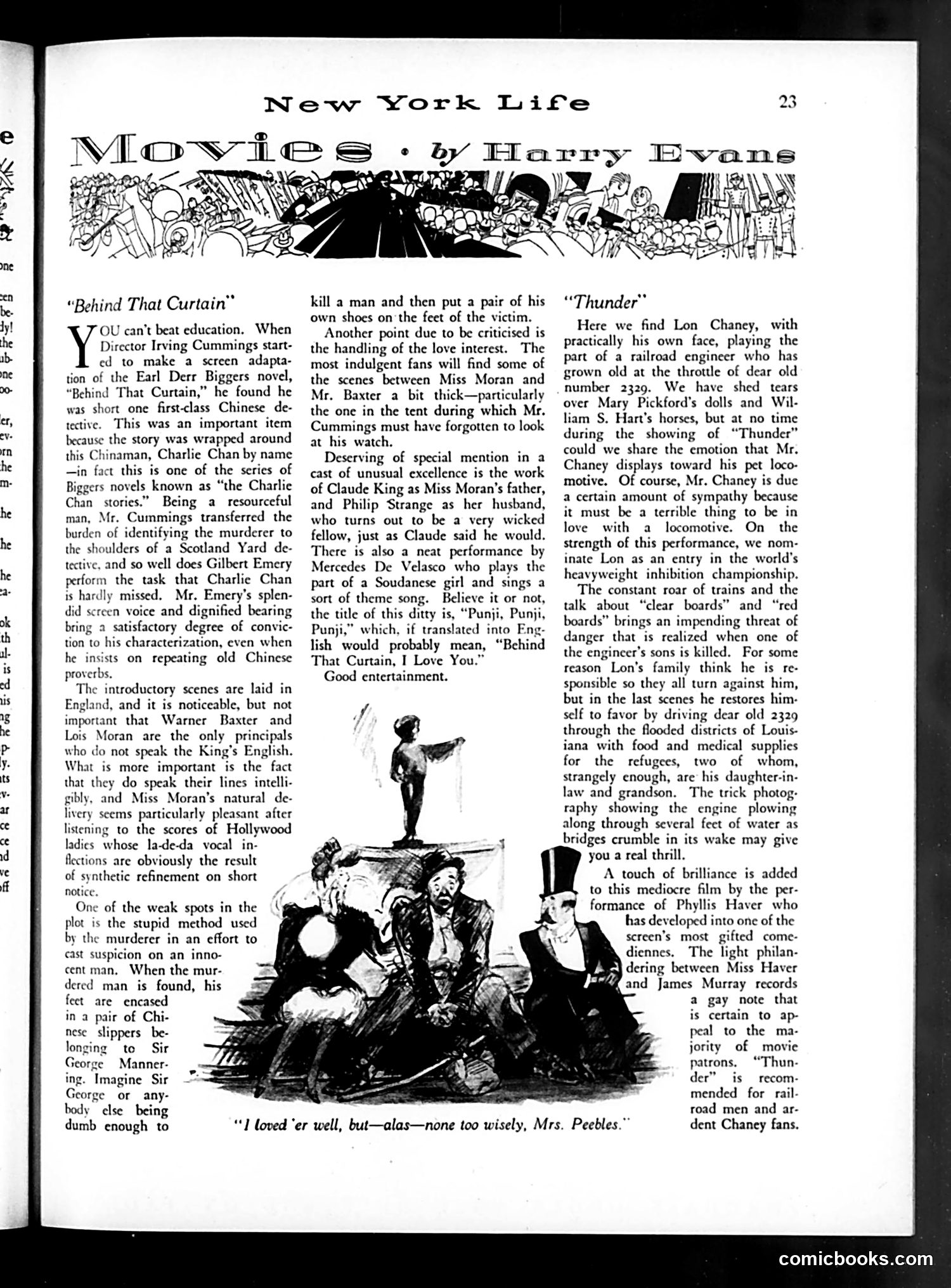
What you’re looking at
This page reviews two films: **"Behind That Curtain"** and **"Thunder."** The first review discusses an adaptation of an Earl Derr Biggers novel featuring detective Charlie Chan. The critic notes that director Irving Cummings replaced the Chinese protagonist with a Scotland Yard detective (Gilbert Emery), finding this substitution surprisingly effective. The review praises the diction of American actors Warner Baxter and Lois Moran against affectedly "refined" Hollywood actresses, and critiques the plot's implausibility—particularly a murderer framing someone by placing the victim in the killer's own Chinese slippers. The second review covers **"Thunder,"** starring Lon Chaney as an aging railroad engineer devoted to his locomotive. The critic humorously notes this sentimental attachment to machinery, then describes the plot: when Chaney's son dies in a train accident, his family blames him, though he eventually redeems himself. Evans treats both films as competent entertainment.
📄 Transcribed text from this page (OCR, searchable)
Machine-transcribed from the original scan — historical spelling and the odd misread are preserved.
New York Life “Behind That Curtain” OU can’t beat education. When Y Director Irving Cummings start- ed to make a screen adapta- tion of the Earl Derr Biggers novel, “Behind That Curtain,” he found he was short one first-class Chinese de- tective. This was an important item because the story was wrapped around this Chinaman, Charlie Chan by name —in fact this is one of the series of Biggers novels known as “the Charlie Chan stories.” Being a resourceful man, Mr. Cummings transferred the burden of identifying the murderer to the shoulders of a Scotland Yard de- tective, and so well does Gilbert Emery perform the task that Charlie Chan is hardly missed. Mr. Emery’s splen- did screen voice and dignified bearing bring a satisfactory degree of convic- tion to his characterization, even when he insists on repeating old Chinese proverbs. The introductory scenes are laid in England, and it is noticeable, but not important that Warner Baxter and Lois Moran are the only principals who do not speak the King’s English. What is more important is the fact that they do speak their lines intelli- gibly, and Miss Moran’s natural de- livery seems particularly pleasant after listening to the scores of Hollywood ladies whose la-de-da vocal in- flections are obviously the result of synthetic refinement on short notice. One of the weak spots in the plot is the stupid method used by the murderer in an effort to cast suspicion on an inno- cent man, When the mur- dered man is found, his fect are encased in a pair of Chi- nese slippers be- longing to Sir George Manner- ing. Imagine Sir George or any- body else being dumb enough to kill a man and then put a pair of his own shoes on the feet of the victim. Another point due to be criticised is the handling of the love interest. The most indulgent fans will find some of the scenes between Miss Moran and Mr. Baxter a bit thick—particularly the one in the tent during which Mr. Cummings must have forgotten to look at his watch. Deserving of special mention in a cast of unusual excellence is the work of Claude King as Miss Moran’s father, and Philip Strange as her husband, who turns out to be a very wicked fellow, just as Claude said he would. There is also a neat performance by Mercedes De Velasco who plays the part of a Soudanese girl and sings a sort of theme song. Believe it or not, the title of this ditty is, “Punji, Punji, Punji,” which, if translated into Eng- lish would probably mean, “Behind That Curtain, I Love You.” Good entertainment. “1 loved ‘er well, but—alas—none too wisely, Mrs. Peebles.” “Thunder™ Here we find Lon Chaney, with practically his own face, playing the part of a railroad engineer who has grown old at the throttle of dear old number 2329. We have shed tears over Mary Pickford’s dolls and Wil- liam S. Hart's horses, but at no time during the showing of “Thunder” could we share the emotion that Mr. Chaney displays toward his pet loco- motive. Of course, Mr. Chaney is due a certain amount of sympathy because it must be a terrible thing to be in love with a locomotive. On the strength of this performance, we nom- inate Lon as an entry in the world’s heavyweight inhibition championship. The constant roar of trains and the talk about “clear boards” and “red boards” brings an impending threat of danger that is realized when one of the engincer’s sons is killed. For some reason Lon's family think he is re- sponsible so they all turn against him, but in the last scenes he restores him- self to favor by driving dear old 2329 through the flooded districts of Louis- iana with food and medical supplies for the refugees, two of whom, strangely enough, are his daughter-in- law and grandson. The trick photog- raphy showing the engine plowing along through several feet of water as bridges crumble in its wake may give you a real thrill. A touch of brilliance is added to this mediocre film by the per- formance of Phyllis Haver who has developed into one of the screen’s most gifted come- diennes. The light philan- Fl dering between Miss Haver br, and James Murray records a gay note that is certain to ap- peal to the ma- jority of movie patrons. “Thun- der” is recom: mended for rail- road men and ar- dent Chaney fans. comicbooks.com