
Life, 1929-07-26 · page 24 of 36
Life — July 26, 1929 — page 24: what you’re looking at
What you’re looking at
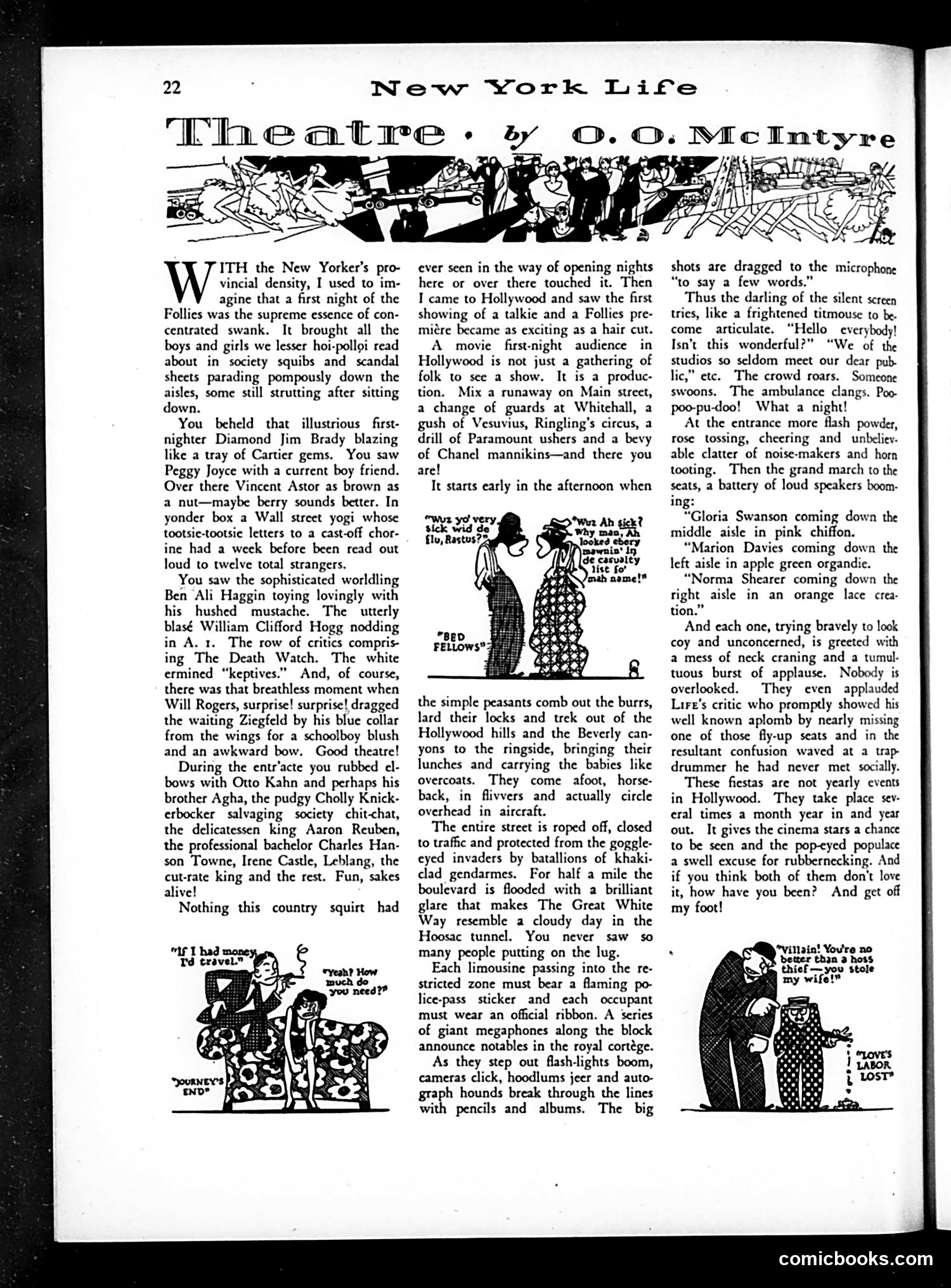
This satirical piece contrasts New York high society with Hollywood celebrity culture. The author compares attending a prestigious Broadway Follies premiere—where genuine socialites like Diamond Jim Brady, Peggy Joyce, and Vincent Astor mingled—to a Hollywood movie premiere. The satire targets Hollywood's manufactured spectacle: the controlled street closures, khaki-uniformed gendarmes, flaming police passes, megaphones announcing arrivals, and orchestrated chaos. McIntyre mocks the artificial pageantry and the struggling silent-film stars now forced to speak awkwardly into microphones ("Hello everybody! Isn't this wonderful?"). The small cartoons appear to illustrate comedic vignettes about theatrical first-nights and social pretension. The piece ridicules how Hollywood's "production" of a premiere—with its deliberate grandeur—paradoxically seems less authentic than New York's more organic display of wealth and status. The implication: New York society is genuinely elite, while Hollywood creates an illusion of importance through machinery and spectacle.
📄 Transcribed text from this page (OCR, searchable)
Machine-transcribed from the original scan — historical spelling and the odd misread are preserved.
New York Life ITH the New Yorker’s pro- vincial density, I used to im- agine that a first night of the Follies was the supreme essence of con- cenurated swank. It brought all the boys and girls we lesser hoi-polloi read about in society squibs and scandal sheets parading pompously down the aisles, some still strutting after sitting down. You beheld that illustrious first- nighter Diamond Jim Brady blazing like a tray of Cartier gems. You saw Peggy Joyce with a current boy friend. Over there Vincent Astor as brown as a nut—maybe berry sounds better. In yonder box a Wall street yogi whose tootsie-tootsie letters to a cast-off chor- ine had a week before been read out loud to twelve total strangers. You saw the sophisticated worldling Ben Ali Haggin toying lovingly with his hushed mustache. The utterly blasé William Clifford Hogg nodding in A. 1. The row of critics compris- ing The Death Watch. The white ermined “keptives.” And, of course, there was that breathless moment when Will Rogers, surprise! surprise! dragged the waiting Ziegfeld by his blue collar from the wings for a schoolboy blush and an awkward bow. Good theatre! During the entr’acte you rubbed el- bows with Ouo Kahn and perhaps his brother Agha, the pudgy Cholly Knick- erbocker salvaging society chit-chat, the delicatessen king Aaron Reuben, the professional bachelor Charles Han- son Towne, Irene Castle, Leblang, the cut-rate king and the rest. Fun, sakes alive! Nothing this country squirt had ever seen in the way of opening nights here or over there touched it. Then I came to Hollywood and saw the first showing of a talkie and a Follies pre- mitre became as exciting as a hair cut. A movie first-night audience in Hollywood is not just a gathering of folk to see a show. It is a produc- tion. Mix a runaway on Main street, a change of guards at Whitehall, a gush of Vesuvius, Ringling’s circus, a drill of Paramount ushers and a bevy of Chanel mannikins—and there you are! It starts early in the afternoon when the simple peasants comb out the burrs, lard their locks and trek out of the Hollywood hills and the Beverly can- yons to the ringside, bringing their lunches and carrying the babies like overcoats. They come afoot, horse- back, in flivvers and actually circle overhead in aircraft. The entire street is roped off, closed to traffic and protected from the goggle- eyed invaders by batallions of khaki- clad gendarmes. For half a mile the boulevard is flooded with a brilliant glare that makes The Great White Way resemble a cloudy day in the Hoosac tunnel. You never saw so many people putting on the lug. Each limousine passing into the re- stricted zone must bear a flaming po- lice-pass sticker and each occupant must wear an official ribbon. A series of giant megaphones along the block announce notables in the royal cortége. As they step out flash-lights boom, cameras click, hoodlums jeer and auto- graph hounds break through the lines ath pencils and albums. The big shots are dragged to the microphone “to say a few words.” Thus the darling of the silent screen tries, like a frightened titmouse to be. come articulate. “Hello everybody! Isn't this wonderful?” “We of the studios so seldom meet our dear pub- lic,” etc. The crowd roars. Someone swoons. The ambulance clangs. Poo- poo-pu-doo! What a night! At the entrance more flash powder, rose tossing, cheering and unbeliev. able clatter of noise-makers and horn tooting. Then the grand march to the seats, a battery of loud speakers boom. ing: “Gloria Swanson coming down the middle aisle in pink chiffon. “Marion Davies coming down the left aisle in apple green organdie. “Norma Shearer coming down the right aisle in an orange lace crea- tion.” And each one, trying bravely to look coy and unconcerned, is greeted with a mess of neck craning and a tumul- tuous burst of applause. Nobody is overlooked. They even applauded Lire’s critic who promptly showed his well known aplomb by nearly missing one of those fly-up seats and in the resultant confusion waved at a trap drummer he had never met. socially. These fiestas are not yearly events in Hollywood. They take place sev- eral times a month year in and year out. It gives the cinema stars a chance to be seen and the pop-eyed populace a swell excuse for rubbernecking. And if you think both of them don’t love it, how have you been? And get off my foot! "Villain! You're no better than a hoss comicbooks.com