
Life, 1929-07-19 · page 27 of 36
Life — July 19, 1929 — page 27: what you’re looking at
What you’re looking at
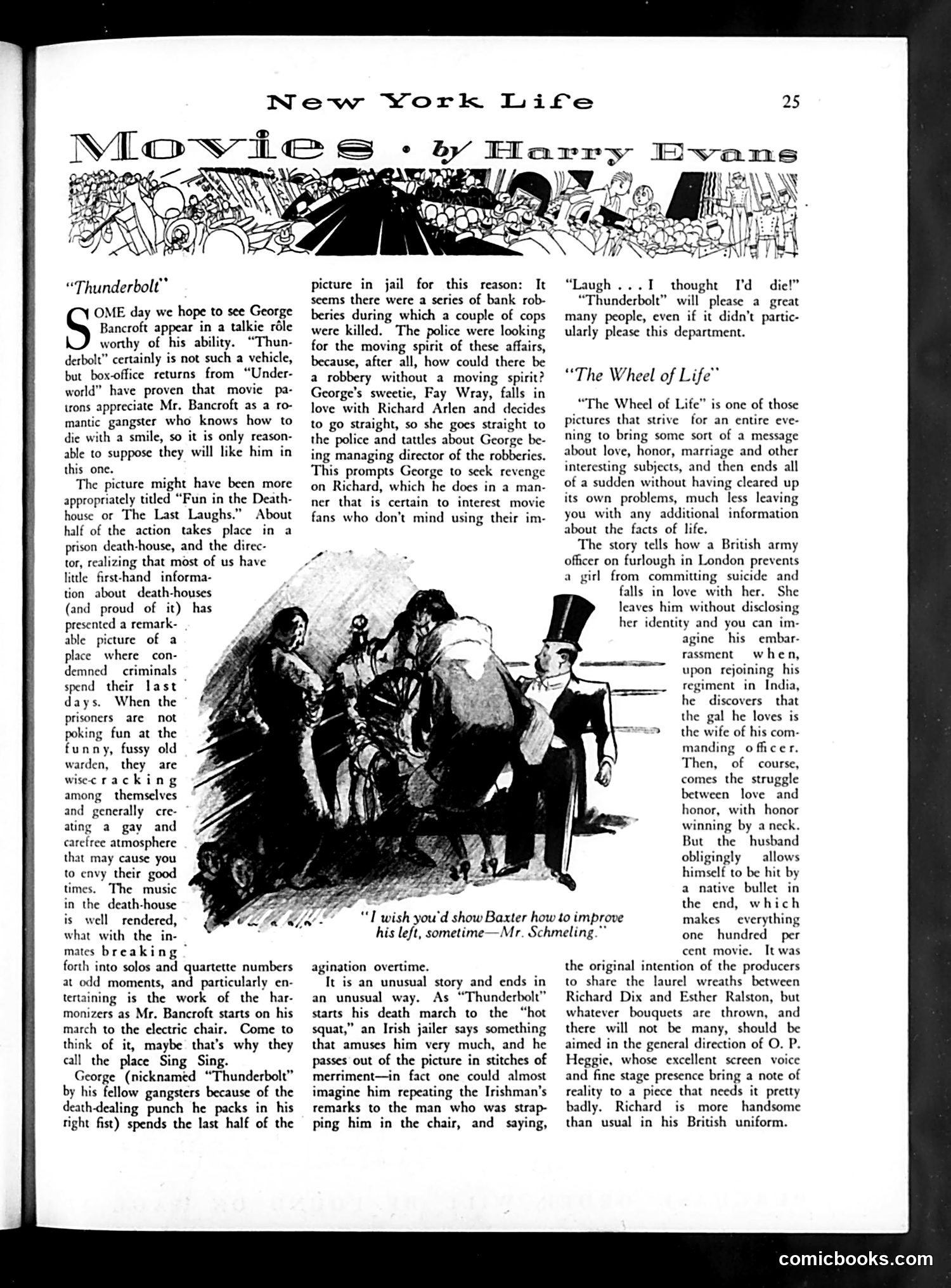
This page reviews two 1929 films. The **cartoon** (captioned "I wish you'd show Baxter how to improve his left, sometime—Mr. Schmeling") references boxer Max Schmeling, a famous contemporary fighter. It's a joke about improving boxing technique, inserted into a death-house scene from "Thunderbolt." The reviews themselves are satirical critiques. "Thunderbolt" stars George Bancroft as a gangster executed for bank robberies; the reviewer mocks how the film treats a death-house as comic entertainment, with prisoners singing and joking before execution. The title joke—calling it "Sing Sing" (the famous prison)—plays on the inmates' musical performances. "The Wheel of Life" is criticized for tackling serious themes (love, honor, marriage) without resolution. A British officer falls for a woman in London, later discovers she's his commanding officer's wife in India, and honor prevails—but the film leaves larger questions unanswered. Both reviews use humor to expose the films' shallow treatments of serious subjects: capital punishment trivialized, and moral dilemmas left unresolved.
📄 Transcribed text from this page (OCR, searchable)
Machine-transcribed from the original scan — historical spelling and the odd misread are preserved.
New York Life “Thunderbolt” S OME day we hope to see George Bancroft appear in a talkie réle worthy of his ability. “Thun- derbolt” certainly is not such a vehicle, but box-office returns from “Under- world” have proven that movie pa- trons appreciate Mr. Bancroft as a ro- mantic gangster who knows how to die with a smile, so it is only reason- able to suppose they will like him in this one. The picture might have been more appropriately titled “Fun in the Death- house or The Last Laughs.” About half of the action takes place in a prison death-house, and the direc- tor, realizing that most of us have little first-hand informa- tion about death-houses (and proud of it) has presented a remark- able picture of a place where con- demned criminals spend their last days. When the prisoners are not poking fun at the funny, fussy old warden, they are wisecracking among themselves and generally cre- ating a gay and carefree atmosphere that may cause you to envy their good times. The music in the death-house is well rendered, what with the in- mates breaking | forth into solos and quartette numbers at odd moments, and particularly en- tertaining is the work of the har- monizers as Mr. Bancroft starts on his march to the electric chair. Come to think of it, maybe that’s why they call the place Sing Sing. George (nicknamed “Thunderbolt” by his fellow gangsters because of the death-dealing punch he packs in his right fist) spends the last half of the We tA picture in jail for this reason: It seems there were a series of bank rob- beries during which a couple of cops were killed. The police were looking for the moving spirit of these affairs, because, after all, how could there be a robbery without a moving spirit? George’s sweetie, Fay Wray, falls in love with Richard Arlen and decides to go straight, so she goes straight to the police and tattles about George be- ing managing director of the robberies. This prompts George to seck revenge on Richard, which he does in a man- ner that is certain to interest movie fans who don’t mind using their im- AE ! PT wish you'd show Baxter how to improve his left, sometime—Mr. Schmeling.” agination overtime. It is an unusual story and ends in an unusual way. As “Thunderbolt” starts his death march to the “hot squat,” an Irish jailer says something that amuses him very much, and he passes out of the picture in stitches of merriment—in fact one could almost imagine him repeating the Irishman’s remarks to the man who was strap- ping him in the chair, and saying, by Ha 7 4 | rPrry Hwans “Laugh ...1 thought I'd die!” “Thunderbolt” will please a great many people, even if it didn’t partic- ularly please this department. “The Wheel of Life™ “The Wheel of Life” is one of those pictures that strive for an entire eve- ning to bring some sort of a message about love, honor, marriage and other interesting subjects, and then ends all of a sudden without having cleared up its own problems, much less leaving you with any additional information about the facts of life. The story tells how a British army officer on furlough in London prevents a girl from committing suicide and falls in love with her. She leaves him without disclosing her identity and you can im- agine his embar- rassment when, upon rejoining his regiment in India, he discovers that the gal he loves is the wife of his com- manding officer. Then, of course, comes the struggle between love and honor, with honor winning by a neck. But the husband obligingly allows himself to be hit by a native bullet in the end, which makes everything one hundred per cent movie. Tt was the original intention of the producers to share the laurel wreaths between Richard Dix and Esther Ralston, but whatever bouquets are thrown, and there will not be many, should be aimed in the general direction of O. P. Heggie, whose excellent screen voice and fine stage presence bring a note of reality to a piece that needs it pretty badly. Richard is more handsome than usual in his British uniform. comicbooks.com