
Life, 1929-07-19 · page 26 of 36
Life — July 19, 1929 — page 26: what you’re looking at
What you’re looking at
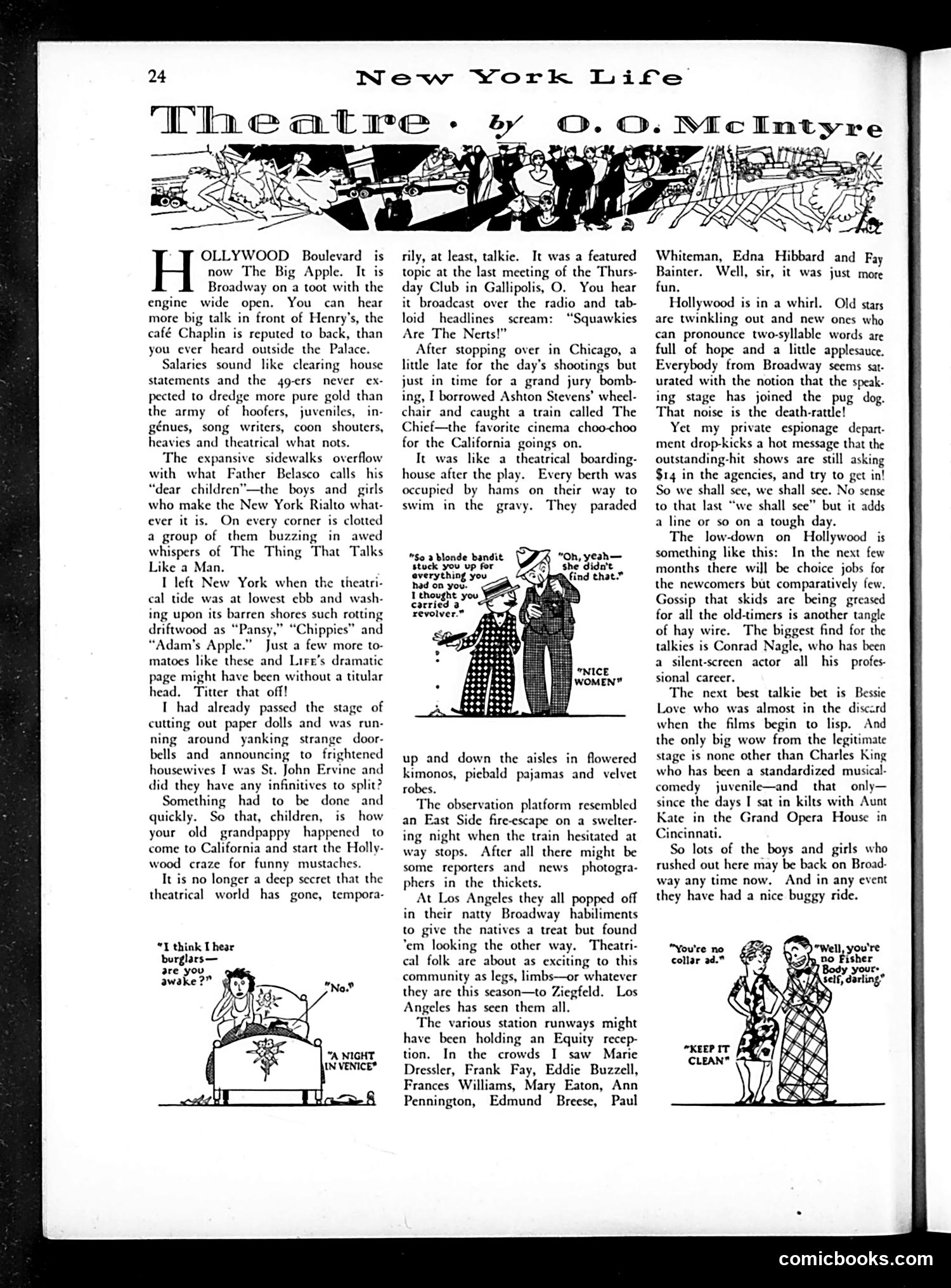
This is a satirical theater column by O.O. McIntyre about Hollywood's transition to "talking pictures" (sound films). The piece mocks the theatrical establishment's panicked migration from Broadway to California. **The central joke**: Theater people are fleeing New York in droves, treating Hollywood like a gold rush. McIntyre satirizes their pretentiousness—they parade around train cars in fancy robes, hoping reporters will notice them, but Los Angeles audiences find them utterly boring ("as exciting as legs"). **The cartoons** illustrate theatrical absurdities: one shows a woman robbing a man who casually mentions he carries three revolvers; another depicts someone hearing "burglars" during a performance of "A Night in Venice." **Historical context**: This reflects the early 1920s panic among stage actors facing the new "talkie" technology. The column names actual performers (Marie Dressler, Frank Fay) arriving in Hollywood. **The satire's point**: Theater people vastly overestimate their importance to the general public, yet the talking picture industry will ultimately succeed—making their dramatic hand-wringing ironic.
📄 Transcribed text from this page (OCR, searchable)
Machine-transcribed from the original scan — historical spelling and the odd misread are preserved.
24 OLLYWOOD Boulevard is H now The Big Apple. It is Broadway on a toot with the engine wide open. You can hear more big talk in front of Henry's, the café Chaplin is reputed to back, than you ever heard outside the Palace. Salaries sound like clearing house statements and the 4g-ers never ex- pected to dredge more pure gold than the army of hoofers, juveniles, in- génues, song writers, coon shouters, heavies and theatrical what nots. The expansive sidewalks overflow with what Father Belasco calls his “dear children”—the boys and _ girls who make the New York Rialto what- ever it is. On every corner is clotted a group of them buzzing in awed whispers of The Thing That Talks Like a Man, I left New York when the theatri- cal tide was at lowest ebb and wash- ing upon its barren shores such rotting driftwood as “Pansy,” “Chippies” and “Adam's Apple.” Just a few more to- matoes like these and Lire’s dramatic page might have been without a titular head. Titter that off! IT had already passed the stage of cutting out paper dolls and was run- ning around yanking strange door- bells and announcing to frightened housewives I was St. John Ervine and did they have any infinitives to split? Something had to be done and quickly. So that, children, is how your old grandpappy happened to come to California and start the Holly- wood craze for funny mustaches. It is no longer a deep secret that the theatrical world has gone, tempora- “1 think [hear burglars— are you 4 awake?” ¢ rily, at least, talkie. It was a featured topic at the last meeting of the Thurs- day Club in Gallipolis, O. You hear it broadcast over the radio and tab- loid headlines scream: “Squawkies Are The Nerts!” After stopping over in Chicago, a little late for the day’s shootings but just in time for a grand jury bomb- ing, I borrowed Ashton Stevens’ wheel- chair and caught a train called The Chief—the favorite cinema choo-choo for the California goings on. It was like a theatrical boarding- house after the play. Every berth was occupied by hams on their way to swim in the gravy. They paraded "$0 a blonde bandit stuck you up for everything you had on you: T thought you carried 3° revolver.” "Oh, yeah— she didn't find that.” up and down the aisles in flowered kimonos, piebald pajamas and velvet robes. The observation platform resembled an East Side fire-escape on a swelter- ing night when the train hesitated at way stops. After all there might be some reporters and news photogra- phers in the thickets. At Los Angeles they all popped off in their natty Broadway habiliments to give the natives a treat but found ‘em looking the other way. Theatri- cal folk are about as exciting to this community as legs, limbs—or whatever they are this season—to Ziegfeld. Los Angeles has seen them all. The various station runways might have been holding an Equity recep- tion, In the crowds I saw Marie Dressler, Frank Fay, Eddie Buzzell, Frances Williams, Mary Eaton, Ann Pennington, Edmund Breese, Paul New York Life ‘The are . by Oo. oO. IE ER EY Se Whiteman, Edna Hibbard and Fay Bainter. Well, sir, it was just more fun. Hollywood is in a whirl. Old stars are twinkling out and new ones who can pronounce two-syllable words are full of hope and a little applesauce. Everybody from Broadway seems sat. urated with the notion that the speak- ing stage has joined the pug dog. That noise is the death-rattle! Yet my private espionage depart. ment drop-kicks a hot message that the outstanding-hit shows are still asking $14 in the agencies, and try to get in! So we shall see, we shall see. No sense to that last “we shall see” but it adds a line or so on a tough day. The low-down on Hollywood is something like this: In the next few months there will be choice jobs for the newcomers but comparatively few. Gossip that skids are being greased for all the old-timers is another tangle of hay wire. The biggest find for the talkies is Conrad Nagle, who has been a silent-screen actor all his profes. sional career. The next best talkie bet is Bessie Love who was almost in the discard when the films begin to lisp. And the only big wow from the legitimate stage is none other than Charles King who has been a standardized musical- comedy juvenile—and that —only— since the days I sat in kilts with Aunt Kate in the Grand Opera House in Cincinnati. So lots of the boys and girls who rushed out here may be back on Broad- way any time now. And in any event they have had a nice buggy ride. "You're no collar ad.* comicbooks.com