
Life, 1929-01-04 · page 24 of 36
Life — January 4, 1929 — page 24: what you’re looking at
What you’re looking at
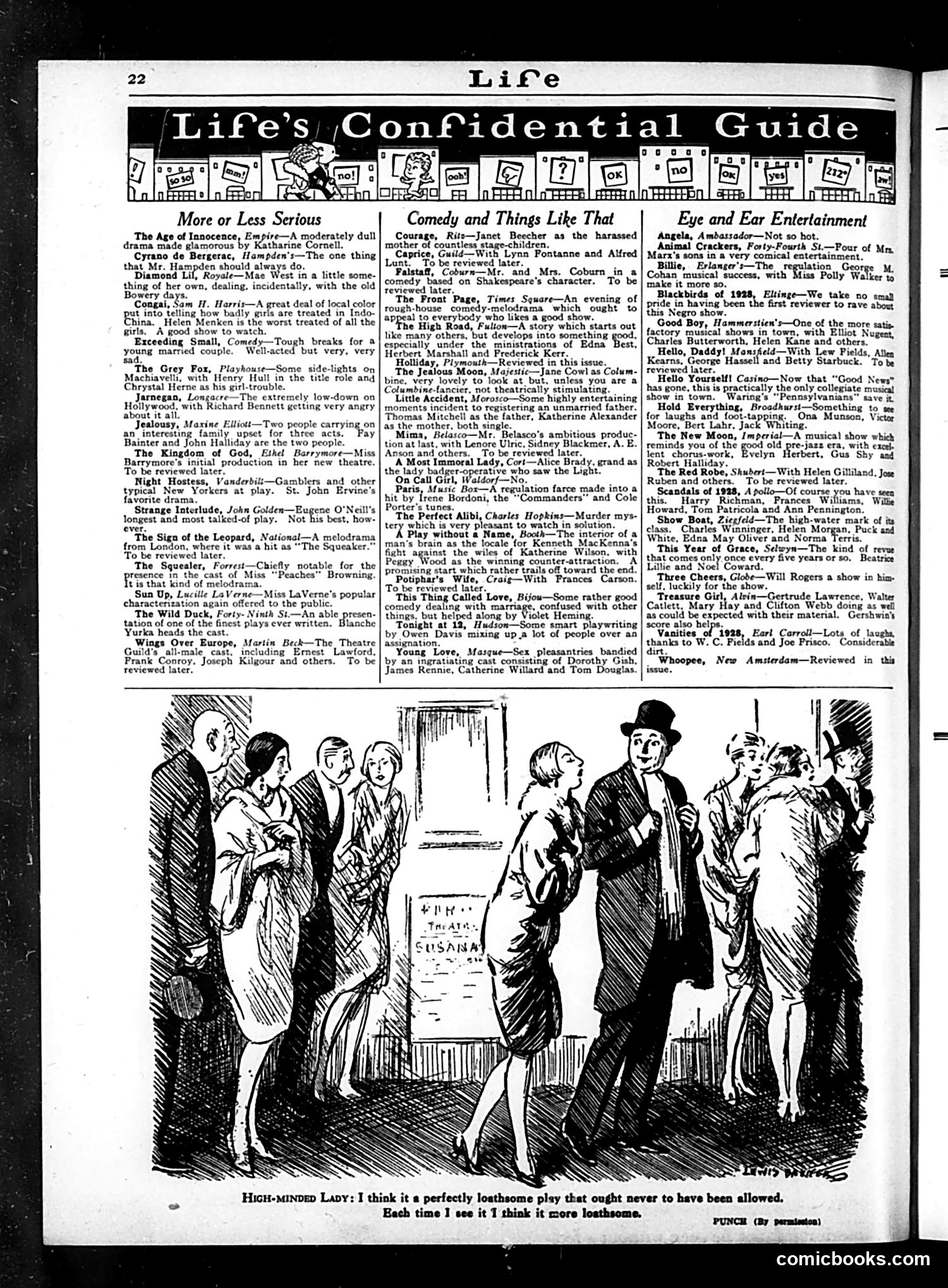
This is a theater review section from Life magazine's "Life's Confidential Guide" feature. The page lists current Broadway productions with brief critical assessments—ranging from "moderately dull" to "good show to watch." The cartoon below depicts a well-dressed woman at a theater entrance complaining to companions about a play. The caption reads: "HIGH-MINDED LADY: I think it a perfectly loathsome play that ought never to have been allowed. Each time I see it I think it more loathsome." **The satire**: The joke mocks theater-goers who repeatedly attend plays they claim to despise, perhaps for social status or habit rather than genuine enjoyment. The woman's contradiction—seeing a show multiple times while denouncing it—skewers pretentious audiences who publicly condemn entertainment while privately supporting it. The reviews themselves cover comedies, melodramas, and experimental works (notably O'Neill's "Strange Interlude"), reflecting 1920s Broadway's mix of commercial and serious theater.
📄 Transcribed text from this page (OCR, searchable)
Machine-transcribed from the original scan — historical spelling and the odd misread are preserved.
More or Less Serious The Age of Innocence, Empire—A moderately dull drama made glamorous by Katharine Cornell. Cyrano de Bergerac, Hampden's—The one thing that Mr. Hampden should always do. Diamond Lil, Royale—Mae West in a little some- thing of her own, dealing, incidentally, with the old Bowery days. Congai, Sam H. Harris—A great deal of local color vat into telling how badly gris are treated in Indo- hina. Helen Menken is the worst treated of all the girls. A good show to watch. Exceeding Small, Comedy—Tough breaks for a young marred couple. Well-acted but very, very sa 4. The Grey Fox, Playhouse—Some side-lights on Machiavelli, with Henry Hull in the title role and Chrystal Herne as his girl-trouble. Jealousy, Maxine Elliott—Two people carrying on an interesting family upset for three acts. Fay Bainter and John Halliday are the two people. The Kingdom of God, Ethel Barrymore—Miss Barrymore's initial production in her new theatre. To be reviewed later. Night Hostess, Vanderbili—Gamblers and other typical New Yorkers at play. St. John Ervine’s favorite drama. Strange Interlude, John Golden—Eugene O'Neill's longest and most talked-of play. Not his best, how- ever. The Sign of the Leopard, National—A melodrama from London, where it was'a hit as “The Squeaker.” To be reviewed later. The Squealer, Forrest—Chiefly notable for the resence in the ‘cast of Miss “Peaches” Browning 1t is that kind of melodrama. Sun Up, Lucille LaVerne—Miss LaVerne’s popular characterization again offered to the public. The Wild Duck, Forty- Ninth St.—An able tation of one of the finest plays ever written. Yurka heads the cast. Wings Over Europe, Martin Beck—The Theatre Guild's all-male cast,’ including Ernest Lawford, . Joseph Kilgour and others. To be reviewed later. resen- jlanche Comedy and Things Like That Courage, Rite—Janet Beecher as the harassed mother of Countless stage-children. eee Lynn Fontanne and Alfred unt. later. Faistaff, Cobwrn—Mr. and Mrs. Coburn in a comedy based on Shakespeare's character. To be reviewed later. . The Front Page, Times Square—An evening of rough-house comedy-melodrama which ought to appeal to everybody who likes a good show. he High Road, Fulion—A story which starts out like many others, but develops into something good, especially under the ministrations of Edna Best, Herbert, Marshall and Prederick Kerr. Holliday, Plymouth—Reviewed in this issue. The Jealous Moon, Majestic—Jane Cowl as Colum- bine. very lovely to look at but, unless you are a Columbine-fancier, not theatrically stimulating. Little Accident, Morosco—Some highly entertaining moments incident to registering an unmarried father. Thomas Mitchell as the father, Katherine Alexander as the mother, both single. - Mima, Belasco—Mr. Belasco’s ambitious produc- tion at last, with Lenore Ulric, Sidney Blackmer, A. E. Anson and others. To be reviewed later. ‘A Most Immoral Lady, Cort—Alice Brady, grand as the lady badger-operat re who saw the Light. On Call Girl, Waldorf—No. . Paris, Music Bor—A regulation farce made into a hit by [rene Bordoni, the “Commanders” and Cole Porter's tunes. The Perfect Alibi, Charles Hopkins—Murder mys- tery which is very pleasant to watch in solution. 4 Play without a Name, Booth—The interior of a man’s brain as the locale for Kenneth MacKenna's fight against the wiles of Katherine Wilson, with Peggy Wood as the winning counter-attraction. A promising start which rather trails off toward the end. Potiphar’s Wife, Craig—With Prances Carson. To be reviewed later. This Thing Called Love, Bijou—Some rather good comedy dealing with marriage, confused with other things, but helped along by Violet Heming. . Tonight at 12, Hudson—Some smart playwriting by Owen Davis mixing up_a lot of people over an assignation. Young Love, Masque—Sex pleasantries bandied | di by an ingratiating cast consisting of Dorothy Gish, James Rennie, Catherine Willard and Tom Douglas. Eye and Ear Entertainment Angela, Ambassador—Not so hot. Animal Crackers, Forty-Fourth St—Pour of Mr Marx's sons in a very comical entertainment. Billie, Erlanger's—The regulation George M. Cohan musical success, with Miss Polly Walker make it more so. Blackbirds of 1928, Eltinge—We take no smal pride in having been the first reviewer to rave about this Negro show. Good Boy, Hammerstien's—One of the more satis factory musical shows in town, with Elliot Nugest Charles Butterworth, Helen Kane and others. Hello, Daddy! Monsfeld—With Lew Pields, Allen Kearns,’ George Hassell and Betty Starbuck. "To be reviewed later. Hello Yourself! Casino—Now that “Good News" has gone, this is practically the only collegiate musical show in town. Waring’s “Pennsylvanians” save it. Hold Everything, Broadhurst—Something to se for laughs and foot-tapping. Ona Munson, Victor Moore, Bert Lahr, Jack Whiting. The New Moon, Imperial—A musical show which feminds you of the good old pre; jazz era, with exce lent chorus-work, Evelyn Herbert. Gus Shy and Robert Halliday. : ‘The Red Robe, Shubert—With Helen Gilliland, Jose Ruben and others. To be reviewed later. Scandals of 1928, A pollo—Of course you have sees this. Harry Rickman, Prances Williams, Wille Howard, Tom Patricola and Ann Pennington. Show Boat, Ziesfeld—The high-water mark of its class, Charles Winninger, Helen Morgan, Puck and White, Edna May Oliver and Norma Terris. This Year of Grace, Selwwyn—The kind of revee that comes only once every five years or 80. Beatrice Lillie and Noel Coward. Three Cheers, Globe—Will Rogers a show in him- self, luckily for the show. Treasure Girl, Alrin—Gertrude Lawrence, Walter Catlett, Mary Hay and Clifton Webb doing as as could be expected score also helps. Vanities of 1928, Earl Carroll—Lots of laughs, thanks to W. C. Pields and Joe Prisco. Considerabie jirt. Whoopee, New Amsterdam—Reviewed in this issue. with their material. Gershwin's Hicu-minvep Lavy: I think it a perfectly loathsome play that ought never to have been allowed. Each time I see it 1 think it more loathsome. PUNCH (By permission) comicbooks.com