
Life, 1929-01-04 · page 23 of 36
Life — January 4, 1929 — page 23: what you’re looking at
What you’re looking at
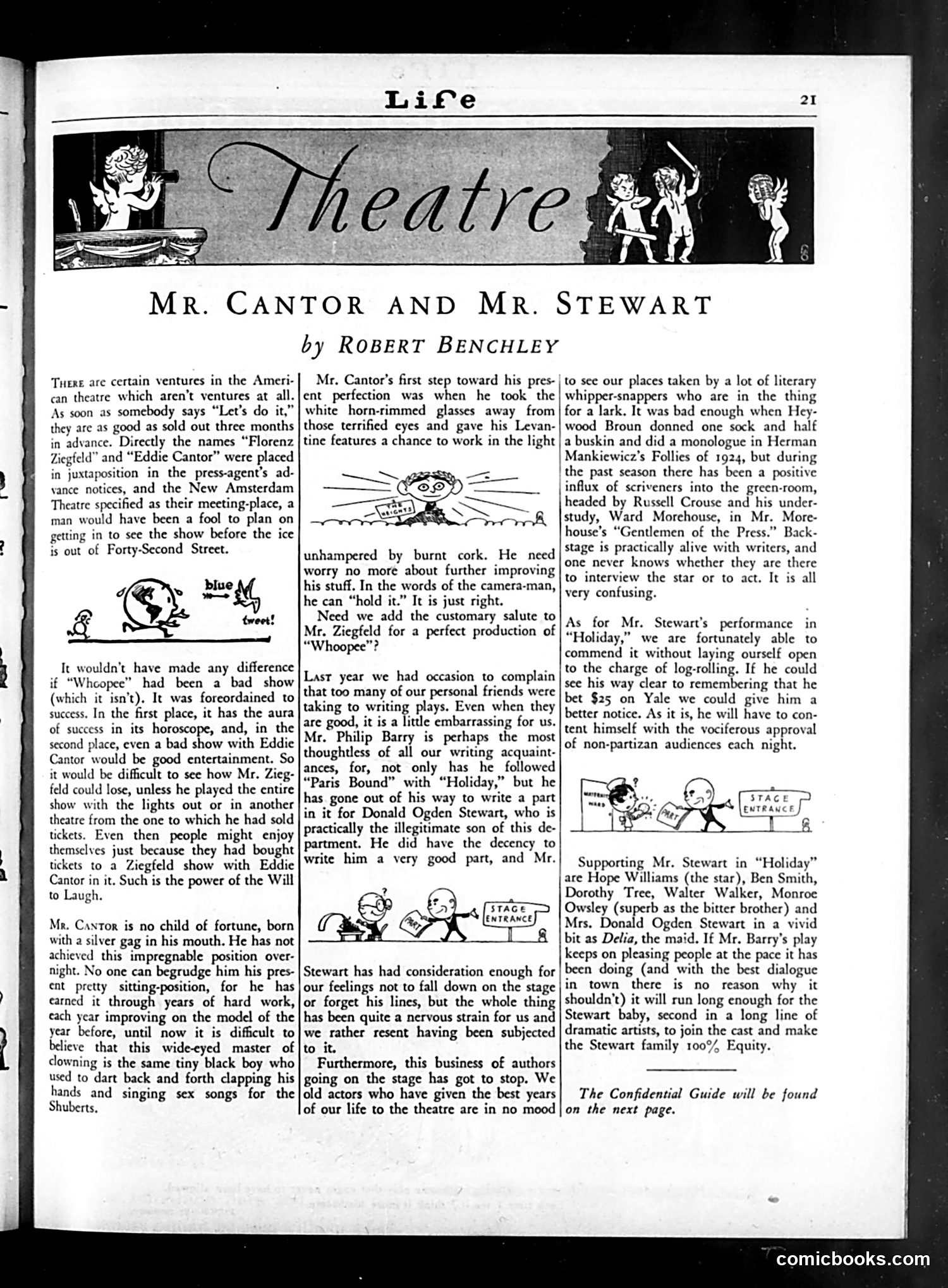
This is theater criticism by humorist Robert Benchley reviewing two Broadway shows: Florenz Ziegfeld's "Whoopee" starring Eddie Cantor, and Philip Barry's "Holiday" featuring Donald Ogden Stewart. **The satire:** Benchley praises Cantor's star power—the show is guaranteed success simply because Cantor's name is attached, regardless of quality. He notes Cantor's evolution from a blackface performer (the "tiny black boy" who sang for the Shuberts) to a polished entertainer who removed the burnt cork makeup and horn-rimmed glasses. **The complaint:** Benchley humorously gripes that too many *writers* are now performing on stage (Stewart, Heywood Broun, Russell Crouse). As someone claiming theatrical legitimacy, he resents these "literary whipper-snappers" taking roles meant for professional actors. This is gentle satire about theatrical gatekeeping and changing entertainment industry practices in the late 1920s. The cartoons illustrate these theater figures in caricature form.
📄 Transcribed text from this page (OCR, searchable)
Machine-transcribed from the original scan — historical spelling and the odd misread are preserved.
MR. CANTOR AND Mr. STEWART by ROBERT BENCHLEY There are certain ventures in the Ameri- can theatre which aren’t ventures at all. As soon as somebody says “Let’s do it,” they are as good as sold out three months in advance. Directly the names “Florenz Ziegfeld” and “Eddie Cantor” were placed in juxtaposition in the press-agent’s ad- vance notices, and the New Amsterdam Theatre specified as their meeting-place, a man would have been a fool to plan on getting in to see the show before the ice is out of Forty-Second Street. It wouldn't have made any difference if “Whoopee” had been a bad show (which it isn’t). It was foreordained to success. In the first place, it has the aura of success in its horoscope, and, in the second place, even a bad show with Eddie Cantor would be good entertainment. So it would be difficult to see how Mr. Zieg- feld could lose, unless he played the entire show with the lights out or in another theatre from the one to which he had sold tickets. Even then people might enjoy themselves just because they had bought tickets to a Ziegfeld show with Eddie Cantor in it. Such is the power of the Will to Laugh. Mr. Cantor is no child of fortune, born with a silver gag in his mouth. He has not achieved this impregnable position over- night. No one can begrudge him his pres- ent pretty sitting-position, for he has earned it through years of hard work, cach year improving on the model of the year before, until now it is difficult to believe that this wide-eyed master of clowning is the same tiny black boy who used to dart back and forth clapping his hands and singing sex songs for the Shuberts, ee Mr. Cantor’s first step toward his pres- ent perfection was when he took the white horn-rimmed glasses away from those terrified eyes and gave his Levan- tine features a chance to work in the light unhampered by burnt cork. He need worry no more about further improving his stuff. In the words of the camera-man, he can “hold it.” It is just right. Need we add the customary salute to Mr. Ziegfeld for a perfect production of “Whoopee”? Lasr year we had occasion to complain that too many of our personal friends were taking to writing plays. Even when they are good, it is a little embarrassing for us. Mr. Philip Barry is perhaps the most thoughtless of all our writing acquaint- ances, for, not only has he followed “Paris Bound” with “Holiday,” but he has gone out of his way to write a part in it for Donald Ogden Stewart, who is practically the illegitimate son of this de- partment. He did have the decency to write him a very good part, and Mr. 2 Stewart has had consideration enough for our feelings not to fall down on the stage or forget his lines, but the whole thing has been quite a nervous strain for us and we rather resent having been subjected to it. Furthermore, this business of authors going on the stage has got to stop. We old actors who have given the best years of our life to the theatre are in no mood to see our places taken by a lot of literary whipper-snappers who are in the thing for a lark. It was bad enough when Hey- wood Broun donned one sock and half a buskin and did a monologue in Herman Mankiewicz’s Follies of 1924, but during the past season there has been a positive | influx of scriveners into the green-room, headed by Russell Crouse and his under- study, Ward Morehouse, in Mr. More- house’s “Gentlemen of the Press.” Back- stage is practically alive with writers, and one never knows whether they are there to interview the star or to act. It is all very confusing. As for Mr. Stewart’s performance in “Holiday,” we are fortunately able to commend it without laying ourself open to the charge of log-rolling. If he could see his way clear to remembering that he bet $25 on Yale we could give him a better notice. As it is, he will have to con- tent himself with the vociferous approval of non-partizan audiences each night. Supporting Mr. Stewart in “Holiday” are Hope Williams (the star), Ben Smith, Dorothy Tree, Walter Walker, Monroe Owsley (superb as the bitter brother) and Mrs. Donald Ogden Stewart in a vivid bit as Delia, the maid. If Mr. Barry's play keeps on pleasing people at the pace it has been doing (and with the best dialogue in town there is no reason why it shouldn’t) it will run long enough for the Stewart baby, second in a long line of dramatic artists, to join the cast and make the Stewart family 100°/, Equity. The Confidential Guide will be found on the next page. comicbooks.com