
Life, 1927-02-17 · page 28 of 34
Life — February 17, 1927 — page 28: what you’re looking at
What you’re looking at
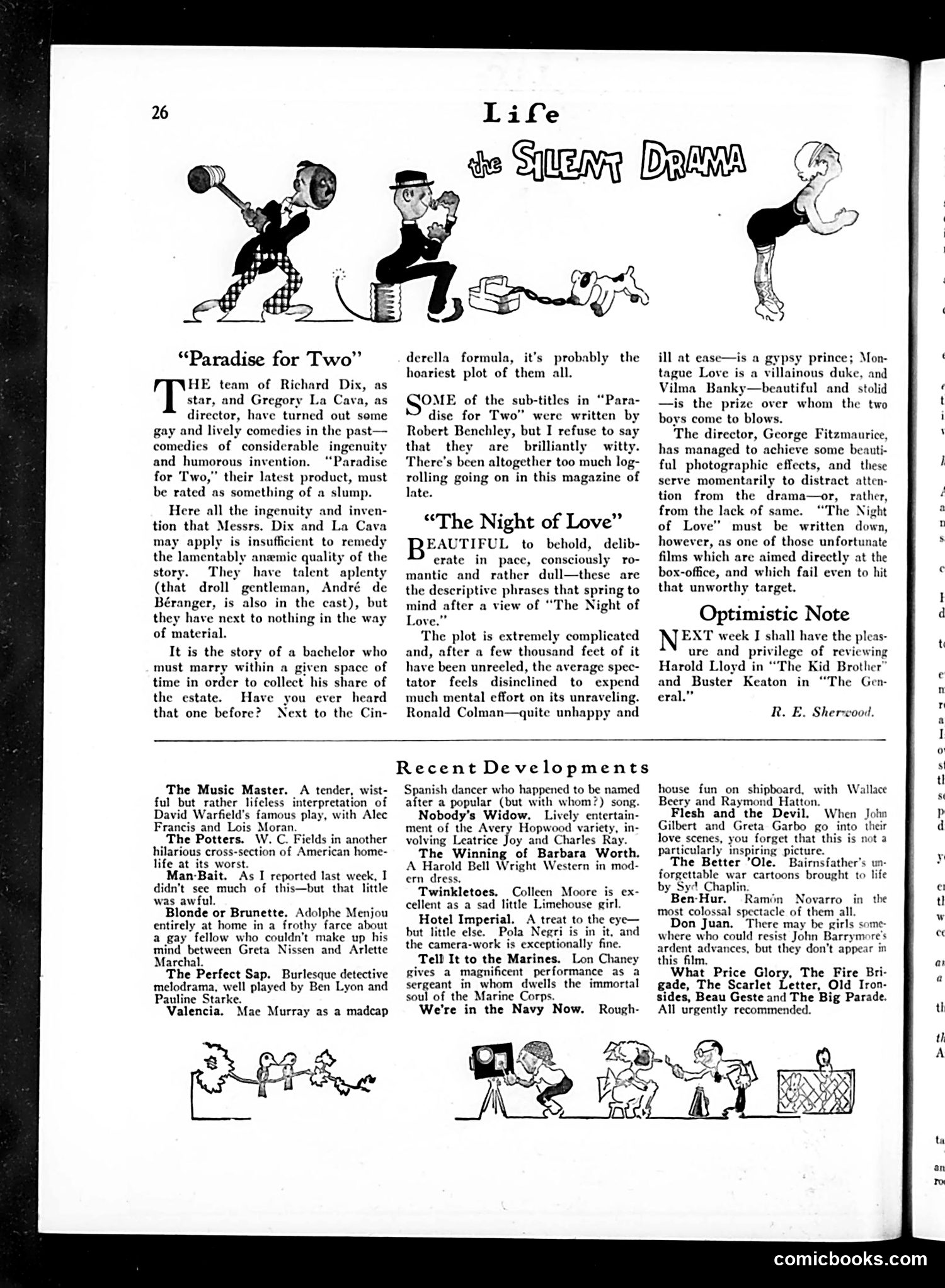
This is a film review page from *Life* magazine's "Silent Drama" section, critiquing contemporary movies (likely mid-1920s based on references to silent film stars like Ronald Colman and Vilma Banky). The reviews are notably **harsh and witty**. The critic dismisses "Paradise for Two" as a creative "slump" using tired plot devices—a bachelor must marry to inherit. He mocks "The Night of Love" as visually pretty but narratively tedious, with Ronald Colman appearing miserable in the role. The tone is **snobbish and caustic**: the critic attacks "log-rolling" (mutual praise among colleagues), accuses films of being cynically "aimed directly at the box-office," and generally suggests contemporary Hollywood is creatively bankrupt. The cartoon headers show exaggerated silent-film physical comedy—dumbbells, slapstick, pratfalls—satirizing the era's reliance on broad physical humor over substantial storytelling. This visual mockery complements the textual criticism of weak material.
📄 Transcribed text from this page (OCR, searchable)
Machine-transcribed from the original scan — historical spelling and the odd misread are preserved.
“Paradise for Two” HE team of Richard Dix, as star, and Gregory La Cava, as director, have turned out some gay and lively comedies in the past— comedies of considerable ingenuity and humorous invention. ‘Paradise for Two,” their latest product, must be rated as something of a slump. Here all the ingenuity and inven- tion that Messrs. Dix and La Cava may apply is insufficient to remedy the lamentably anemic quality of the story. They have talent aplenty (that droll gentleman, André de Béranger, is also in the cast), but they have next to nothing in the way of material. It is the story of a bachelor who must marry within a given space of time in order to collect his share of the estate. Have you ever heard that one before? Next to the Cin- derella formula, it’s probably the hoariest plot of them all. OME of the sub-titles in “Para- dise for Two” were written by Robert Benchley, but I refuse to say that they are brilliantly witty. There’s been altogether too much log- rolling going on in this magazine of late. “The Night of Love” EAUTIFUL to behold, delib- erate in pace, consciously ro- mantic and rather dull—these are the descriptive phrases that spring to mind after a view of “The Night of Love.” The plot is extremely complicated and, after a few thousand feet of it have been unreeled, the average spec- tator feels disinclined to expend much mental effort on its unraveling. Ronald Colman—quite unhappy and ill at ease—is a gypsy prince; Mon- tague Love is a villainous duke, and Vilma Banky—beautiful and stolid —is the prize over whom the two boys come to blows. The director, George Fitzmaurice, has managed to achieve some beauti- ful photographic effects, and_ these serve momentarily to distract atten- tion from the drama—or, rather, from the lack of same. he Night of Love” must be written down, however, as one of those unfortunate films which are aimed directly at the box-office, and which fail even to hit that unworthy target. Optimistic Note NEST week J shall have the pleas- ure and privilege of reviewing Harold Lloyd in “The Kid Brother” and Buster Keaton in “The Gen- eral.” R. E. Sherwood. The Music Master. A tender, wist- ful but rather lifeless interpretation of David Warfield’s famous play, with Alec Francis and Lois Moran. The Potters. W. C. Fields in another hilarious cross-section of American home- life at its worst. Man-Bait. As I reported last week, I didn’t see much of this—but that little was awful. Blonde or Brunette. Adolphe Menjou entirely at home in a frothy farce about a gay fellow who couldn't make up his mind between Greta Nissen and Arlette Marchal. The Perfect Sap. Burlesque detective melodrama, well played by Ben Lyon and Pauline Starke. Valencia. Mae Murray as a madcap Recent Developments Spanish dancer who happened to be named after a popular (but with whom?) song. Nobody’s Widow. Lively entertain- ment of the Avery Hopwood variety, in- volving Leatrice Joy and Charles Ray. The Winning of Barbara Worth. A Harold Bell Wright Western in mod- ern dress. Twinkletoes. Colleen Moore is ex- cellent as a sad little Limehouse girl. Hotel Imperial. A treat to the eye— but little else. Pola Negri is in it, and the camera-work is exceptionally fine. Tell It to the Marines. Lon Chaney gives a magnificent performance as a sergeant in whom dwells the immortal soul of the Marine Corps. We're in the Navy Now. Rough- house fun on shipboard, with Wallace Beery and Raymond Hatton. Flesh and the Devil. When John Gilbert and Greta Garbo go into their love scenes, you forget that this is not a particularly inspiring picture. The Better 'Ole. Bairnsfather’s un- forgettable war cartoons brought to life by Syd Chaplin. Ben-Hur. Ramin Novarro most colossal spectacle of them all Don Juan. There may be girls where who could resist John Barry ardent advances, but they don’t appear in this film. What Price Glory, The Fire Bri- gade, The Scarlet Letter, Old Iron- sides, Beau Geste and The Big Parade. All urgently recommended. in the comicbooks.com