
Life, 1927-01-06 · page 28 of 39
Life — January 6, 1927 — page 28: what you’re looking at
What you’re looking at
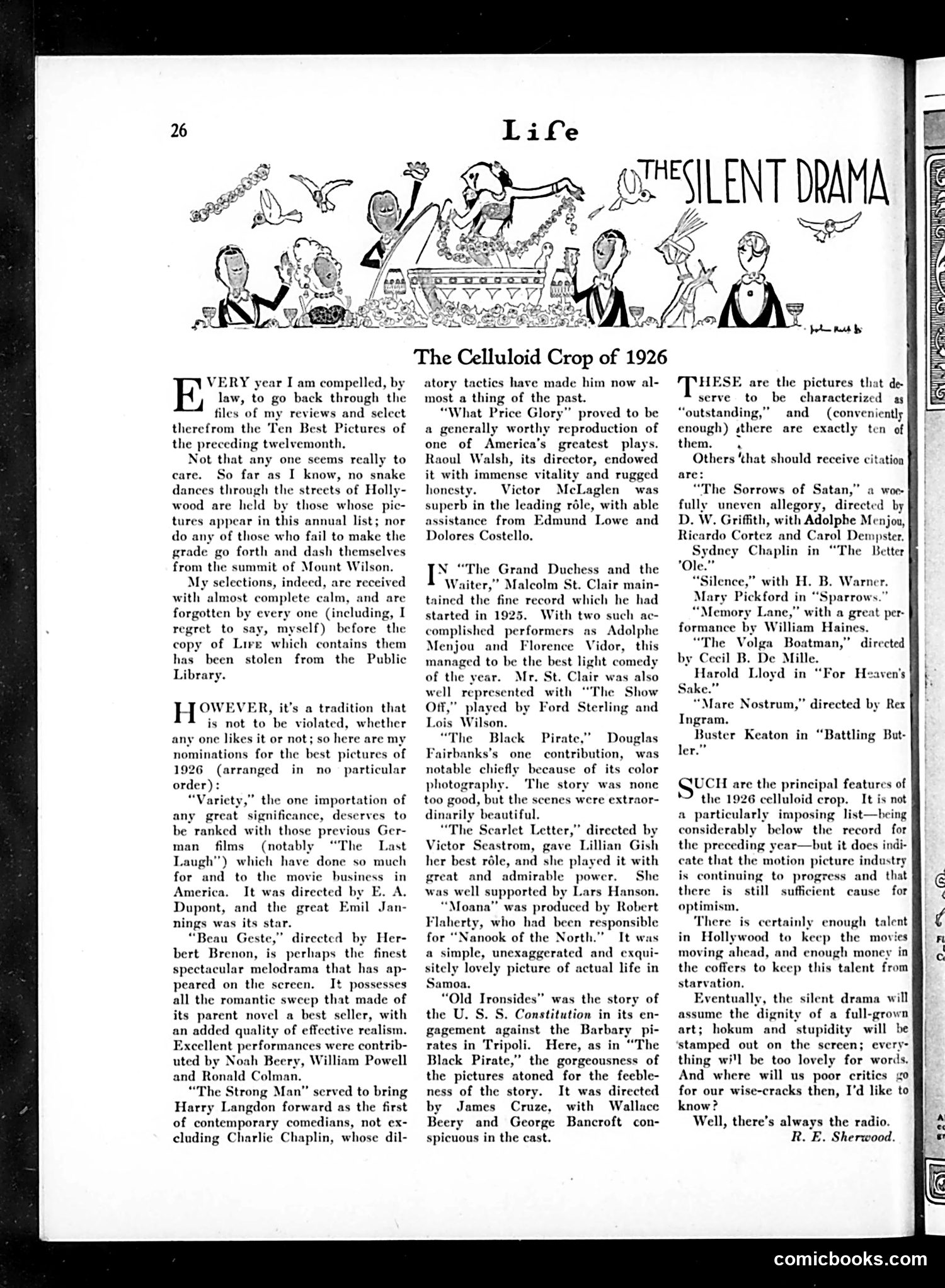
This page is R.E. Sherwood's annual "Ten Best Pictures" film review for 1926. The cartoon header depicts industry figures celebrating silent cinema's output that year. The text is a critical roundup naming top films, including *Variety* (a German import), *Beau Geste*, *What Price Glory*, and *The Scarlet Letter*. Notably, Sherwood dismisses Charlie Chaplin as nearly obsolete due to his "dilatory tactics," while praising Harry Langdon as the superior contemporary comedian. Key context: This is the silent film era; actors like Emil Jannings, Victor McLaglen, and Lillian Gish are praised for their physical performances. The review treats cinema seriously as an art form worthy of critical consideration—a relatively new stance. The tone is witty but somewhat exasperated, as Sherwood notes his annual list-making is "forgotten by every one" and generates no public interest whatsoever.
📄 Transcribed text from this page (OCR, searchable)
Machine-transcribed from the original scan — historical spelling and the odd misread are preserved.
VERY year I am compelled, by E law, to go back through the files of my reviews and select therefrom the Ten Best Pictures of the preceding twelvemonth, Not that any one seems really to care. So far as I know, no snake dances through the streets of Holly- wood are held by those whose pic- tures appear in this annual list; nor do any of those who fail to make the grade go forth and dash themselves from the summit of Mount Wilson. My selections, indeed, are received with almost complete calm, and are forgotten by every one (including, I regret to say, myself) before the copy of Lr which contains them has been stolen from the Public Library. is OWEVER, it’s a tradition that is not to be violated, whether any one likes it or not; so here are my nominations for the best pictures of 1926 (arranged in no particular order): “Variety,” the one importation of any great significance, deserves to be ranked with those previous Ger- man films (notably “The Last Laugh”) which have done so much for and to the movie business in America. It was directed by A. Dupont, and the great Emil J nings was its star. “Beau Geste,” directed by Her- bert Brenon, is perhaps the finest spectacular melodrama that has ap- peared on the screen. It possesses all the romantic sweep that made of its parent novel a best seller, with an added quality of effective realism. Excellent performances were contrib- uted by Noah Beery, William Powell and Ronald Colman. “The Strong Man” served to bring Harry Langdon forward as the first of contemporary comedians, not ex- eluding Charlie Chaplin, whose dil- Jan- The Celluloid Crop of 1926 atory tactics have made him now al- most a thing of the past. “What Price Glory” proved to be a generally worthy reproduction of one of America’s greatest plays. Raoul Walsh, its director, endowed it with immense vitality and rugged honesty. Victor McLaglen was superb in the leading réle, with able assistance from Edmund Lowe and Dolores Costello. N “The Grand Duchess and the Waiter,” Malcolm St. Clair main- tained the fine record which he had started in 19: With two such ac- complished performers as Adolphe Menjou and Florence Vidor, tl managed to be the best light comedy of the y Mr. St. Clair was also well represented with “The Show ” played by Ford Sterling and Wilson. fhe Black Pirate,” Douglas Fairbanks’s one contribution, was notable chiefly because of its color photography. The story was none too good, but the scenes were extraor- dinarily beautiful. “The Scarlet Letter,” directed by Victor Seastrom, gave Lillian Gish her best réle, and she played it with great and admirable power. She was well supported by Lars Hanson. foana” was produced by Robert Flaherty, who had been respons for “Nanook of the North.” It w a simple, unexaggerated and exqu sitely lovely picture of actual life in Samoa. “Old Ironsides” was the story of the U. S. S. Constitution in its en- gagement against the Barbary pi- rates in Tripoli. Here, as in “The Black Pirate,” the gorgeousness of the pictures atoned for the feeble- ness of the story. It was directed by James Cruze, with Wallace Beery and George Bancroft con- spicuous in the cast. are the pictures that de serve to be characterized as “outstanding,” and (conveniently enough) sthere are exactly ten of them. Others ‘that should receive ci are: “The Sorrows of Satan,” a woe- fully uneven allegory, directed by D. W. Griffith, with Adolphe Menjou, Ricardo Cortez and Carol Dempster, Sydney Chaplin in “The Better “Ole.” : lence,” with H. B. Warner. ty Pickford in “Sparrows.” “Memory Lane,” with a great per- formance by William Haines. “The Volga Boatman,” directed by Cecil B. De Mille. Harold Lloyd in “For Heaven's ‘THESE tion “Mare Nostrum,” Ingram. Buster Keaton in “Battling But- ler.” directed by Rex UCH are the principal features of the 1926 celluloid crop. It is not a particularly imposing list—being considerably below the record for the preceding year—but it does indi- cate that the motion picture industry is continuing to progress and that there is still sufficient cause for optimism, There is certainly enough talent in Hollywood to keep the mc moving ahead, and enough mone: the coffers to keep this talent from starvation. Eventually, the silent drama will assume the dignity of a full-grown art; hokum and stupidity will be stamped out on the screen; every- thing wil be too lovely for words. And where will us poor critics 40 for our wise-cracks then, I'd like to know? Well, there’s always the radio. R. E. Sherwood. comicbooks.com