
Life, 1926-07-15 · page 25 of 37
Life — July 15, 1926 — page 25: what you’re looking at
What you’re looking at
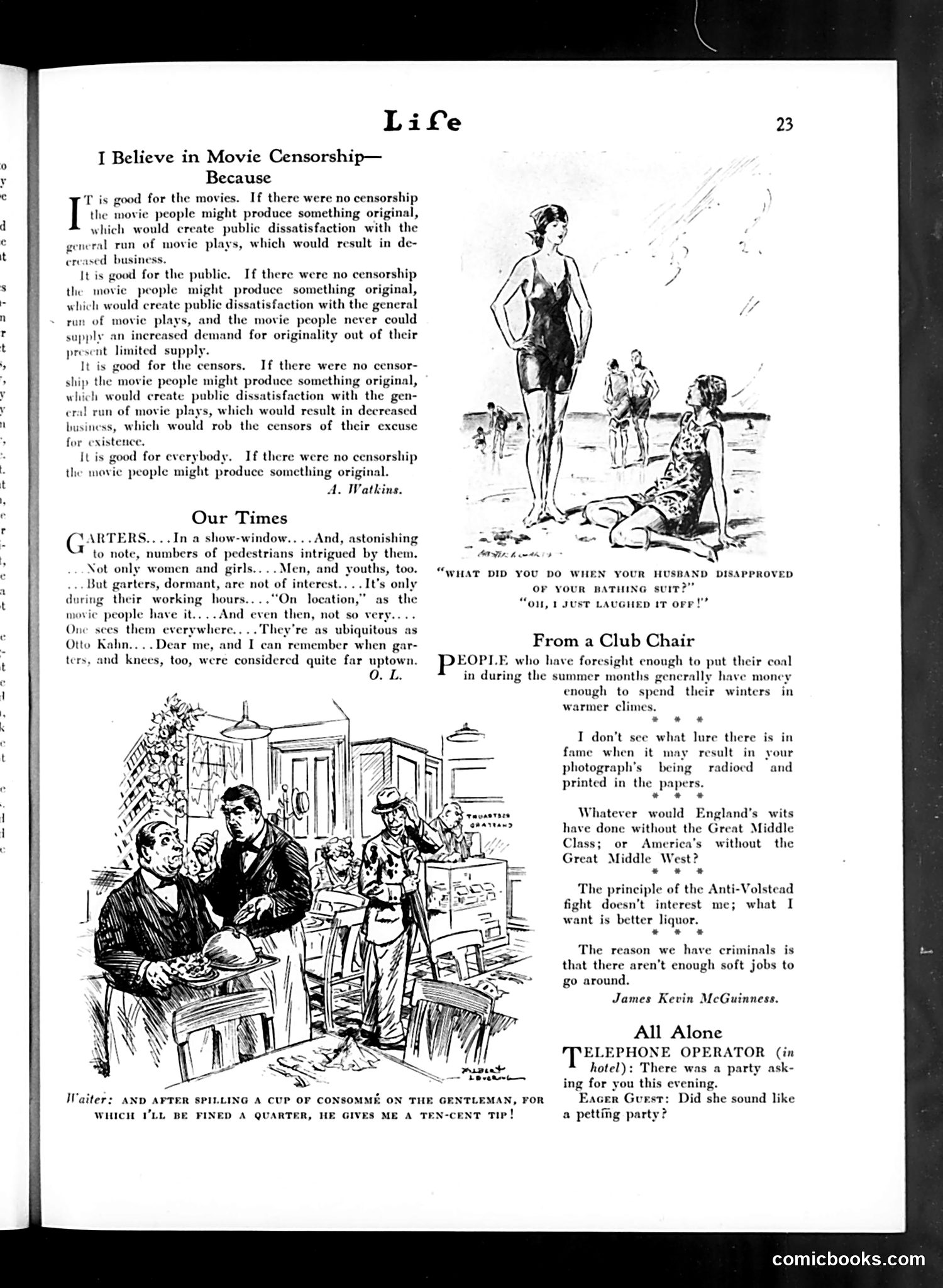
This page from *Life* magazine presents satirical commentary on 1920s American social issues. **"I Believe in Movie Censorship"** is ironic social criticism. A. Watkins argues FOR censorship by listing absurd reasons—claiming it protects the movie industry from producing original content that might satisfy audiences better than current mediocre films. The satire mocks both the film industry's resistance to innovation and censorship boards' self-interested justification for existing. **"Our Times"** contains observational humor about changing social norms. References to garters and knees being displayed in public shock an older generation (O.L.), reflecting 1920s anxieties about women's changing fashion and behavior. Otto Kahn's observation treats modern fashion as ubiquitous and inevitable. **"From a Club Chair"** offers witty one-liners on wealth, fame, social class, and Prohibition—the latter mocking anti-Prohibition activists by suggesting the real issue isn't moral principle but quality liquor. **The cartoons** depict class interactions: a waiter's mishap, a beach scene suggesting marital discord, and a hotel operator's innuendo about an "eager guest" receiving a call from a woman.
📄 Transcribed text from this page (OCR, searchable)
Machine-transcribed from the original scan — historical spelling and the odd misread are preserved.
I Believe in Movie Censorship— Because T is good for the movies. If there were no censorship I the movie people might produce something original, which would create public dissatisfaction with the general run of movie plays, which would result in de- creased business. It is good for the public. If there were no censorship the movie people might produce something original, which would create public dissatisfaction with the general run of movie plays, and the movie people never could supply an increased demand for originality out of their present limited supply. It is good for the censors. If there were no censor- ship the movie people might produce something original, which would create public dissatisfaction with the gen- eral run of movie plays, which would result in decreased business, which would rob the censors of their excuse for existence, It is good for everybody. If there were no censorship the movie people might produce something original. A, Watkins. Our Times GATE In a show-window J to note, numbers of pede Not only women and girls....Men, and youths, too. But garters, dormant, are not of interest It’s only during their working hours....‘‘On location,” as the - And, astonishing ns intrigued by them. One sees them everywhere... They’ Otto Kahn. as ubiquitous as - Dear me, and I can remember when gar- ters, and knees, too, were considered quite far uptown. oO. L. Waiter: AND AFTER SPILLING A CUP OF CONSOMME ON THE GENTLEMAN, FOR “WHAT DID YOU DO WHEN YOUR HUSBAND DISAPPROVED OF YOUR BAT , “Ou, 1 JUST LAUGH From a Club Chair P EOPI.E who have foresight enough to put their coal in during the summer months generally have money enough to spend their winters in warmer climes. ** # I don’t see what lure there is in fame when it may result in’ your photograph’s being radioed and printed in the papers. oe + Whatever would England's wits have done without the Great Middle Class; or America’s without the Great Middle West? 8 # The principle of the Anti-Volstead fight doesn’t interest me; what I want is better liquor. 8 * son we have criminals is aren't enough soft jobs to go around. James Kevin McGuinness. All Alone ELEPHONE OPERATOR (in hotel): There was a party ask- ing for you this evening. Eacer Guest: Did she sound like ENT TIP! WHICH ULL BE FINED A QUARTER, HE GIVES ME A TEN a petting party comicbooks.com