
Life, 1926-07-15 · page 23 of 37
Life — July 15, 1926 — page 23: what you’re looking at
What you’re looking at
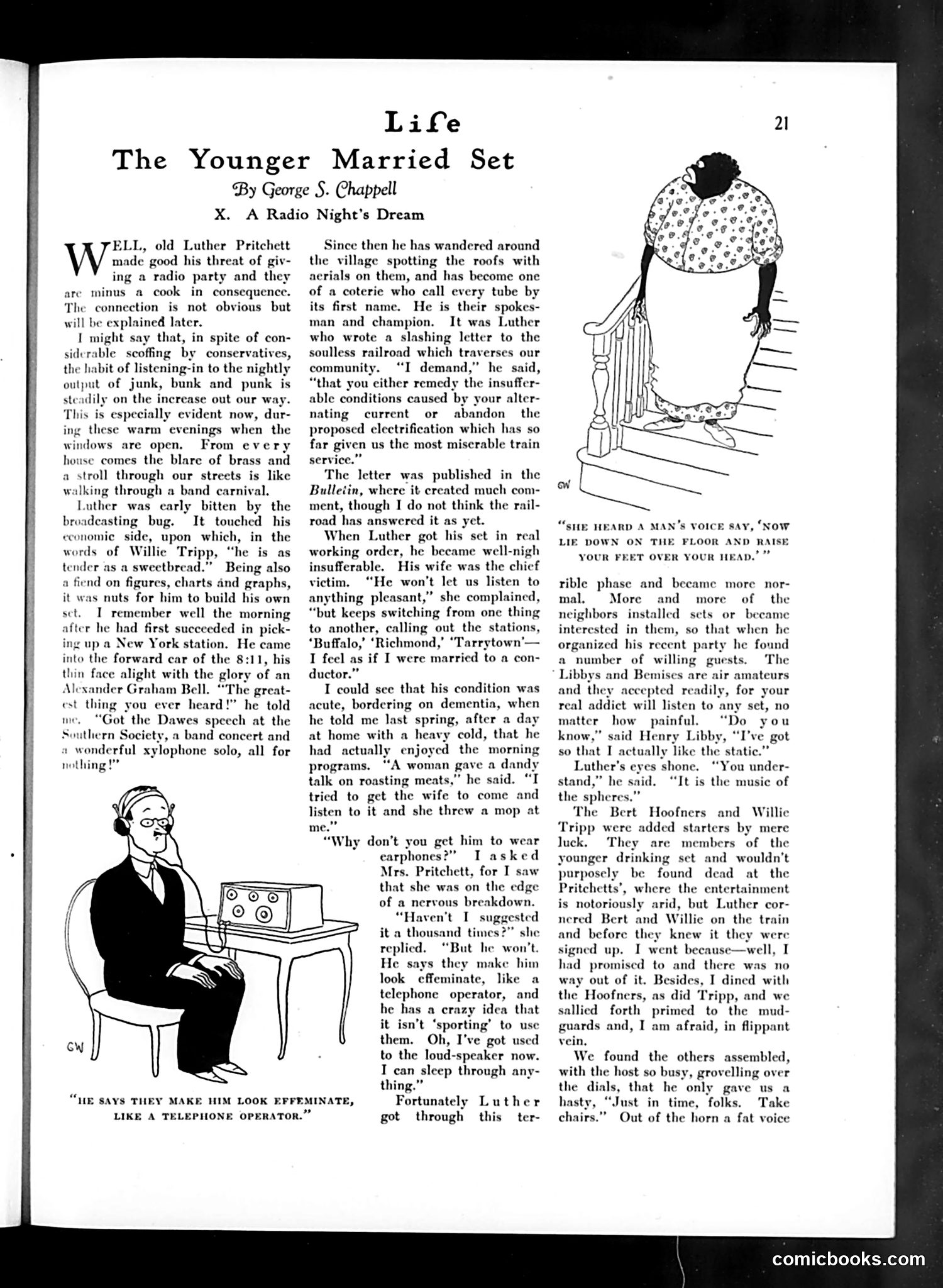
This 1920s satirical story mocks the early radio craze and its obsessive enthusiasts. Luther Pritchett represents the typical early radio adopter—a man so consumed by his homemade radio set that he alienates his wife and household staff through constant, loud broadcasting. The cartoon (bottom left) illustrates Mrs. Pritchett's complaint: Luther refuses to use earphones because he fears they'll make him "look effeminate, like a telephone operator"—revealing period anxieties about masculinity. He also considers private listening "unsporting," insisting on subjecting everyone to the loud public broadcast. The satire targets both radio's novelty appeal and the social disruption it caused. The story notes the "steadily increasing" habit despite "considerable scoffing by conservatives," capturing the generational divide over new technology. The illustration of the woman at right appears to depict someone listening to radio broadcasts, embodying the passive consumption that increasingly defined domestic leisure during this era.
📄 Transcribed text from this page (OCR, searchable)
Machine-transcribed from the original scan — historical spelling and the odd misread are preserved.
Life The Younger Married Set By George S. Chappell X. A Radio Night's Dream ELL, old Luther Pritchett W nade good his threat of giv- ng a radio party and they are minus a cook in consequence. The connection is not obvious but will be explained later. I might say that, in spite of con- siderable scoffing by conservatives, the habit of listening-in to the nightly output of junk, bunk and punk is steadily on the increase out our way. This is especially evident now, dur- ing these warm evenings when the windows are open. From every house comes the blare of brass and a stroll through our streets is like walking through a band carnival. Luther was carly bitten by the broadcasting bug. It touched his upon which, in the words of Willie Tripp, “he is as tender as a sweetbread.” Being also a fiend on figures, charts and graphs, it was nuts for him to build his own set. I remember well the morning after he had first succeeded in pick- ¢ up a New York station. He came into the forward car of the 8:11, his thin face alight with the glory of an Alexander Graham Bell. “The great- est thing you ever heard!” he told me. “Got the Dawes speech at the Southern Society, a band concert and 1 wonderful xylophone solo, all for nothing! “Sie SAYS THEY MAKE HIM LOOK EFFEMINATE, LIKE A TELEPHONE OPERATOR.” Since then he has wandered around the village spotting the roofs with aerials on them, and has become one of a coterie who call every tube by its first name. He is their spokes- man and champion. It was Luther who wrote a slashing letter to the soulless railroad which traverses our community. “I demand,” he said, “that you cither remedy the insuffer- able conditions caused by your alter- nating current or abandon the proposed electrification which has so far given us the most miserable train servi The letter was published in the Bulletin, where it created much com- ment, though I do not think the rail- road has answered it as yet. When Luther got his set in real working order, he became well-nigh insufferable. His wife was the chief victim. “He won't let us listen to anything pleasant,” she complained, “but keeps switching from one thing to another, calling out the stations, ‘Buffalo,’ ‘Richmond,’ ‘Tarrytown’— I feel as if I were married to a con- ductor.” I could see that his condition was acute, bordering on dementia, when he told me last spring, after a day at home with a heavy cold, that he had actually enjoyed the morning programs. “A woman gave a dandy talk on roasting meats,” he said. “T tried to get the wife to come and listen to it and she threw a mop at me.” “Why don’t you get him to wear earphones?” I asked Mrs. Pritchett, for I saw that she was on the edge of a nervous breakdown. “Haven't I suggested it a thousand times?” she replied. “But he won't. He says they make him look effeminate, like a telephone operator, and he has a crazy idea that it isn’t ‘sporting’ to use them. Oh, I've got used to the loud-speaker now. I can sleep through any- thing.” Fortunately Luther got through this ter- rible phase and became more nor- mal, More and more of the neighbors installed sets or became interested in them, so that when he organized his recent party he found a number of willing guests. The and Bemises are air amateurs y accepted readily, for your real addict will listen to any set, no matter how painful. know,” said Henry Libby, so that I actually like the ste Luther's eyes shone. “You under- stand,” he . “It is the music of the spheres.” The Bert Hoofners and Willie Tripp were added starters by mere Juck. They are members of the younger drinking sect and wouldn't purposely be found dead at the Pritchetts’, where the entertainment is notoriously arid, but Luther cor- nered Bert and Willie on the train and before they knew it they were signed up. I went because—well, I had promised to and there was no way out of it. Besides, I dined with the Hoofners, as did Tripp, and we sallied forth primed to the mud- guards and, I am afraid, in flippant vein, We found the others assembled, with the host so busy, grovelling over the dials, that he only gave us a hasty, “Just in time, folks. Take Out of the horn a fat voice comicbooks.com