
Life, 1926-07-15 · page 16 of 37
Life — July 15, 1926 — page 16: what you’re looking at
What you’re looking at
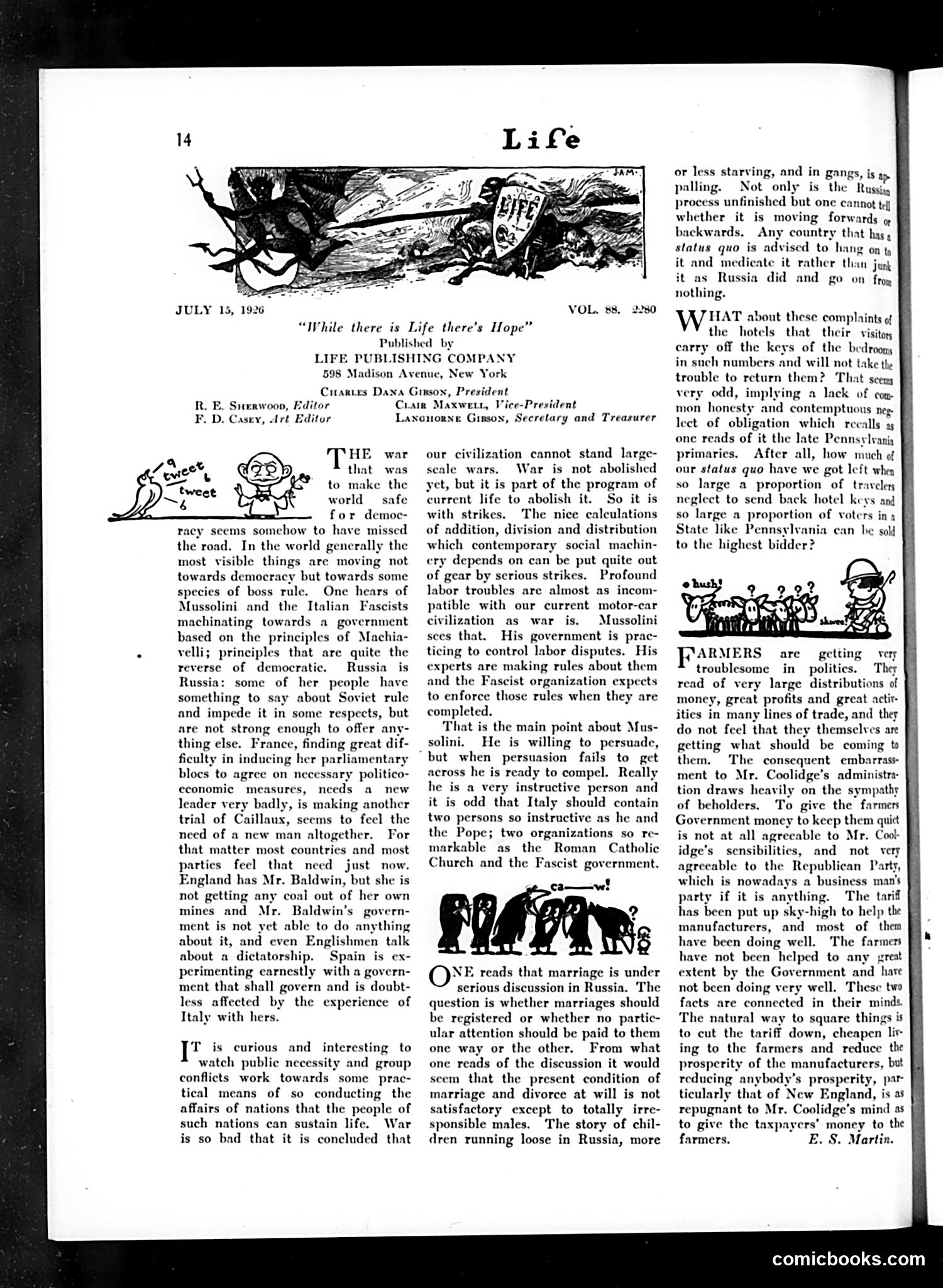
This page contains editorial commentary on contemporary political crises rather than traditional editorial cartoons. The text discusses labor unrest, Mussolini's Fascist government in Italy, and Russian Soviet rule as competing models for social order. Two small illustrations appear: one showing a figure labeled "Sweet" (unclear context), and another depicting silhouetted figures in what appears to be a confrontational stance, likely representing labor disputes or class conflict. The editorial argues that while democracy struggles with strikes and labor troubles, authoritarian systems like Mussolini's Italy and Soviet Russia attempt to impose order through force and control. The writer suggests these represent two competing answers to managing industrial civilization's problems—a key debate of 1920s America.
📄 Transcribed text from this page (OCR, searchable)
Machine-transcribed from the original scan — historical spelling and the odd misread are preserved.
ra aed JULY 15, 1926 VOL. 88. 2280 “While there is Life there’s Hope” Published by LIFE PUBLISHING COMPANY 598 Madison Avenue, New York Curantes Dana Ginson, President R. E. Snerwoon, Editor F. D. Casey, Art Editor HE war that was to make the world — safe for democ- jow to have missed the road. In the world generally the most visible things are moving not towards democracy but towards some species of boss rule. One hears of Mussolini and the Italian Fascists machinating towards a government based on the principles of Machia- velli; principles that are quite the reverse of democratic. Russia is Russia: some of her people have something to say about Soviet rule and impede it in some respects, but are not strong enough to offer any- thing else. France, finding great dif- ficulty in inducing her parliamentary blocs to agree on necessary politico- economic measures, needs a new leader very badly, is making another trial of Caillaux, seems to feel the need of a new man altogether. For that matter most countries and most parties feel that need just now. England has Mr. Baldwin, but she is not getting any coal out of her own mines and Mr. Baldwin’s govern- ment is not yet able to do anything about it, and even Englishmen talk about a dictatorship. Spain is ex- perimenting earnestly with a govern- ment that shall govern and is doubt- less affected by the experience of Italy with hers. T is curious and interesting to watch public necessity and group conflicts work towards some prac- tical means of so conducting the affairs of nations that the people of such nations can sustain life. War is so bad that it is concluded that Cram Maxweu, V Lancuorne Gipson e-President Secretary and Treasurer our civilization cannot stand large- ale wars, War is not abolished yet, but it is part of the program of current life to abolish it. So it is with strikes. The nice calculations of addition, division and distribution which contemporary social machin- ery depends on can be put quite out of gear by serious strikes. Profound labor troubles are almost as incom- patible with our current motor-car civilization as war is. Mussolini sees that. His government is prac- ticing to control labor disputes. His experts are making rules about them and the Fascist organization expects to enforce those rules when they are completed That is the main point about Mus- solini. He is willing to persuade, “but when persuasion fails to get across he is ready to compel. Really he is a very instructive person and it is odd that Italy should contain two persons so instructive as he and the Pope; two organizations so re- markable as the Roman Catholic Church and the Fascist government. ca——w! NE reads that marriage is under serious discussion in Russia. The question is whether marriages should be registered or whether no partic- ular attention should be paid to them one way or the other. From what one reads of the discussion it would seem that the present condition of marriage and divorce at will is not satisfactory except to totally irre- sponsible males. The story of chil- dren running loose in Russia, more or less starving, and in gangs, is > palling. Not only is the Russiss process unfinished but one cannot te whether it is moving forwards backwards. Any country that has, status quo is advised to Z on to it and medicate it rather than junk it as Russia did and go on frog nothing. HAT about these complaints of the hotels that their visitors carry off the keys of the bedroons in such numbers and will not take the trouble to return them? That seems very odd, implying a lack of com mon honesty and contemptuous neg. lect of obligation which recalls 95 one reads of it the late Pennsylvania primaries. After all, how much of our status quo have we got left wheo so large a proportion of traveler neglect to send back hotel keys and so large a proportion of voters ins State like Pennsylvania can be sold to the highest bidde JFrakMERS are getting very troublesome in politics. They read of very large distributions of money, great profits and great actis- ities in many lines of trade, and they do not feel that they themselves are getting what should be coming to them. The consequent embarrass- ment to Mr. Coolidge’s administra- tion draws heavily on the sympathy of beholders. To give the farmers Government money to keep them quiet is not at all agreeable to Mr. Cool- idge’s sensibiliti and not very agreeable to the Republican Party, which is nowadays a business man’s party if it is anything. The tarif has been put up sky-high to help the manufacturers, and most of them have been doing well. The farmers have not been helped to any great extent by the Government and have not been doing very well. These two facts are connected in their minds. The natural way to square things is to cut the tariff down, cheapen lis- ing to the farmers and reduce the prosperity of the manufacturers, but reducing anybody's prosperity, par ticularly that of New England, is as repugnant to Mr. Coolidge’s mind as to give the taxpayers’ money to the farmers. E. S. Martin. comicbooks.com