
Life, 1925-12-17 · page 28 of 40
Life — December 17, 1925 — page 28: what you’re looking at
What you’re looking at
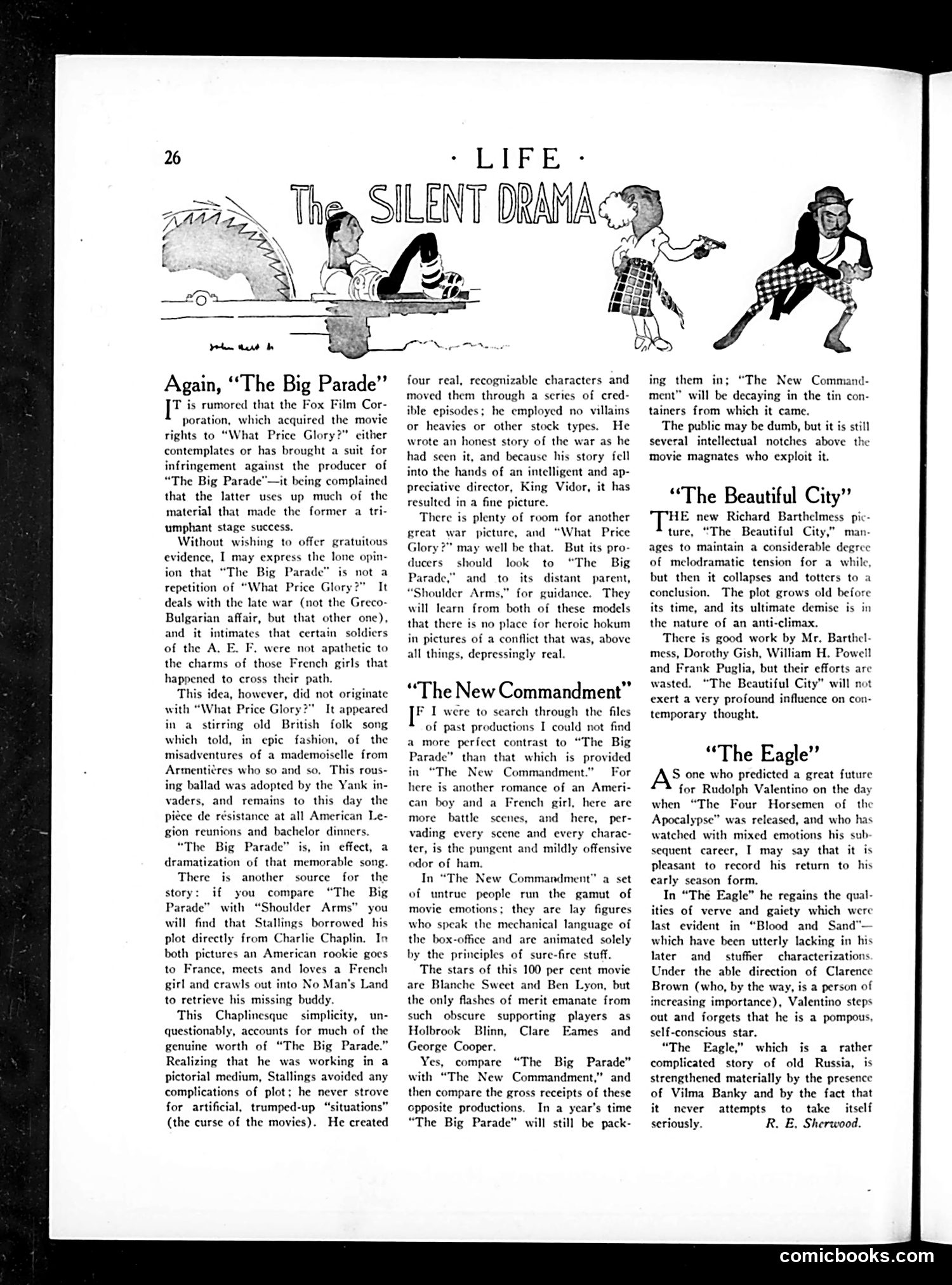
This page reviews several World War I-themed silent films, primarily comparing **"The Big Parade"** with competitor films like **"What Price Glory?"** and **"The New Commandment."** The small cartoon at top depicts a slapstick scene—likely referencing the physical comedy common to silent films of this era. The article argues that "The Big Parade" succeeds through simplicity and realism, borrowing plot elements from **Charlie Chaplin's "Shoulder Arms"** (a 1918 war comedy). The reviewer credits director **King Vidor** and writer Stallings for avoiding artificial "situations" and instead creating genuine characters facing honest wartime experiences—particularly American soldiers meeting French women. The critique contrasts this with **"The New Commandment,"** dismissing it as overwrought melodrama ("ham") despite starring **Blanche Sweet** and **Ben Lyon.** The reviewer predicts "The Big Parade" will endure commercially while "The New Commandment" fades—praising authenticity over theatrical excess in cinema.
📄 Transcribed text from this page (OCR, searchable)
Machine-transcribed from the original scan — historical spelling and the odd misread are preserved.
Again, “The Big Parade’’ T is rumored that the Fox Film Cor- poration, which acquired the movie rights to “What Price Glory?” either contemplates or has brought a suit for infringement against the producer of “The Big Parade"—it being complained that the latter uses up much of the material that made the former a tri- umphant stage success. Without wishing to offer gratuite evidence, I may express the lone opin- ion that “The Big Parade” is not a repetition of “What Price Glory?” It deals with the late war (not the Greco- Bulgarian affair, but that other one), and it intimates that certain soldiers of the A. E, F. were not apathetic to the charms of those French girls that happened to cross their path. This idea, however, did not originate with “What Price Glory It appeared in a stirring old British folk song which told, in epic fashion, of the misadventures of a mademoiselle from Armentiéres who so and so, This rous- ing ballad was adopted by the Yank in- vaders, and remains to this day the piéce de résistance at all American Le- gion reunions and bachelor dinners. “The Big Parade” is, in effect, a dramatization of that memorable song. There is another source for the story: if you compare “The Big Parade” with “Shoulder Arms” you will find that Stallings borrowed his plot directly from Charlie Chaplin. In both pictures an American rookie goes to France, meets and loves a French girl and crawls out into No Man's Land to retrieve his missing buddy. This Chaplinesque simplicity, un- questionably, accounts for much of the genuine worth of “The Big Parade.” Realizing that he was working in a pictorial medium, Stallings avoided any complications of plot; he never strove for artificial, trumped-up “situations” (the curse of the movies). He created * LIFE = four real, recognizable characters and moved them through a series of cred- ible episodes; he employed no villains or heavies or other stock types. He wrote an honest story of the war as he had seen it, and because his story fell into the hands of an intelligent and ap- preciative director, King Vidor, it has resulted in a fine picture. There is plenty of room for another great war picture, and “What Price Glory?” may well be that. But its pro- ducers should look to “The Big ade,” and to its distant parent, houlder Arms,” for guidance. They will learn from both of these models that there is no place for heroic hokum in pictures of a conflict that was, above all things, depressingly real. “The New Commandment” I were to search through the files of past productions I could not find a more perfect contrast to “The Big Parade” than that which is provided in “The New Commandment.” For here is another romance of an Ameri- can boy and a French girl, here are more battle and here, per- vading every scene and every charac- ter, is the pungent and mildly offensive odor of ham. In “The New Commandment” a set of untrue people run the gamut of movie cmotions; they are lay figures k the mechanical language of x-office and are animated solely by the principles of sure-fire stuff. The stars of this 100 per cent movie are Blanche Sweet and Ben Lyon, but the only flashes of merit emanate from such obscure supporting players as Holbrook Blinn, Clare Eames and George Cooper. Yes, compare “The Big Parade” with “The New Commandment,” and then compare the gross receipts of these opposite productions. In a year’s time “The Big Parade” will still be pack- scenes, ing them in; “The New Command- ment” will be decaying in the tin con- tainers from which it came. The public may be dumb, but it is still several intellectual notches above the movie magnates who exploit it. “The Beautiful City” HE new Richard Barthelmess pic- ture, “The Beautiful City,” man- ages to maintain a considerable degree of melodramatic tension for a while, but then it collapses and totters to a conclusion. The plot grows old before its time, and its ultimate demise is in the nature of an anti-climax. There is good work by Mr. Barthel- mess, Dorothy Gish, William H. Powell and Frank Puglia, but their efforts are wasted. “The Beautiful City” will not exert a very profound influence on con- temporary thought. “The Eagle” AS one who predicted a great future for Rudolph Valentino on the day when “The Four Horsemen of the Apocalypse” was released, and who has watched with mixed emotions his sub sequent career, I may say that it is pleasant to record his return to his early season form. In “The Eagle” he regains the qual- ities of verve and gaiety which were last evident in “Blood and Sand"— which have been utterly lacking in his later and stuffer characterizations. Under the able direction of Clarence Brown (who, by the wa: a person of increasing importance), Valentino steps out and forgets that he is a pompous, self-conscious star. “The Eagle,” which is a rather complicated story of old Russia, is strengthened materially by the presence of Vilma Banky and by the fact that it never attempts to take _ itself seriously. R. E, Sherwood. comicbooks.com