
Life, 1925-12-17 · page 22 of 40
Life — December 17, 1925 — page 22: what you’re looking at
What you’re looking at
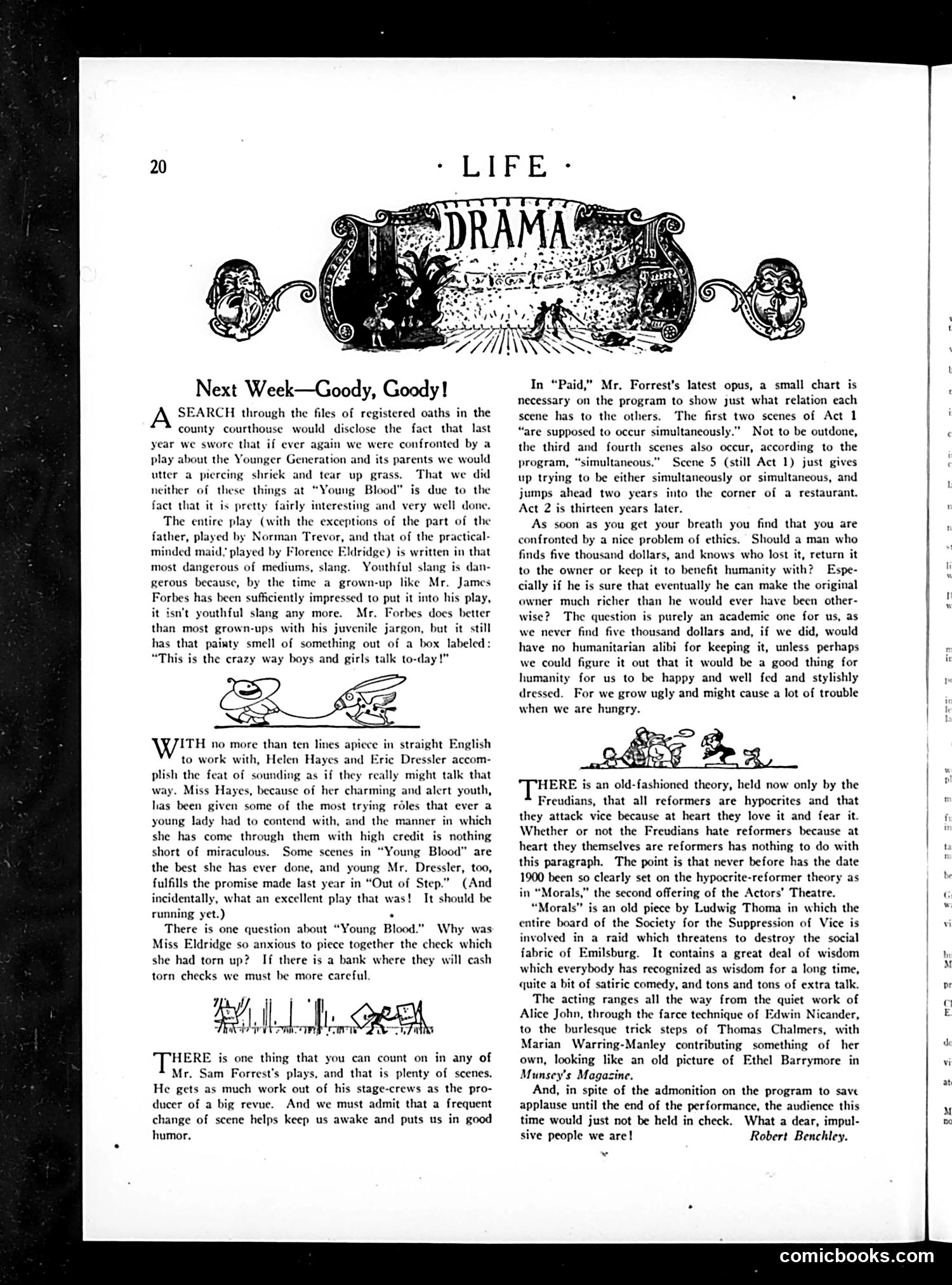
This is a theater review page from Life magazine's "Drama" section. The critic discusses three Broadway plays: **"Young Blood"**: Stars Helen Hayes and Eric Dressler. The reviewer praises Hayes's performance despite the play's heavy reliance on dated "youthful slang"—dialogue that sounds artificially stiff because the playwright waited too long to capture authentic youth speech. The critic humorously notes that by the time James Forbes wrote the slang down, it was already outdated. **"Paid"**: A Sam Forrest play criticized for its confusing timeline—scenes supposedly occur simultaneously, then jump forward years without clear structure. The reviewer jokes about needing a chart to follow the plot. **"Morals"**: Briefly mentioned as containing wisdom about reformers and hypocrisy. The small decorative illustrations throughout show theatrical masks and figures—typical period magazine decoration. The tone is witty and slightly sarcastic toward playwrights struggling to capture contemporary youth culture authentically.
📄 Transcribed text from this page (OCR, searchable)
Machine-transcribed from the original scan — historical spelling and the odd misread are preserved.
Next Week—Goody, Goody! SEARCH through the files of registered oaths in the county courthouse would disclose the fact that last year we swore that if ever again we were confronted by a play about the Younger Generation and its parents we would utter a piercing shriek and tear up grass. That we did neither of these things at “Young Blood” is due to the fact that it is pretty fairly interesting and very well done. The entire play (with the exceptions of the part of the father, played by Norman Trevor, and that of the practical- minded maid, played by Florence Eldridge) is written in that most dangerous of mediums, slang. Youthful slang is dan- gerous because, by the time a grown-up like Mr. James Forbes has been sufficiently impressed to put it into his play, it isn't youthful slang any more. Mr. Forbes does better than most grown-ups with his juvenile jargon, but it still has that painty smell of something out of a box labeled: “This is the crazy way boys and girls talk to-day ITH no more than ten lines apiece in straight E: to work with, Helen Hayes and Eric Dressler accom- plish the feat of sounding as if they really might talk that way. Miss Hayes, because of her charming and alert youth, lias been given some of the most trying rdles that ever a young lady had to contend with, and the manner in which she has come through them with high credit is nothing short of miraculous. Some scenes in “Young Blood” are the best she has ever done, and young Mr. Dressler, too, fulfills the promise made last year in “Out of Step.” (And incidentally, what an excellent play that was! It should be running yet.) . There is one question about “Young Blood.” Why was Miss Eldridge so anxious to piece together the check which she had torn up? If there is a bank where they will cash torn checks we must be more careful. HERE is one thing that you can count on in any of Mr. Sam Forrest's plays, and that is plenty of scenes. He gets as much work out of his stage-crews as the pro- ducer of a big revue. And we must admit that a frequent change of scene helps keep us awake and puts us in good humor. glish In “Paid,” Mr. Forrest’s latest opus, a small chart is necessary on the program to show just what relation each scene has to the others. The first two scenes of Act 1 “are supposed to occur simultaneously.” Not to be outdone, the third and fourth scenes also occur, according to the program, “simultaneous.” Scene 5 (still Act 1) just gives up trying to be either ultaneously or simultaneous, and jumps ahead two years into the corner of a restaurant. Act 2 is thirteen years later. As soon as you get your breath you find that you are confronted by a nice problem of ethics. Should a man who finds five thousand dollars, and knows who lost it, return it to the owner or keep it to benefit humanity with? Espe- cially if he is sure that eventually he can make the original owner much richer than he would ever have been other- wise? The question is purely an academic one for us, as we never find five thousand dollars and, if we did, would have no humanitarian alibi for keeping it, unless perhaps we could figure it out that it would be a good thing for humanity for us to be happy and well fed and stylishly dressed. For we grow ugly and might cause a lot of trouble when we are hungry. x) HERE is an old-fashioned theory, held now only by the Freudians, that all reformers are hypocrites and that they attack vice because at heart they love it and fear it. Whether or not the Freudians hate reformers because at heart they themselves are reformers has nothing to do with this paragraph. The point is that never before has the date 1900 been so clearly set on the hypocrite-reformer theory as in “Morals,” the second offering of the Actors’ Theatre. “Morals” is an old piece by Ludwig Thoma in which the entire board of the Society for the Suppression of Vice is involved in a raid which threatens to destroy the social fabric of Emilsburg. It contains a great deal of wisdom which everybody has recognized as wisdom for a long time, quite a bit of satiric comedy, and tons and tons of extra talk. The acting ranges all the way from the quiet work of Alice John, through the farce technique of Edwin Nicander, to the burlesque trick steps of Thomas Chalmers, with Marian Warring-Manley contributing something of her own, looking like an old picture of Ethel Barrymore in Munsey’s Magazine. And, in spite of the admonition on the program to save applause until the end of the performance, the audience this time would just not be held in check. What a dear, impul- sive people we are! Robert Benchley. comicbooks.com