
Life, 1925-12-17 · page 18 of 40
Life — December 17, 1925 — page 18: what you’re looking at
What you’re looking at
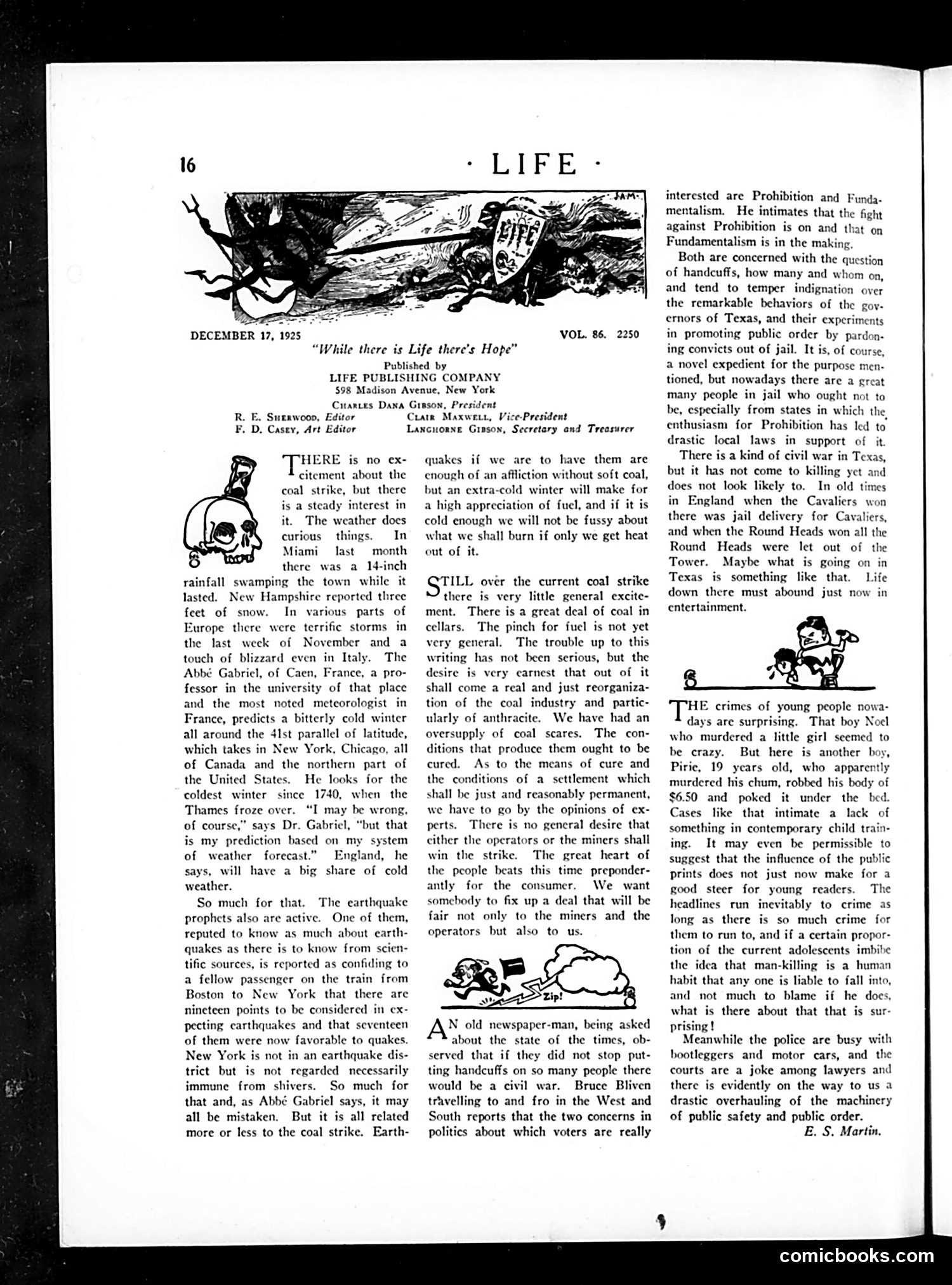
This page contains editorial commentary rather than satirical cartoons. The main illustration shows a skeletal figure labeled "LIFE" emerging from or trapped in what appears to be a coffin or box, symbolizing the magazine's concern with contemporary social issues. The text discusses the coal strike, winter weather hardships, and crime among young people. The skull imagery represents Death or decay—likely commenting on social problems threatening American stability. A secondary cartoon depicts a figure sleeping or dead, possibly relating to public indifference toward these crises. The editorial tone is reformist rather than humorous, using visual metaphors to emphasize serious concerns: fuel shortages, labor unrest, and juvenile delinquency. The "Death" motif suggests these issues pose existential threats to society if left unaddressed.
📄 Transcribed text from this page (OCR, searchable)
Machine-transcribed from the original scan — historical spelling and the odd misread are preserved.
iu DECEMBER 17, 1925 VOL. 86. 2250 “While there is Life there's Hope” Published by LIFE PUBLISHING COMPANY $98 Madison Avenue, New York Cuances Dana Ginson, President R. E, Surrwoon, Editor F. D. Casey, Art Editor HERE is no ex- citement about the coal strike, but there is a steady interest in it. The weather does curious things. In Miami last month there was a 14-inch rainfall swamping the town while it lasted. New Hampshire reported three feet of snow. In various parts of Europe there were terrific storms in the last week of November and a touch of blizzard even in Italy. The Abbé Gabriel, of Caen, France, a pro- fessor in the university of that place and the most noted meteorologist in France, predicts a bitterly cold winter all around the 41st parallel of latitude, which takes in New York, Chicago, all of Canada and the northern part of the United States. He looks for the coldest winter since 1740, when the Thames froze o y be wrong, of course,” says Dr. Gabr but that is my prediction based on my system of weather forecast.” England, he says, will have a big share of cold weather. So much for that. The earthquake prophets also are active. One of them, reputed to know as much about earth- quakes as there is to know from s tific sources, is reported as confiding to a fellow passenger on the train from Boston to New York that there are nineteen points to be considered in ex- pecting carthquakes and that seventeen of them were now favorable to quakes. New York is not in an earthquake dis- trict but is not regarded necessarily immune from shivers. So much for that and, as Abbé Gabriel says, it may all be mistaken. But it is all related more or less to the coal strike. Earth- Crate Maxwett, Vice-President Lancuorne Gisson, Secretary ond Treasurer quakes if we are to have them are enough of an affliction without soft coal, but an extra-cold winter will make for a high appreciation of fuel, and if it is cold enough we will not be fussy about what we shall burn if only we get heat out of it. ILL over the current coal strike there is very little general excite- ment. There is a great deal of coal in cellars. The pinch for fuel is not yet very general, The trouble up to this writing has not been serious, but the desire is very earnest that out of it shall come a real and just reorganiza- tion of the coal industry and_partic- ularly of anthracite. We have had an oversupply of coal scares. The con- ditions that produce them ought to be cured. As to the means of cure and the conditions of a settlement which shall be just and reasonably permanent, we have to go by the opinions of ex- perts. There is no general desire that cither the operators or the miners shall win the strike. The great heart of the people beats this time preponder- antly for the consumer. We want somebody to fix up a deal that will be fair not only to the miners and the operators but also to us. old newspaper-man, being asked bout the state of the times, ob- served that if they did not stop put- ting handcuffs on so many people there would be a civil war. Bruce Bliven travelling to and fro in the West and South reports that the two concerns in politics about which voters are really interested are Prohibition and Funda- mentalism. He intimates that the fight against Prohibition is on and that on Fundamentalism is in the making. Both are concerned with the question of handcuffs, how many and whom on, and tend to temper indignation over the remarkable behaviors of the gov- ernors of Texas, and their experiments in promoting public order by pardon- ing convicts out of jail. It is, of course, a novel expedient for the purpose men- tioned, but nowadays there are a great many people in jail who ought not to be, especially from states in which the enthusiasm for Prohibition has led to drastic local laws in support of it. There is a kind of civil war in Texas, but it has not come to killing yet and does not look likely to. In old ti: in England when the Cavaliers won there was jail delivery for Cavaliers, and when the Round Heads won all the Round Heads were let out of the Tower. Maybe what is going on in Texas is something like that. Life down there must abound just now in entertainment. 'HE crimes of young people nowa- days are surprising. That boy Noel who murdered a little girl seemed to be crazy. But here is another boy, Piric, 19 years old, who apparently murdered his chum, robbed his body of $6.50 and poked it under the bed. Cases like that intimate a lack of something in contemporary child train- ing. It may even be permissible to suggest that the influence of the public prints does not just now make for a good steer for young readers. The headlines run inevitably to crime as long as there is so much crime for them to run to, and if a certain propor- tion of the current adolescents imbibe the idea that man-killing is a human habit that any one is liable to fall into, and not much to blame if he does, what is there about that that is sur- prising! Meanwhile the police are busy with bootleggers and motor cars, and the courts are a joke among lawyers and there is evidently on the way to us a drastic overhauling of the machinery of public safety and public order. E. S. Martin, comicbooks.com