
Life, 1925-02-05 · page 26 of 36
Life — February 5, 1925 — page 26: what you’re looking at
What you’re looking at
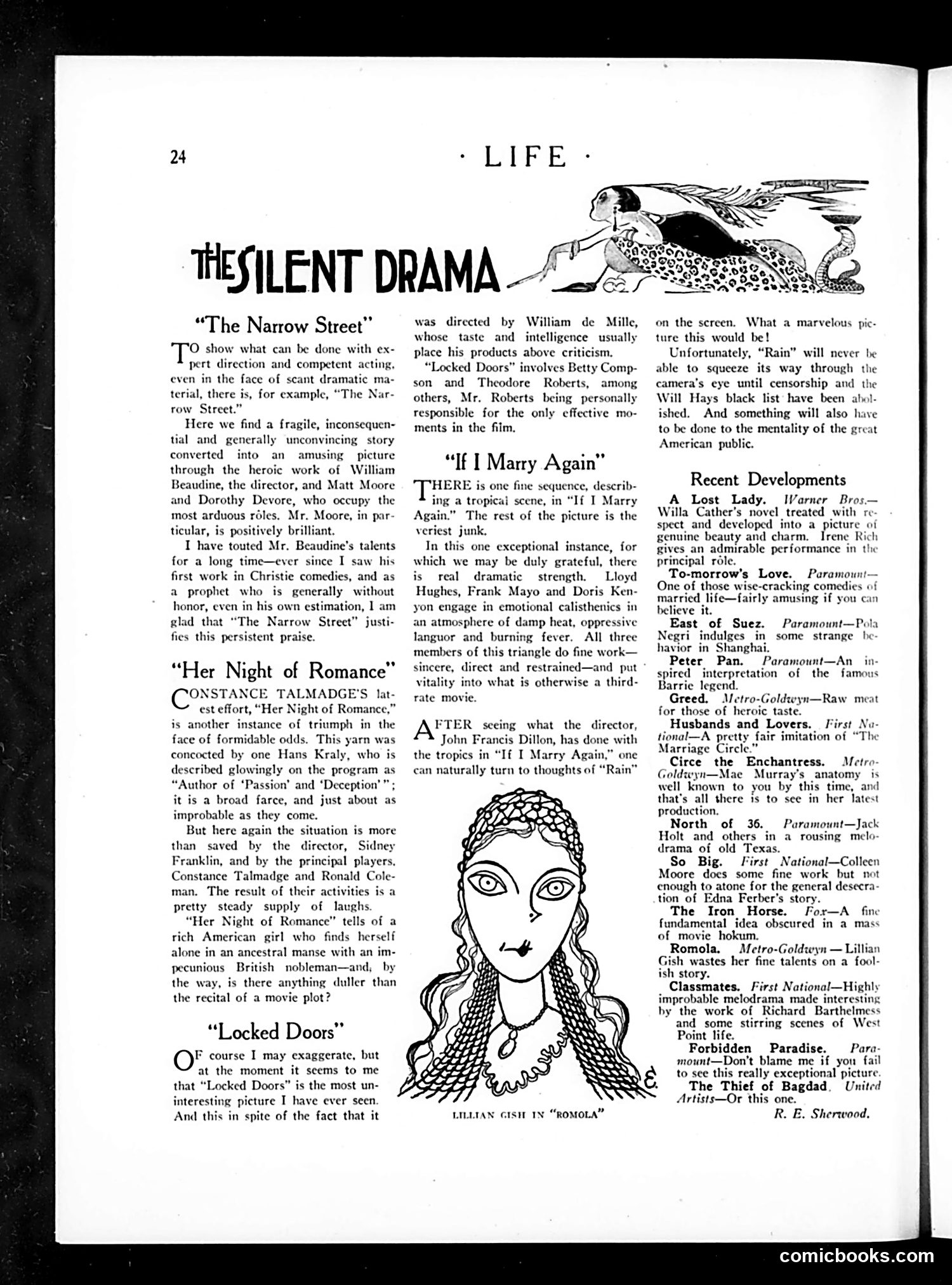
This page reviews several silent films, with a portrait illustration of actress Lillian Gish (captioned as appearing in "Romola"). The reviews are written by R.E. Sherwood, a prominent theater critic of the era. The critic praises directors William Beaudine and Sidney Franklin for elevating weak material through skilled direction and acting. He's particularly enthusiastic about Constance Talmadge's performance in "Her Night of Romance." Notably, Sherwood expresses frustration about censorship, lamenting that a film adaptation of "Rain" (likely Somerset Maugham's controversial play about a prostitute) cannot be made due to the "Will Hays black list"—referring to the newly-established Motion Picture Association's censorship code. This reflects 1920s cultural tensions between artistic freedom and moral gatekeeping. The reviews exemplify how silent-era critics evaluated films primarily through directorial skill and acting, given the medium's reliance on visual storytelling.
📄 Transcribed text from this page (OCR, searchable)
Machine-transcribed from the original scan — historical spelling and the odd misread are preserved.
= LE, = THES|LENT DRAMA “The Narrow Street” 'O show what can be done with ex- pert direction and competent acting, even in the face of scant dramatic ma- terial, there is, for example, “The N row Street.” Here we find a fragile, inconsequen- tial and generally unconvincing story converted into an amusing picture through the heroic work of William Beaudine, the director, and Matt Moore and Dorothy Devore, who occupy the most arduous rdles. Mr. Moore, in par- ticular, is positively brilliant. I have touted Mr. Beaudine’s talents for a long time—ever since I saw his first work in Christie comedies, and as a prophet who is generally without honor, even in his own estimation, 1 am glad that “The Narrow Street” justi- fies this persistent praise. : ” “Her Night of Romance ONSTANCE TALMADGE'S lat- est effort, “Her Night of Romance,” is another instance of triumph in the face of formidable odds. This yarn was concocted by one Hans Kraly, who is described glowingly on the program “Author of ‘Passion’ and ‘Deception’ it is a broad farce, and just about as improbable as they come. But here again the situation is more than saved by the director, Sidney Franklin, and by the principal players, Constance Talmadge and Ronald Cole- man. The result of their activities is a pretty steady supply of laughs. “Her Night of Romance” tells of a rich American girl who finds herself alone in an ancestral manse with an im- pecunious British nobleman—and, by the way, is there anything duller than the recital of a movie plot? “Locked Doors” O F course I may exaggerate, but at the moment it seems to me that “Locked Doors” is the most un- interesting picture I have ever seen. And this in spite of the fact that it was directed by William de Mille, whose taste and intelligence ust y place his products above criticism. “Locked Doors” involves Betty Comp- son and Theodore Roberts, among others, Mr. Roberts being personally responsible for the only effective mo- ments in the film, “If | Marry Again” “THERE is one fine sequence, describ- ing a tropical scene, in “If I Marry Again.” The rest of the picture is the veriest junk, In this one exceptional instance, for which we may be duly grateful, there is real dramatic strength. Lloyd Hughes, Frank Mayo and Doris Ken- yon engage in emotional calisthenics in an atmosphere of damp heat, oppressive languor and burning fever. All three members of this triangle do fine work— sincere, direct and restrained—and put vitality into what is otherwise a third- rate movie. FTER seeing what the director, John Francis Dillon, has done with the tropics in “If I Marry Again,” one can naturally turn to thoughts of “Rain” LILLIAN GISH IN “ROMOLA” on the sercen, What a marvelous pic- ture this would be! Unfortunately, “Rain” will never be able to squeeze its way through the camera’s eye until censorship and the Will Hays black list have been abol- ished. And something will also have to be done to the mentality of the great American public. Recent Developments A Lost Lady. [Varner Bros.— Willa Cather's novel treated with re- spect and developed into a picture of genuine beauty and charm. Irene Rich gives an admirable performance in the principal role. To-morrow’s Love. Paramoun!— One of those wise-cracking comedies of married life—fairly amusing if you can believe it. East of Suez. Negri indulges in havior in Shanghai, Peter Pan. Paramount—An_in- spired interpretation of the famous Barrie legend. Greed. Metro-Goldwyn—Raw meat for those of heroic tast Husbands and Lovers. tional—A pretty fair imitation of Marriage Circle. Circe the Enchantress. Metro- Goldwyn—Mae Murray's anatomy. is well known to you by this time, and that’s all there is to see in her latest production. North of 36. Paramount—Jack Holt and others in a rousing melo- drama of old Texas. So Big. First National—Colleen Moore docs some fine work but not enough to atone for the general desecra- tion of Edna Ferber’s story. The Iron Horse. Fox—A fine fundamental idea obscured in a mass of movie hokum. Romola. — Metro-Goldwyn — Lillian Gish wastes her fine talents on a fool- ish story. Classmates. First National—Highly improbable melodrama made interesting by the work of Richard Barthelmess and some stirring scenes of West Point life. Forbidden Paradise. — Para- mount—Don't blame me if you fail to see this really exceptional picture. The Thief of Bagdad. United Artists—Or this one. R. E. Sherwood. Paramount—Pola some strange he- First Na- “The comicbooks.com