
Life, 1925-02-05 · page 20 of 36
Life — February 5, 1925 — page 20: what you’re looking at
What you’re looking at
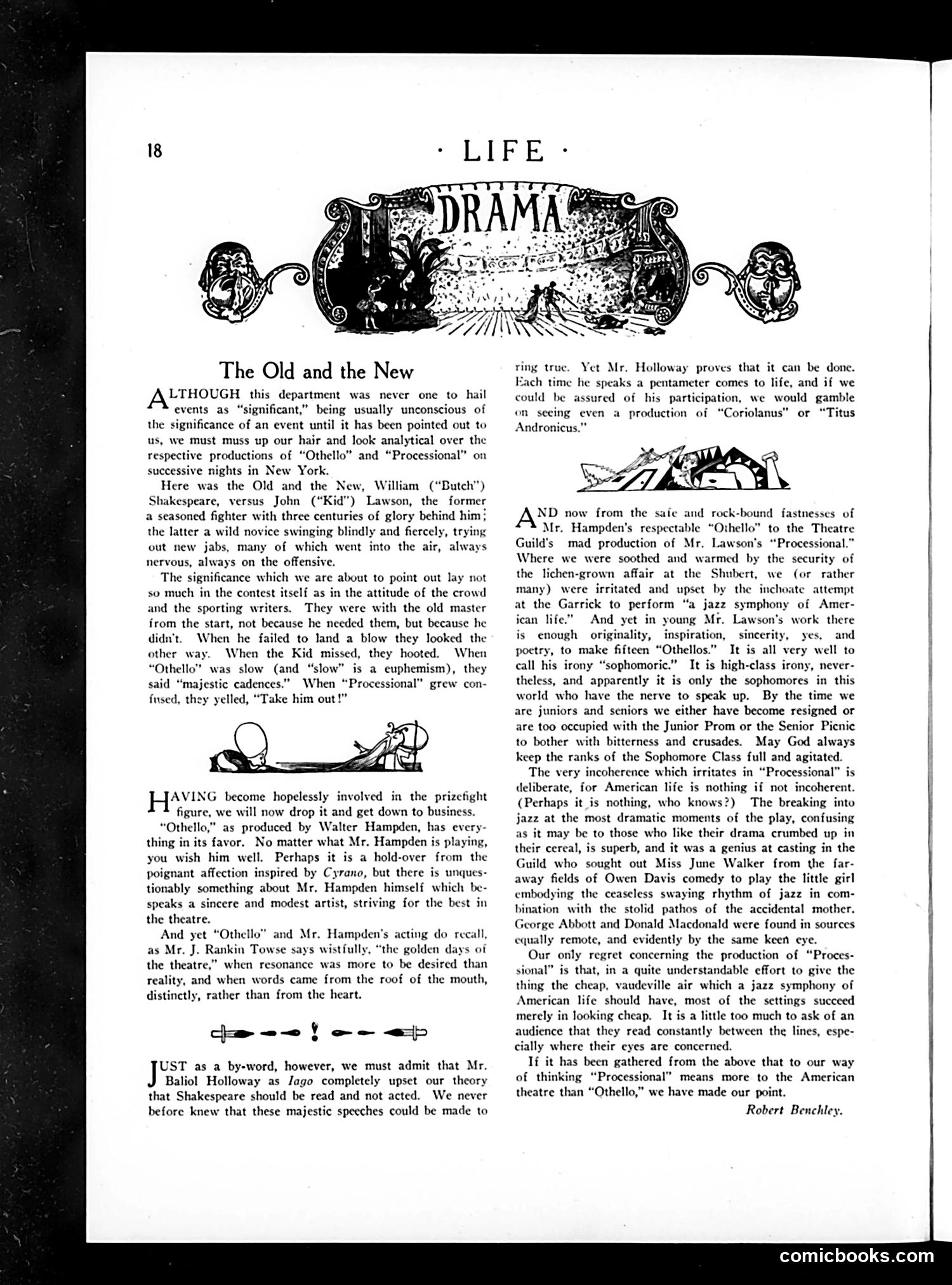
This *Life* magazine article compares two Broadway productions: Walter Hampden's classical *Othello* and John ("Kid") Lawson's avant-garde play *Processional*. The satire targets audience bias and critical double standards. The author uses a prizefight metaphor: the established Shakespearean production receives protective, forgiving treatment ("majestic cadences" excuses slowness), while the experimental new play faces harsh judgment ("Take him out!") for similar flaws. The piece praises Baliol Holloway's performance as Iago for proving Shakespeare's language can feel authentic rather than merely declamatory. However, it ultimately champions Lawson's chaotic, jazz-influenced work—despite (or because of) its "incoherence"—as capturing genuine American life and youthful artistic courage. The author suggests that by adulthood, people lose the nerve for such bold, bitter artistic experimentation.
📄 Transcribed text from this page (OCR, searchable)
Machine-transcribed from the original scan — historical spelling and the odd misread are preserved.
The Old and the New ALTHOUGH this department was never one to hail events as “significant,” being usually unconscious of the significance of an event until it has been pointed out to us, we must muss up our hair and look analytical over the respective productions of “Othello” and “Processional” on successive nights in New York. Here was the Old and the New, William (“Butch”) Shakespeare, versus John (“Kid”) Lawson, the former a seasoned fighter with three centuries of glory behind him; the latter a wild novice swinging blindly and fiercely, trying out new jabs, many of which went into the air, always nervous, always on the offensive. The significance which we are about to point out lay not so much in the contest itself as in the attitude of the crowd and the sporting writers. They were with the old master from the start, not because he needed them, but because he didn't. When he failed to land a blow they looked the other way. When the Kid missed, they hooted. When “Othello” was slow (and “slow” is a euphemism), they said “majestic cadences.” When “Processional” grew con- fused, they yelled, “Take him out!” AVING become hopelessly involved in the prizefight figure, we will now drop it and get down to business. “Othello,” as produced by Walter Hampden, has every- thing in its favor. No matter what Mr. Hampden is playing, you wish him well, Perhaps it is a hold-over from the poignant affection inspired by Cyrano, but there is unques- tionably something about Mr. Hampden himself which be- speaks a sincere and modest artist, striving for the best in the theatre. And yet “Othello” and Mr. Hampden’s acting do recall, as Mr. J. Rankin Towse says wistfully, “the golden days o the theatre,” when resonance was more to be desired than reality, and when words came from the roof of the mouth, distinctly, rather than from the heart. j= —-—- { oe =) UST as a by-word, however, we must admit that Mr. Baliol Holloway as Jago completely upset our theory that Shakespeare should be read and not acted. We never before knew that these majestic speeches could be made to ring true. Yet Mr, Holloway proves that it can be done. Each time he speaks a pentameter comes to life, and if we could be assured of his participation, we would gamble on seeing even a production of “Coriolanus” or “Titus Andronicus.” ND now from the saie and rock-bound fastnesses of Mr. Hampden's respectable “Othello” to the Theatre Guild's mad production of Mr. Lawson's “Processional.” Where we were soothed and warmed by the security of the lichen-grown affair at the Shubert, we (or rather many) were irritated and upset by the inchoate attempt at the Garrick to perform “a jazz symphony of Amer- And yet in young Mr. Lawson's work there is enough originality, inspiration, sincerity, yes, and poetry, to make fifteen “Othellos.” It is all very well to call his irony “sophomoric.” It is high-class irony, never- theless, and apparently it is only the sophomores in this world who have the nerve to speak up. By the time we are juniors and seniors we either have become resigned or are too occupied with the Junior Prom or the Senior Picnic to bother with bitterness and crusades. May God always keep the ranks of the Sophomore Class full and agitated. The very incoherence which irritates in “Processional” is deliberate, for American life is nothing if not incoherent. (Perhaps it is nothing, who knows?) The breaking into jazz at the most dramatic moments of the play, confusing as it may be to those who like their drama crumbed up in their cereal, is superb, and it was a genius at casting in the Guild who sought out Miss June Walker from the far- away fields of Owen Davis comedy to play the little girl embodying the ceaseless swaying rhythm of jazz in com- bination with the stolid pathos of the accidental mother. George Abbott and Donald Macdonald were found in sources equally remote, and evidently by the same keen eye. Our only regret concerning the production of “Proces- sional” is that, in a quite understandable effort to give the thing the cheap, vaudeville air which a jazz symphony of American life should have, most of the settings succeed merely in looking cheap. It is a little too much to ask of an audience that they read constantly between the lines, espe- cially where their eyes are concerned. If it has been gathered from the above that to our way of thinking “Processional” means more to the American theatre than “Othello,” we have made our point. Robert Benchley. comicbooks.com