
Life, 1925-02-05 · page 16 of 36
Life — February 5, 1925 — page 16: what you’re looking at
What you’re looking at
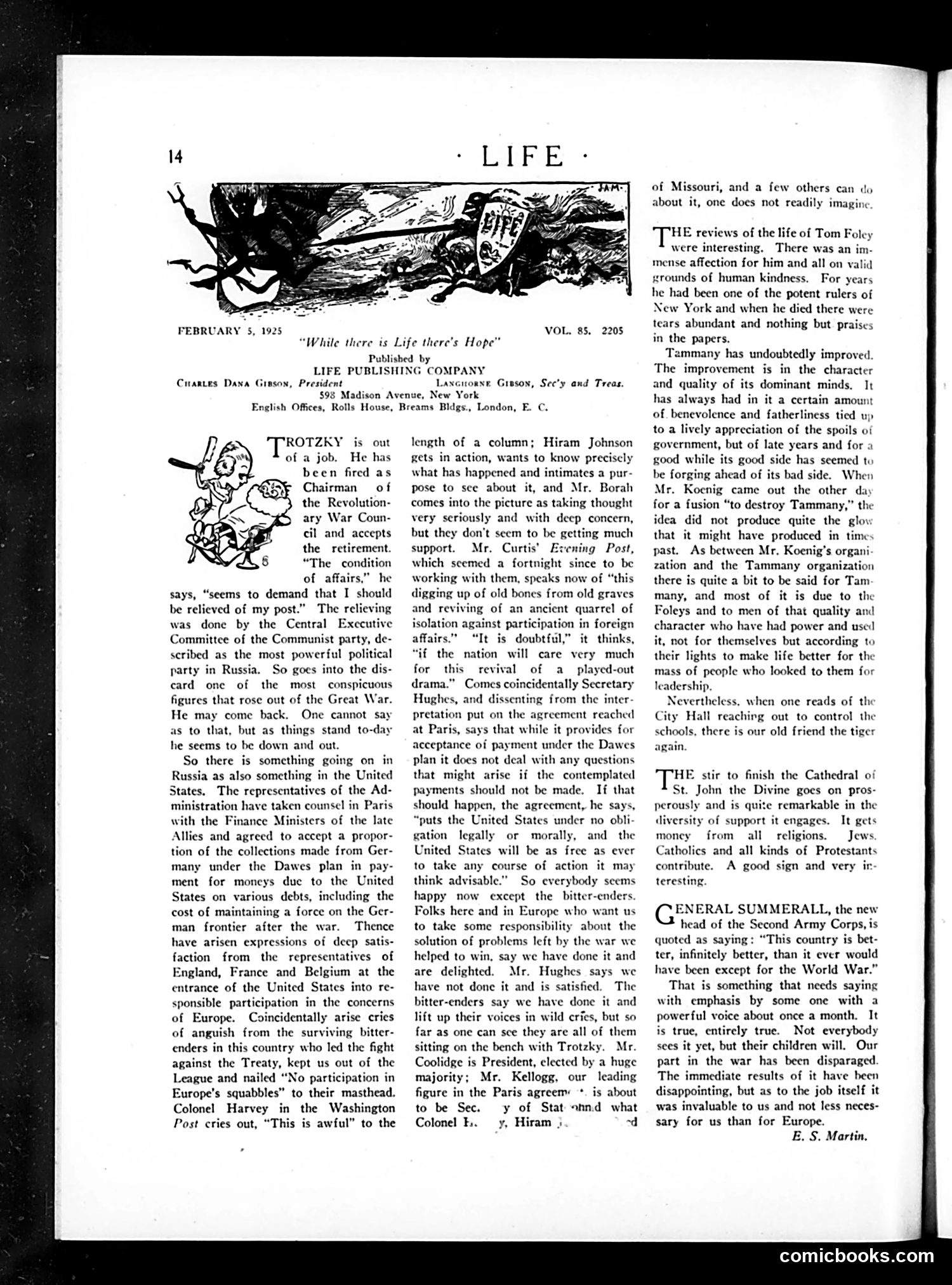
The cartoon depicts **Trotsky** as a small, disheveled figure sitting on a bench labeled "Chairman of the Revolutionary War Council." The satire comments on Trotsky's diminished political power within the Soviet Union—he's physically portrayed as insignificant despite his formerly prominent position. The text discusses how Trotsky "seems to demand that I believed in my post," referencing the Communist Party's internal power struggles. By 1925, **Stalin was consolidating control**, and Trotsky was being sidelined. The cartoon mocks Trotsky's apparent irrelevance while portraying him as clinging to his revolutionary credentials. The overall point: once-powerful revolutionary figures can become politically powerless when factional struggles shift within authoritarian regimes.
📄 Transcribed text from this page (OCR, searchable)
Machine-transcribed from the original scan — historical spelling and the odd misread are preserved.
EBRUARY 5, 1925 VOL, 83, 2205 “While there is Life there's Hope” Published by LIFE PUBLISHING COMPANY Cartes Dana Grrsox, President Laxcuoane Gipson, Sec’y and Treas. $98 Madison Avenue, New York English Offices, Rolls House, Breams Bldgs., London, E. C. ROTZKY is out of a job. He has been fired as Chairman of the Revolution- ary War Coun- cil and accepts the retirement. “The condition of affairs,” he says, “seems to demand that I should be relieved of my post.” The relieving was done by the Central Executive Committee of the Communist party, de- scribed as the most powerful political party in Russia. So goes into the dis- card one of the most conspicuous figures that rose out of the Great War. He may come back. One cannot say as to that, but as things stand to-day he seems to be down and out. So there is something going on in Russia as also something in the United States. The representatives of the Ad- ministration have taken counsel in Paris with the Finance Ministers of the late Allies and agreed to accept a propor- tion of the collections made from Ger- many under the Dawes plan in pay- ment for moneys duc to the United States on various debts, including the cost of maintaining a force on the Ger- man frontier after the war. Thence have arisen expressions of deep satis- faction from the representatives of England, France and Belgium at the entrance of the United States into re- sponsible participation in the concerns of Europe. Coincidentally arise cries of anguish from the surviving bitter- enders in this country who led the fight against the Treaty, kept us out of the League and nailed “No participation in Europe’s squabbles” to their masthead. Colonel Harvey in the Washington Post cries out, “This is awful” to the length of a column; Hiram Johnson gets in action, wants to know precisely what has happened and intimates a pur- Pose to sce about it, and Mr. Borah comes into the picture as taking thought very seriously and with deep concern, but they don’t seem to be getting much support. Mr. Curtis’ ing Post, which seemed a fortnight since to be working with them, speaks now of “this digging up of old bones from old graves and reviving of an ancient quarrel of isolation against participation in foreign affairs.” “It is doubtful,” it thinks, “if the nation will care very much for this revival of a played-out drama.” Comes coincidentally Secretary Hughes, and dissenting from the inter- pretation put on the agreement reached at Paris, says that while it provides for acceptance of payment under the Dawes plan it does not deal with any questions that might arise if the contemplated payments should not be made. If that should happen, the agreement, he says, “puts the United States under no obli gation legally or morally, and the United States will be as free as ever to take any course of action it may think advisable.” So everybody seems happy now except the bitter-enders. Folks here and in Europe who want us to take some responsibility about the solution of problems left by the war we helped to win, say we have done it and are delighted. Mr. Hughes says we have not done it and is satisfied. The bitter-enders say we have done it and lift up their voices in wild cries, but so far as one can sce they are all of them sitting on the bench with Trotzky. Mr. Coolidge is President, elected by a huge majority; Mr. Kellogg, our leading figure in the Paris agreemy *. is about to be Sec. y of Stat nnd what Colonel Is. y, Hiram 3 | of Missouri, and a few others can about it, one does not readily imagine HE reviews of the life of Tom Foley were interesting. There was an im- mense affection for him and all on valid grounds of human kindness. For years he had been one of the potent rulers of New York and when he died there were tears abundant and nothing but praises in the papers. Tammany has undoubtedly improved. The improvement is in the character and quality of its dominant minds, It has always had in it a certain amount of. benevolence and fatherliness tied up to a lively appreciation of the spoils of government, but of late years and for a good while its good side has seemed to be forging ahead of its bad side. When Mr. Koenig came out the other day for a fusion “to destroy Tammany,” the idea did not produce quite the glow that it might have produced in times past. As between Mr. Koenig’s organi zation and the Tammany organization there is quite a bit to be said for Tam many, and most of it is due to the Foleys and to men of that quality and character who have had power and used it, not for themselves but according to their lights to make life better for the s of people who looked to them for leadership. evertheless, when one reads of the City Hall reaching out to control the schools, there is our old friend the tiger again. 'HE stir to finish the Cathedral of St. John the Divine goes on pros- perously and is quite remarkable in the diversity of support it engages. It gets money from all religions. Jews Catholics and all kinds of Protestants contribute. A good sign and very ir teresting. G NERAL SUMMERALL, the new head of the Second Army Corps, is quoted as saying: “This country is bet- ter, infinitely better, than it ever would have been except for the World War.” That is something that needs saying with emphasis by some one with a powerful voice about once a month. It is true, entirely true. Not everybody sees it yet, but their children will. Our part in the war has been disparaged. The immediate results of it have been disappointing, but as to the job itself it was invaluable to us and not less neces- sary for us than for Europe. E. S. Martin, comicbooks.com