
Life, 1921-06-02 · page 28 of 44
Life — June 2, 1921 — page 28: what you’re looking at
What you’re looking at
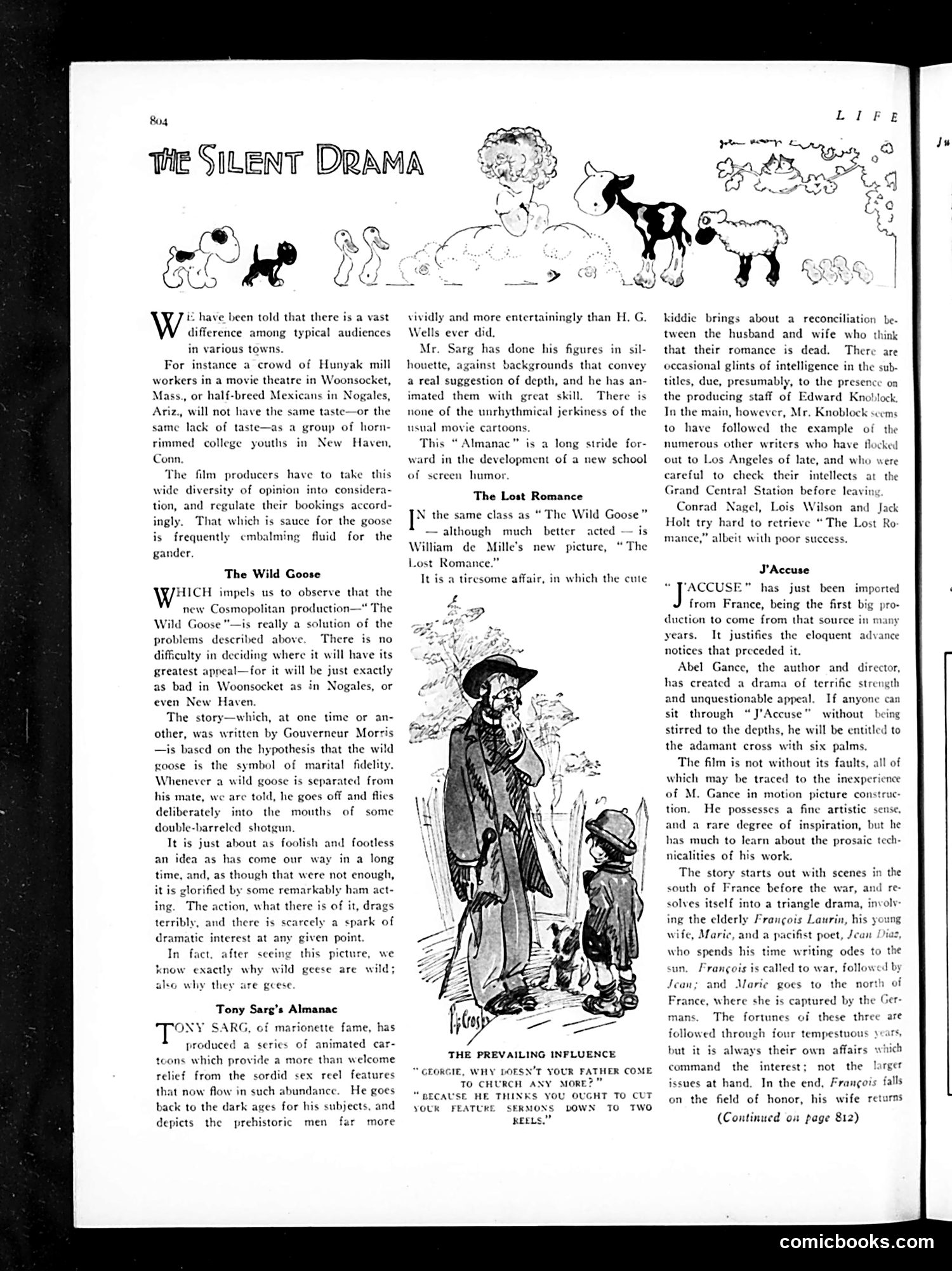
This page reviews several 1920s silent films. The main satirical point concerns audience taste: Life mocks film producers' assumption that different demographics (mill workers, Mexicans, college students) have vastly different preferences. The reviewer argues *The Wild Goose* is "just exactly as bad" everywhere—equally terrible regardless of audience. The film itself, a Cosmopolitan production, uses the absurd premise that wild geese symbolize marital fidelity. The review harshly criticizes its "foolish" plot, poor acting, and draggy pacing. A cartoon caption jokes that a father stopped attending church because sermons should be "cut down to two reels"—likening lengthy sermons to tedious silent films. Other reviews discuss *Tony Sarg's Almanac* (praised for animated cartoons improving beyond "sordid sex reel features"), *The Lost Romance*, and *J'Accuse*, a French import the critic praises as powerful drama. The overall tone: Life positions itself as sophisticated critic mocking Hollywood's mediocrity while defending artistic merit in film.
📄 Transcribed text from this page (OCR, searchable)
Machine-transcribed from the original scan — historical spelling and the odd misread are preserved.
Bog have been told that there is a vast Woe among typical audiences in various towns. For instance a crowd of Hunyak mill workers in a movie theatre in Woonsocket, Mass., or half-breed Mexicans in Nogales, Ariz., will not have the same taste—or the same lack of taste—as a group of horn- rimmed college youths in New Haven, Conn, The film producers have to take this wide diversity of opinion into conside tion, and regulate their bookings accord- ingly. is frequently That which is sauce for the goose embalmi: fluid for the gander. The Wild Goose Wwicy impels us to observe that the new Cosmopolitan production— he Wild Goose "—is really a solution of the problems described above, There is no difficulty in deciding where it will have its greatest appeal—for it will be just exactly as bad in Woonsocket a Nogales, or even New Haven. The story—which, at one time or an- other, was written by Gouverneur Morris —is based on the hypothesis that the wild goose is the symbol of marital fidelity. Whenever a wild goose is separated from his mate, we deliberately double-barreled shotgun. ¢ told, he goes off and flies into the mouths of some It is just about as foolish and footless an idea as has come our way in a long time, and, as though that were not enough, it is glorified by some remarkably ham ac ing. The action, what there is of it, drags terribly, and there is scarcely a spark of dramatic interest at any given point. In fact, after sceing this pict know exactly why wild geese are wild; ako why they are geese Tony Sarg’s Almanac ONY SARG, of marionette fame, has produced a series of animated car- toons which provide a more than welcome relief from the sordid sex reel features that now flow in such He goes back to the dark ages for his subjects, and depicts the bundance. prehistoric men far more vividly and more entertainingly than H. G. Wells ever did. Mr. S houette, against backgrounds that convey a real suggestion of depth, and he has an- imated them with great. skill. rg has done his figures in sil- ere is none of the unrhythmical jerkiness of the usual movie cartoons. This “ Almanac” is a long stride for- ward in the development of a new school of screen humor. The Lost Romance N the same class as “The Wild Goose” - although much better acted — is William de Mille’s new picture, “T Lost Romance.” It is a tiresome affair, in which the cute THE PREVAILING INFLUENCE “GEORGIE, WHY DOESN'T YOUR FATHER COME TO CHURCH ANY MORE?” CAUSE HE THINKS YOU OUGHT TO CUT YOUK FEATURE SERMONS DOWN TO TWO REELS.” kiddie brings about a reconciliation be- tween the husband and wife who think that their romance is dead. There are occasional glints of intelligence in the sub- titles, due, presumably, to the presence the producing staff of Edward Kr Tn the main, however, Mr. Knoblock seems to have followed the numerous other writers who have ] example of the ed out to Los Angeles of late, and wh careful to check their intellects at Grand Central Station before leaving Conrad Nagel, Lois Wilson and Jack Holt try hard to retrieve “ The mance,” albeit with poor success. Lost Ro: J’Accuse “ACCUSE” has just been imported from France, being the first big pro- duction to come from that source in many years. It justifies the eloquent advance notices that preceded it. Abel Gance, the author and director, has created a drama of terrific strength and unquestionable appeal. If anyone can sit through “J'’Accuse" without stirred to the depths, he will be entitled to the adamant cross with six palms. The film is not without its faults, all of which may be traced to the inexperience of M. Gance in motion picture con tion, He posse: being es a fine artistic sense, and a rare degree of inspiration, but he has much to learn about the prosaic tech- nicalities of his work. The story starts out with scenes in the south of France before the war, and re- solves itself into a triangle dram: ing the elderly Francois Laurin, his ic, Maric, and a pacifist poet, Je who spends his time writing odes to the sun, Francois is called to war, follow Jean; and Marie goes to the nort ce, Where she is captured by the Ger- The followed through four tempestuous 5 mans. fortunes of these three but it is always their own affairs the the issues at hand. In the end, Francois { on the field of honor, his wife returns (Continued on page 812) command interest; not 1 comicbooks.com