
Life, 1921-06-02 · page 24 of 44
Life — June 2, 1921 — page 24: what you’re looking at
What you’re looking at
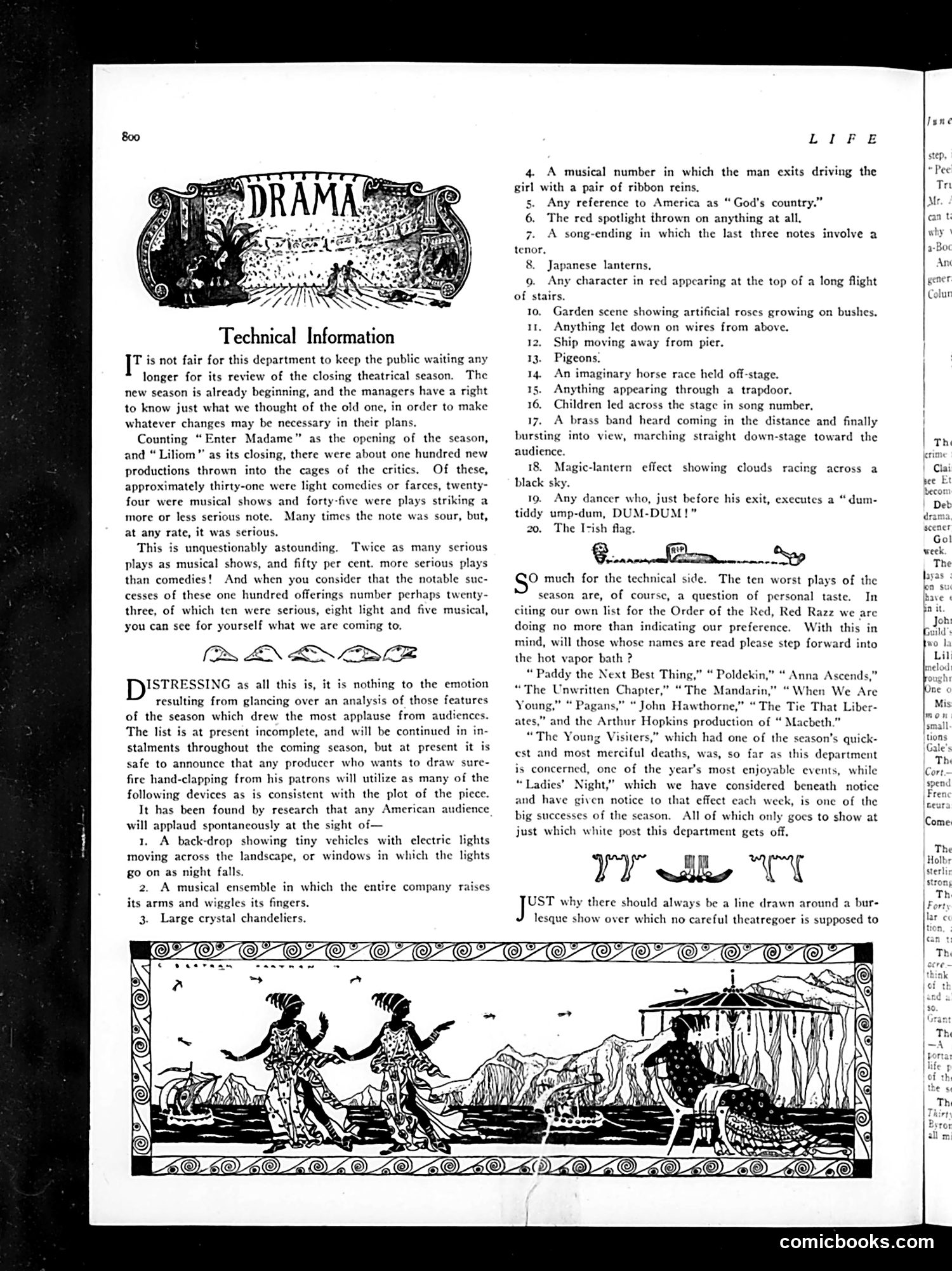
This page satirizes the theatrical season by mocking what audiences actually applaud for, rather than quality drama. The anonymous critic lists 20 "technical devices" guaranteed to produce applause—artificial spectacle rather than genuine artistry. Items include: tiny electric-lit vehicles on backdrops, actors wiggling fingers in unison, crystal chandeliers, "God's country" references, red spotlights, Japanese lanterns, characters descending staircases, artificial roses, things lowered on wires, ships moving away, pigeons, offstage horse races, trapdoors, children in songs, brass bands, and Irish flags. The point: Broadway audiences were predictably manipulated by cheap theatrical tricks and nationalist sentimentality rather than demanding substantive performances. The critic then lists the season's ten worst plays—including "Paddy the Next Best Thing" and others—implying these likely relied on such devices. The decorative illustration shows performers in an exoticized stage scene, reinforcing the artificiality critique.
📄 Transcribed text from this page (OCR, searchable)
Machine-transcribed from the original scan — historical spelling and the odd misread are preserved.
Technical Information I" is not fair for this department to keep the public waiting any longer for its review of the closing theatrical season. The new season is already beginning, and the managers have a right to know just what we thought of the old one, in order to make whatever changes may be necessary in their plans. Counting ter Madame" as the opening of the season, and “ Liliom” as its closing, there were about one hundred new productions thrown into the cages of the critics. Of these, approximately thirty-one were light comedies or farces, twenty- four were musical shows and forty-five were plays striking a more or less serious note. Many times the note was sour, but, at any rate, it was serious. This is unquestionably astounding. Twice as many serious plays as musical shows, and fifty per cent. more serious plays than comedies! And when you consider that the notable suc- cesses of these one hundred offerings number perhaps twenty- three, of which ten were serious, eight light and five musical, you can sce for yourself what we are coming to, ISTRESSING as all this is, it is nothing to the emotion resulting from glancing over an analysis of those features of the season which drew the most applause from audiences. The list is at present incomplete, and will be continued in in- stalments throughout the coming season, but at present it is safe to announce that any producer who wants to draw sure- fire hand-clapping from his patrons will utilize as many of the following devices as is consistent with the plot of the piece. It has been found by research that any American audience will applaud spontancously at the sight of— 1. A back-drop showing tiny vehicles with electric lights moving across the landscape, or windows in which the lights go on as night falls. 2. A musical ensemble in which the entire company raises its arms and wiggles its fingers. 3. Large crystal chandeliers. LIFE 4. A musical number in which the man exits driving the girl with a pair of ribbon reins, s. Any reference to America as “God's country.” 6. The red spotlight thrown on anything at all, 7. A song-ending in which the last three notes involve a tenor, 8. Japanese lanterns, 9. Any character in red appearing at the top of a long flight of stairs. to. Garden scene showing artificial roses growing on bushes. 11, Anything let down on wires from above. 12, Ship moving away from pier, 13. Pigeons. 14. An imaginary horse race held off-stage. 15. Anything appearing through a trapdoor. 16. Children led across the stage in song number, 17, A br, band heard coming in the distance and finally bursting into view, marching straight down-stage toward the audience. 18. Magic-lantern effect showing clouds racin Dlack sky. 19. Any dancer who, just before his exit, executes a “dum- tiddy ump-dum, DUM-DUM!” 20. The Irish flag. ea Sy O much for the technical side. The ten worst plays of the season are, of course, a question of personal taste. In citing our own list for the Order of the Ked, Red z we are doing no more than indicating our preference. With this in mind, will those whose names are read please step forward into the hot vapor bath ? “Paddy the Next Best Thing,” “ Poldeki Anna Ascend “The Unwritten Chapter,” “The Mandarin,” “When We Are Young,” “ Pagans,” “ John Hawthorne,” “The Tie T! ates,” and the Arthur Hopkins production of “ Macbeth.” “The Young Visiters,” which had one of the season's quick- est and most merciful dea across a » So far as this department is concerned, one of the year’s most enjoyable events, while “ Ladies’ Night,” which we have considered beneath notice and have given notice to that effect cach week, is one of the big successes of the season. All of which only goes to show at just which white post this department gets off. 0 a UST why there should always be a line drawn around a bur- lesque show over which no careful theatregoer is supposed to © AOA CkACKA CACY CKA OA OSAOXA comicbooks.com