
Life, 1921-03-17 · page 30 of 40
Life — March 17, 1921 — page 30: what you’re looking at
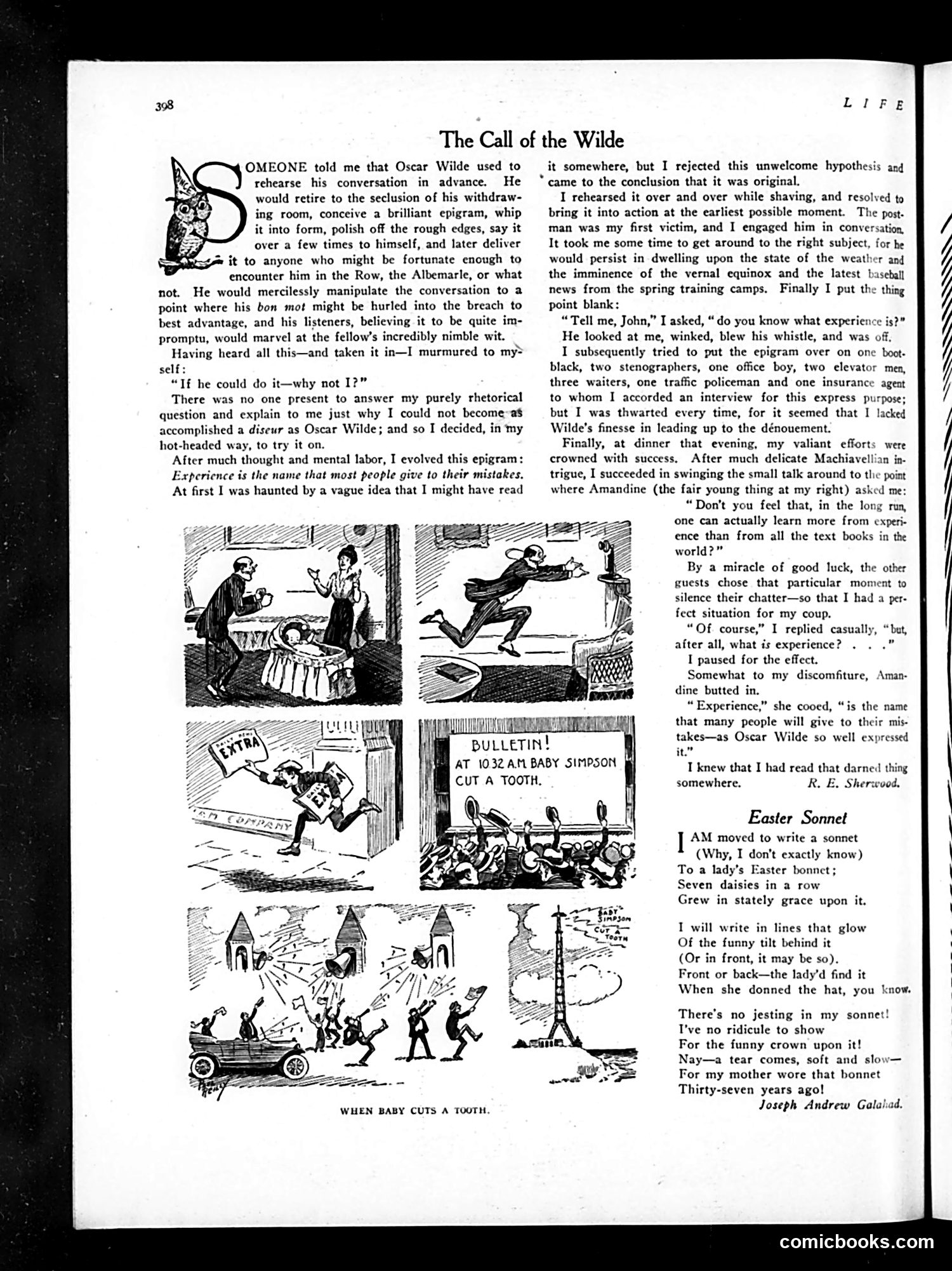
What you’re looking at
This article mocks Oscar Wilde's famous reputation for witty conversation by describing how the author attempted to imitate Wilde's method: carefully rehearsing clever epigrams before deploying them in social situations. The author crafts what he believes is an original observation—"Experience is the name that most people give to their mistakes"—and repeatedly tries it out on various people (a postman, doorman, stenographers, waiters, a traffic policeman). Each attempt fails due to his clumsy social manipulation. Finally, at a dinner party, a woman named Amandine delivers *his own* epigram back to him—attributing it directly to Oscar Wilde. The satire's point: the author's "original" wit wasn't original at all; he'd unconsciously plagiarized Wilde without realizing it. The cartoon illustrations show comical failures as he pursues various victims with his prepared line.
📄 Transcribed text from this page (OCR, searchable)
Machine-transcribed from the original scan — historical spelling and the odd misread are preserved.
LIFE The Call of the Wilde OMEONE told me that Oscar Wilde used to rehearse his conversation in advance. He would retire to the seclusion of his withdraw- ing room, conceive a brilliant epigram, whip it into form, polish off the rough edges, say it over a few times to himself, and later deliver a it to anyone who might be fortunate enough to encounter him in the Row, the Albemarle, or what not. He would mercilessly manipulate the conversation to a point where his bon mot might be hurled into the breach to best advantage, and his listeners, believing it to be quite im- promptu, would marvel at the fellow’s incredibly nimble wit. Having heard all this—and taken it in—I murmured to my self: “Tf he could do it—why not 1?” There was no one present to answer my purely rhetorical question and explain to me just why I could not become-as accomplished a diseur as Oscar Wilde; and so I decided, in my hot-headed way, to try it on. After much thought and mental labor, I evolved this epigram: Experience is the name that most people give to their mistakes. At first I was haunted by a vague idea that I might have read \\\ \ h, \ AT 1032 AM BABY SIMPSON CUT A TOOTH. WHEN BABY CUTS A TOOTH, it somewhere, but I rejected this unwelcome hypothesis and * came to the conclusion that it was original. I rehearsed it over and over while shaving, and resolved to bring it into action at the earliest possible moment. The post. man was my first victim, and I engaged him in conversation, It took me some time to get around to the right subject, for he would persist in dwelling upon the state of the weather and the imminence of the vernal equinox and the latest baseball news from the spring training camps. Finally I put the thing point blank: “Tell me, John,” I asked, “do you know what experience is?” He looked at me, winked, blew his whistle, and was off, I subsequently tried to put the epigram over on one boot. black, two stenographers, one office boy, two elevator men, three waiters, one traffic policeman and one insurance agent to whom I accorded an interview for this express purpose; but I was thwarted every time, for it seemed that I lacked Wilde's finesse in leading up to the dénouement. Finally, at dinner that evening, my valiant efforts were crowned with success. After much delicate Machiavellian in- trigue, I succeeded in swinging the small talk around to the point where Amandine (the fair young thing at my right) asked me: “Don’t you feel that, in the long run, one can actually learn more from experi- ence than from all the text books in the world?” By a miracle of good luck, the other guests chose that particular moment to silence their chatter—so that I had a per- fect situation for my coup. “Of course,” I replied casually, “but, after all, what is experience? . . .” I paused for the effect. Somewhat to my discomfiture, Aman- dine butted in. “Experience,” she cooed, “is the name that many people will give to their mis- takes—as Oscar Wilde so well expressed it.” I knew that I had read that darned thing somewhere, R, E. Sherwood, Easter Sonnet AM moved to write a sonnet (Why, I don't exactly know) To a lady’s Easter bonnet; Seven daisies in a row Grew in stately grace upon it. I will write in lines that glow Of the funny tilt behind it (Or in front, it may be so). Front or back—the lady’d find it When she donned the hat, you know. There’s no jesting in my sonnet! I've no ridicule to show For the funny crown upon it! Nay—a tear comes, soft and slow— For my mother wore that bonnet Thirty-seven years ago! Joseph Andrew Galaliad. comicbooks.com ig i er ag a aR Ng